


“94 percent the world production of saffron in Iran” is the headline of a 2015 report, not a live 2026 statistic. The report described Iran’s dominant position in saffron, the concentration of production in Khorasan, and the pressures facing growers at that time. Its exact percentages and tonnages belong to the agricultural years discussed below and should not be repeated as current figures without a newer, comparable source.
What the 94 percent claim meant
Mehr News Agency attributed the figure to an official in Iran’s Ministry of Agriculture, identified in the original report as Majdzadeh. He said Iran produced 94 percent of the world’s saffron and that more than 90 percent of global output belonged to the country. The same report estimated that about 80 percent of Iranian production was exported, explaining why saffron was treated as both a strategic crop and a source of foreign-currency earnings.
The broad conclusion—that Iran was by far the largest producer—is consistent with later research. A study covering 2008–2014 described Iran as accounting for about 90 percent of global saffron cultivation area and production. The FAO’s account of Iran’s qanat-based saffron system also says the country produces more than 90 percent of the world’s saffron. Neither source makes the article’s exact 94 percent a permanent figure. Production shares change with the year, crop losses, data definitions and output in other countries.
Iranian saffron area and production in the report
The ministry’s figures used Iranian agricultural years. For year 1392, approximately 2013–14, the report gave about 84,000 hectares under saffron and production of 311 tonnes. For year 1393, approximately 2014–15, cultivated area was forecast at about 88,000 hectares, while production was estimated at roughly 280 tonnes. The 1393 totals had not yet been finalized when the interview took place.
That contrast is important: more planted land did not automatically produce a larger harvest. Frost in the two main producing provinces, followed by severe summer heat and drought, was said to have weakened saffron corms and reduced flowering. Majdzadeh reported an output decline of about 20 percent in South Khorasan and about 30 percent in Razavi Khorasan. The ministry nevertheless expected cultivated area to rise by another 10 percent in 1394.
Modern agronomic research supports the underlying caution. Saffron yield and quality respond to temperature, rainfall, soil, plant health and cultivation practice. Area alone cannot tell a buyer or grower how much marketable dried stigma a season produced.
Why Khorasan dominated production
The 2015 report said 21 Iranian provinces cultivated saffron, but approximately 95 percent of production came from Razavi Khorasan and South Khorasan. Razavi Khorasan was assigned about 78 percent and South Khorasan 17–18 percent. The remaining roughly 5 percent was spread across 19 provinces.
Fars, Kerman, Yazd, North Khorasan and Isfahan were among the other provinces named. Cultivation in Qazvin and Hamedan was described as very limited, although several provinces had plans to expand. These were snapshots of a particular period, not fixed rankings for every later harvest.
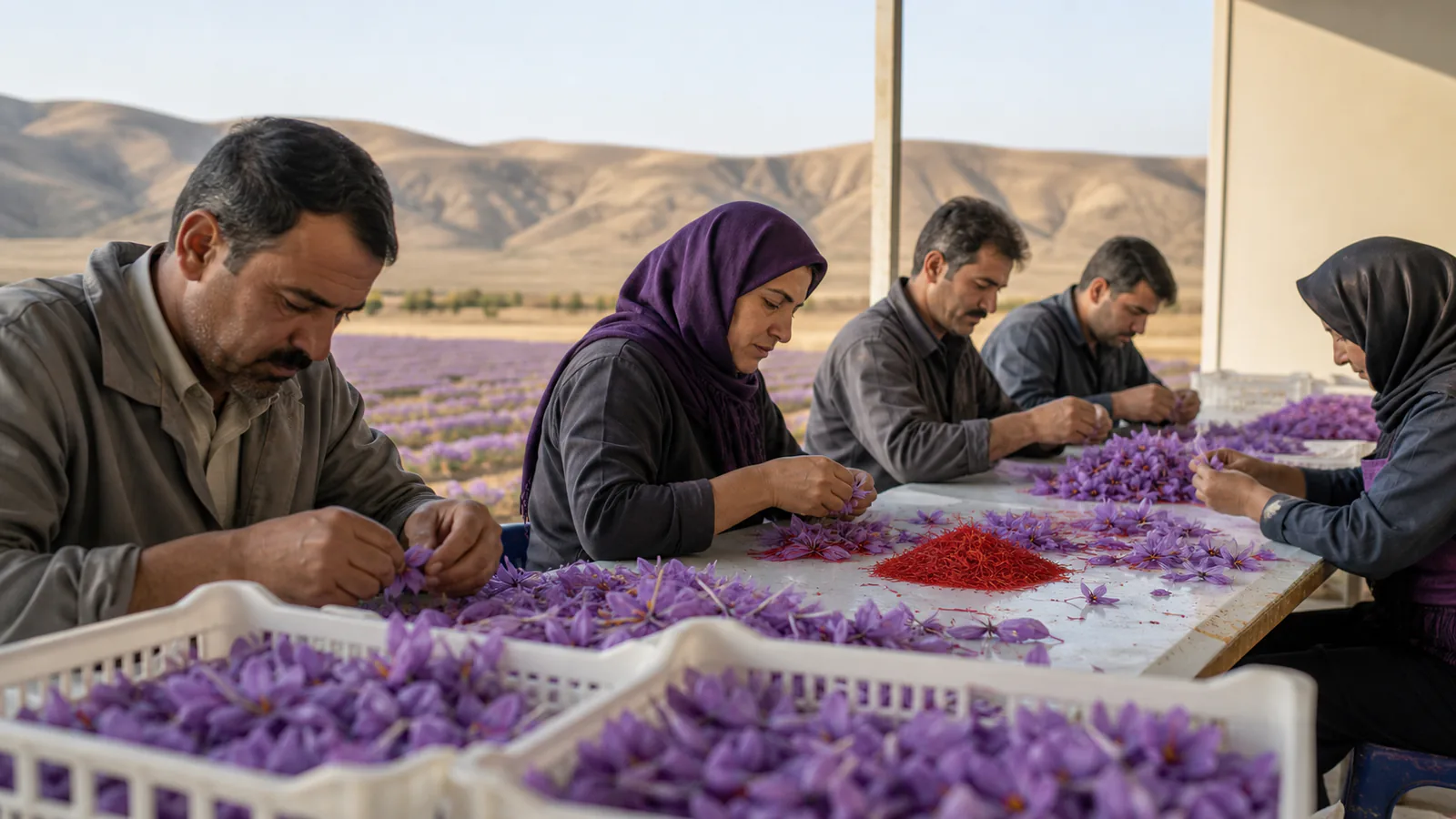
Khorasan’s role reflects more than acreage. The crop is connected to generations of knowledge about corm selection, irrigation, flower picking, stigma separation and drying. The FAO-recognized system in Gonabad shows how saffron farming developed alongside qanat water management in an arid environment.
Exports, destinations and the intermediary problem
For year 1392, the report listed exports of 137 tonnes worth about US$200 million. For 1393, it estimated around 150 tonnes worth approximately US$220–230 million. The United Arab Emirates, Saudi Arabia, Spain and other European countries were named as destinations, with Spain and the UAE receiving much of the product.
Officials were concerned that Iranian saffron was leaving in bulk, passing through intermediaries and reaching other markets under another brand. They expected that easier direct trade after a possible relaxation of sanctions could reduce the role of intermediaries and influence prices. That was a forward-looking view expressed in 2015, not a guarantee of what later happened.
The ministry also described work on a national saffron brand, standardization, genetic research and cooperation with research bodies, the private sector, trade organizations and the Ministry of Health. The report referred to bringing saffron into the commodity exchange as another attempt to improve market structure.
The saffron corm-smuggling dispute
Ali Hosseini, a member of the National Saffron Council, told Mehr that Iranian saffron corms had been smuggled to Afghanistan for seven or eight years. He linked the movement of planting material to the expansion of Afghan cultivation and warned that Afghanistan could become a major regional competitor.
The ministry official was more guarded. He said the ministry could confirm smuggling only through written reports from the police and other responsible agencies. He described meetings with provincial authorities and farmer-awareness efforts intended to prevent unlawful corm movement. Keeping both positions matters: Hosseini made an allegation and warning, while the ministry said formal evidence was required.
The story also raised a wider issue. Saffron cannot be protected simply by trying to keep planting material within one country. Other producers can develop improved stock and cultivation methods. Long-term competitiveness depends on quality, traceability, research, efficient production and a recognizable origin—not on the assumption that rivals will remain small.
How to read a saffron production statistic today
Before using a number such as 94 percent, check four things:
- The year: a harvest estimate from 2014–15 does not describe the current crop.
- The measure: hectares planted, flowers harvested, dried saffron produced and saffron exported are different quantities.
- The status: a forecast, preliminary estimate and finalized agricultural statistic should not be treated as interchangeable.
- The source and method: production may be reported by a ministry, trade database, research study or industry body using different coverage and definitions.
Export volume also cannot be substituted for production. Some saffron is consumed domestically, stocks can move between years, and material may be re-exported through another country.
The useful conclusion
Iran’s leadership in saffron production was real and substantial, and Khorasan was the center of that production. The original article also recorded something more useful than a headline percentage: the crop was vulnerable to frost, heat, drought, fragmented branding and indirect export routes even while cultivated area expanded.
The figure of 94 percent should therefore stay attached to the 2015 report that produced it. For a current comparison, use a recent source that states the harvest year, geographic coverage and definition of production.

![Exporting Saffron to Turkey + Price Guide [Complete 0 to 100]](https://img.rowhanisaffron.com/20260827003933/saffron-export-turkey-quality-inspection.webp)



