


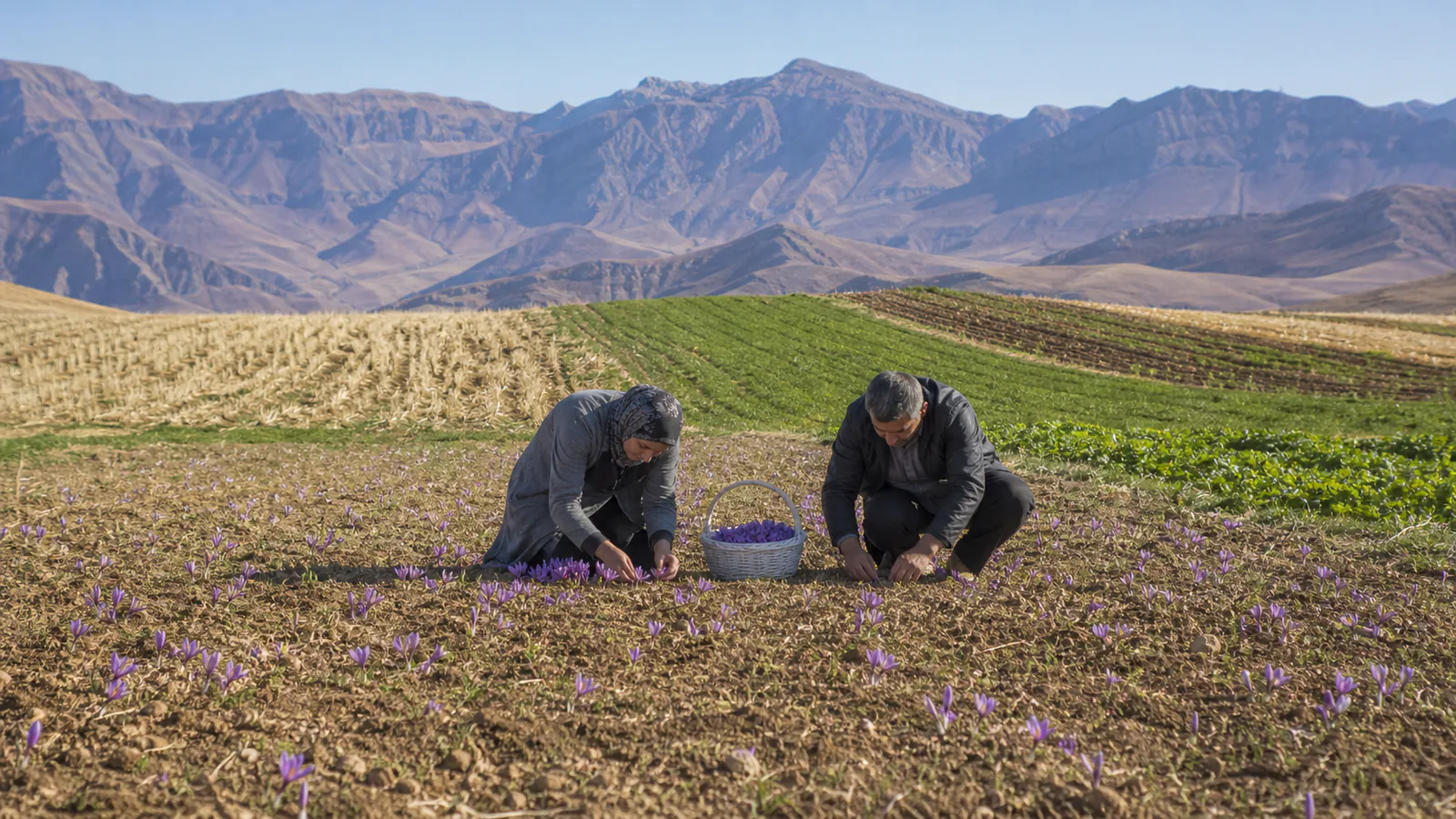
Chaharmahal and Bakhtiari grows field crops such as wheat, alfalfa, potatoes and maize, along with orchard and medicinal crops; saffron became a small but expanding part of that mix. A 2015 report said provincial saffron area had doubled to about 100 hectares and described an average dried-saffron yield of roughly 4–4.5 kilograms per hectare.
The original headline called that development a turn toward “red gold.” The phrase captured growers’ interest, but it should not be read as a promise that saffron will make every mountain field profitable. The province’s elevation, cold conditions and varied terrain create opportunities and constraints that must be assessed at field level.
What crops are grown in Chaharmahal and Bakhtiari?
Chaharmahal and Bakhtiari lies in the Zagros region of southwestern Iran. FAO places it in Iran’s Southern Zagros agro-ecological zone. Within the province, elevation, slope, rainfall, temperature, soil and access to irrigation vary substantially, so there is no single crop list that fits every county.
A land-allocation study in the Shahrekord region identifies wheat, alfalfa, potato and maize as important irrigated land uses. Research conducted elsewhere in the province documents peach and almond orchards as well as medicinal and aromatic plants such as hyssop. Those examples explain the “crops grown in Chaharmahal and Bakhtiari Province” context more accurately than describing the area only as a new saffron centre.
Saffron fits the medicinal-and-aromatic segment of this wider farm economy. Its autumn flowering and summer dormancy can complement some local rotations, but the decision must account for the field’s winter cold, drainage, water quality, labour and alternative crops.
Why farmers began testing saffron
The 2015 report described farmers allocating more land to saffron after early trials produced encouraging results. A local grower interviewed by Mehr News Agency cited the crop’s market value and water-use pattern. Cultivation was reported around Ben, Farrokh Shahr and Babaheydar.
The translation claimed saffron could grow in any climate. That is too broad. Crocus sativus is grown across different regions, but commercial performance depends on compatible seasonal temperatures, well-drained soil, healthy corms and timely irrigation. A published location-suitability study uses multiple environmental variables for precisely that reason.
The province’s high elevations can support the cold period associated with saffron development, yet frost timing and severity can also damage flowers or reduce yield. “Cold region” is therefore context, not a quality certificate.
The historical 100-hectare expansion
Zabihollah Gharib, identified in the archived report as the provincial agriculture director-general, said 100 hectares were dedicated to saffron that year—about twice the previous area. He reported yields of approximately 4–4.5 kilograms of dried saffron per hectare and said harvest had started in October.
The article also described the main harvest as a short period around late October and early November. Exact timing changes with altitude, field age and weather. Growers need labour ready when flowers open; delays in picking and stigma separation can affect both recovery and quality.
A later 2019 report from the provincial horticulture manager recorded 200 hectares and forecast 800 kilograms, equivalent to an average of four kilograms per hectare. It named Kiar as the county with the largest planted area. These figures show reported growth after 2015, but they remain dated snapshots rather than current acreage.
What is a typical saffron yield per hectare?
There is no single typical yield that safely predicts a new farm. The 2015 Chaharmahal and Bakhtiari report’s 4–4.5 kilograms per hectare and the 2019 report’s four-kilogram average are useful local historical references. They do not guarantee that a first-year field will reach the same level.
Saffron is perennial. Production commonly changes as daughter corms develop, planting density changes and the field ages. Corm size and health, soil condition, irrigation timing, weed pressure, nutrition, frost and post-harvest losses all affect the measured dried yield.
Research also shows that provincial averages can hide large differences. A national water-footprint study of Iranian saffron found meaningful variation among provinces and reported a relatively high economic water footprint for Chaharmahal and Bakhtiari in its 2008–2014 dataset. That does not rule out local cultivation; it argues against assuming that a low-water reputation automatically means the best return per unit of water.
Income depends on more than the retail price
The 2015 article quoted a saffron price of roughly six to seven million toman per kilogram. The machine translation rendered the currency incorrectly, and the figure is now obsolete. It should not be used to value a crop today.
A farmer’s return depends on dried yield, grade, labour, corm establishment, land, water, losses, testing, packaging and the price actually paid at the farm or processor—not the price of a tiny retail pack. The first planting year also differs from a mature field, so a one-season calculation can mislead.
The local farmer in the original report said a planting could remain productive for about seven years. Productive life varies with management and field conditions. A sound budget models more than one yield path and includes the cost of eventually lifting or renewing the field.
Quality is created in the field and after harvest
A food-industry graduate quoted in the report praised the aroma and colour of provincial saffron and argued for better packaging and distribution. Climate may influence the crop, but origin alone does not prove a lot’s grade.
A study of Iranian saffron from different locations found that local environment, cultivation practice and viral infection can affect quality. After flowering, prompt picking, hygienic stigma separation, controlled drying, moisture protection and traceability become equally important.
Packaging can preserve a well-produced lot and communicate its identity. It cannot repair weak drying, contamination or mixed origin. Investment should therefore begin with field and post-harvest control, followed by packaging designed for a real buyer.
How saffron fits the province’s crop choices
The search interest around this page is broader than saffron. Readers want to know the main crops of Chaharmahal and Bakhtiari and where saffron fits among them. Research in the Shahrekord area identifies wheat, alfalfa, potato and maize; other studies document peaches, almonds and medicinal plants. Saffron is one option within that diverse system.
Land-allocation research is valuable because it compares crops rather than judging each in isolation. Soil suitability, water availability, labour, market access and environmental limits can make one crop a better use of a specific parcel than another. The best saffron field is not merely land where corms survive; it is land where the crop performs better than realistic alternatives without creating an unsustainable water or labour burden.
A measured route to a stronger local saffron sector
The historical expansion showed that Chaharmahal and Bakhtiari could produce commercial saffron. It did not establish the province as Iran’s new production “pole,” and higher hectares alone would not prove that outcome.
A stronger route is to trial suitable sites, record yield by field age, test water and soil, use healthy corms and prepare labour and drying capacity before harvest. Producers can then build honest origin records and packaging around measured quality. That approach respects the promise of red gold while keeping the province’s broader crop economy—and the farmer’s real costs—in view.

![Exporting Saffron to Turkey + Price Guide [Complete 0 to 100]](https://img.rowhanisaffron.com/20260827003933/saffron-export-turkey-quality-inspection.webp)



