


Iran’s best-known saffron cities are in the three Khorasan provinces. Torbat-e Heydariyeh is central to the huge production base of Razavi Khorasan, while Ghaen (Qaen) and the wider Ghaenat area in South Khorasan have an exceptional reputation for saffron heritage and quality. Faruj leads production in North Khorasan. Yet no city name, by itself, proves that one packet is “the best saffron in the world.” Quality belongs to the individual lot and depends on the harvest, separation, drying, storage, authenticity and laboratory results.
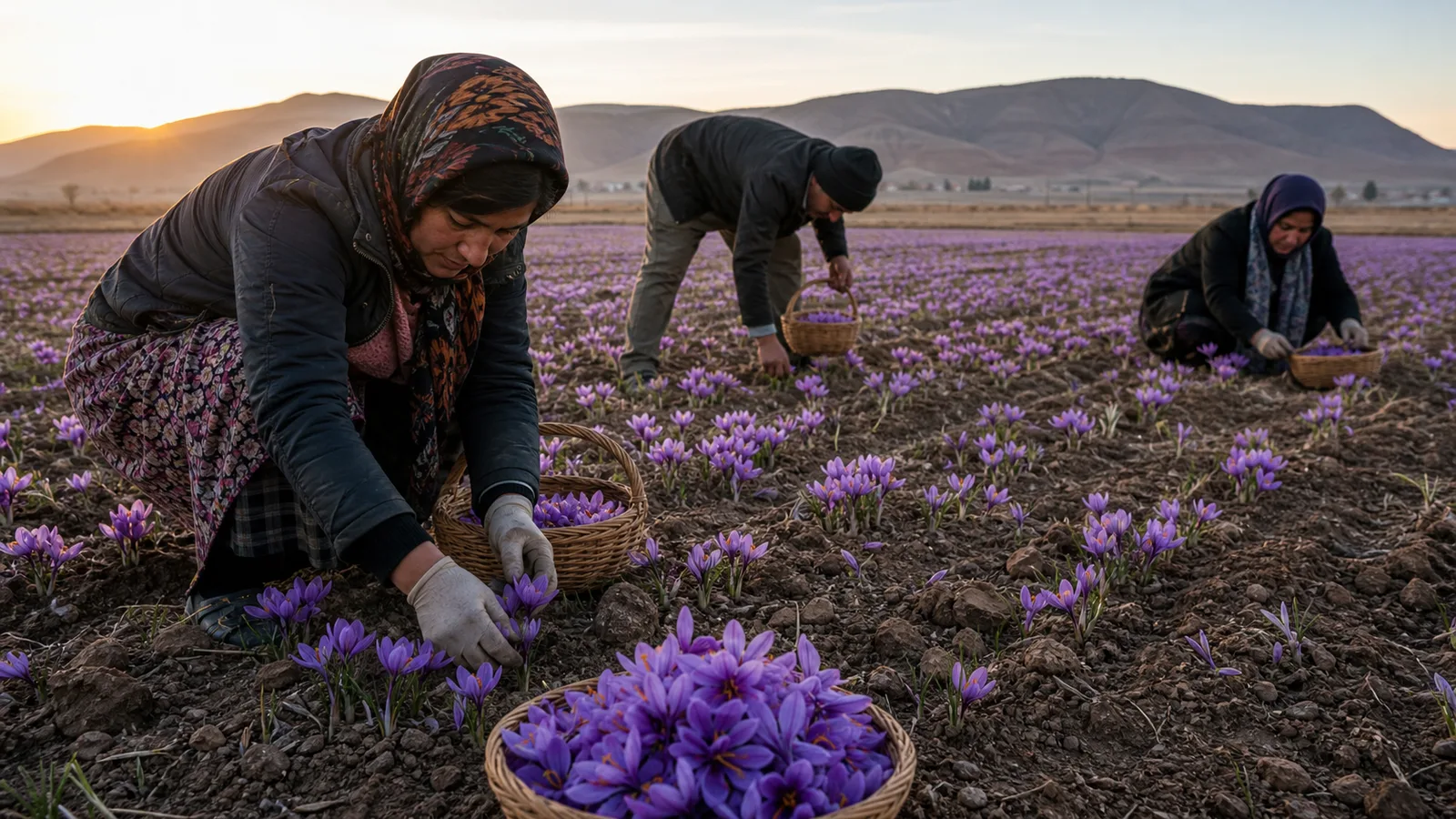
Where is most saffron produced?
Iran is the world’s largest saffron producer. In 2025, the UN Food and Agriculture Organization said the country produced more than 90% of global saffron. Within Iran, production is concentrated overwhelmingly in Razavi Khorasan, South Khorasan and North Khorasan. Fields also exist in Isfahan, Yazd, Kerman, Fars, Hamadan, Qazvin, Lorestan, Khuzestan, Semnan and other provinces.
Published area and production figures change with the reporting year, drought, frost and whether agencies count planted or bearing land. The numbers below are therefore dated rather than presented as a live league table.
Razavi Khorasan: Iran’s largest production base
Razavi Khorasan is the clear leader by area and output. An official provincial report in June 2023 recorded about 91,000 hectares of saffron and annual production that could range from 250 to 300 tonnes depending on rain, drought and frost. It attributed more than 70% of Iranian production to the province.
Its best-known saffron-producing places include:
- Torbat-e Heydariyeh, one of the most prominent centres for fields, processing and trade;
- Gonabad, whose Qanat-based saffron system is recognised by FAO as a Globally Important Agricultural Heritage System;
- Khaf, Taybad, Bajestan, Zaveh and Torbat-e Jam, all part of the province’s established saffron geography;
- Mashhad, an important processing, laboratory, packaging and trading centre as well as the provincial capital.
Older versions of this article quoted 82,000 hectares. That number reflected an earlier reporting period; it should not be mixed with the 2023 estimate as though both describe the same season.
South Khorasan: Ghaenat, Birjand and a strong quality reputation
South Khorasan ranked second in official provincial reports, with 17,152 hectares recorded in 2021. Ghaenat alone accounted for 5,088 hectares and 22.738 tonnes in a report from that year. The province’s important centres include Ghaen, Birjand, Ferdows and Boshruyeh.
Ghaen and Ghaenat are widely promoted as Iran’s “saffron capital,” and the name carries real cultural and commercial value. Some growers pick flowers or closed buds before sunrise and separate and dry the stigmas quickly, practices that can help protect colour and aroma. Tourist visits during the short autumn flower season also keep the region’s saffron identity visible. A separate account of the Ghaenat saffron quality-improvement programme explains how local work has addressed production as well as post-harvest handling.
It is still too broad to say every South Khorasan lot is better than every Razavi Khorasan lot. A carefully harvested and tested product from either province can outperform a poorly dried one from a famous city.
North Khorasan: Faruj, Shirvan and Esfarayen
North Khorasan is the third major part of Iran’s saffron belt. A May 2020 official report said the crop was grown in all eight counties of the province. It recorded Faruj first, with 2,453 hectares and about 14 tonnes a year, followed by Shirvan and Esfarayen. These are historical figures, useful for identifying the production centres rather than stating today’s output.
Other Iranian saffron regions
Isfahan
Isfahan has long been one of the largest producers outside Khorasan. Saffron fields have been reported around Shahin Shahr, Golpayegan, Najafabad, Natanz and Nain. The 1,300-hectare figure in the old article came from an earlier period and should be treated as dated, not current.
Yazd
Yazd’s dry climate supports established saffron production around Bahabad, Bafgh, Mehriz and Abarkuh. A previous version accidentally called these “cities in Kerman”; they are in Yazd province. An official 2019 report placed Bahabad first in the province with roughly 400 hectares at that time. The article’s older 900-hectare and three-tonne totals are retained here only as historical scale, not present-day statistics.
Kerman and the wider map
Kerman also has recognised production, especially around Zarand, Baft and Kuhbanan. Other producing provinces include Fars, Hamadan, Qazvin, Lorestan, Khuzestan and Semnan. This wider distribution is why sweeping claims that all northern or southern provinces are unsuitable are inaccurate. Local elevation, summer moisture, drainage, winter temperature and irrigation matter more than a province’s position on a map.
So where does the best saffron come from?
If “best” means the deepest production heritage and the largest concentration of specialist growers, the Khorasan region is the strongest answer. If it means a specific product worth buying, origin is only the beginning.
Look for a lot that is:
- made from genuine Crocus sativus stigmas, without dyed fibres or foreign material;
- cleanly separated and dried soon after harvest;
- protected from light, heat, air and moisture;
- identified by harvest year, origin and traceable lot information;
- supported, where available, by testing under recognised saffron methods.
The current ISO 3632-1:2025 specification applies to dried saffron in filament, cut-filament and powder forms. Codex’s saffron standard and analytical methods assess matters including moisture, foreign material, and the compounds associated with taste, aroma and colouring strength: picrocrocin, safranal and crocin. Those measurements are a sounder basis for comparison than a city name or marketing superlative. Buyers can use the practical checks in our guide to authentic and premium saffron alongside any supplier documentation.
What makes Iranian saffron fields distinctive?
Saffron grows through autumn and winter and rests as a corm during summer. The established Khorasan areas combine dry summers with cool-season growth, suitable soils and generations of specialised labour. Harvest is concentrated into a short window: flowers are picked promptly, stigmas are separated by hand, and drying must begin without unnecessary delay.
That human and post-harvest chain matters as much as climate. Delayed separation, contamination, excessive heat during drying or poor storage can diminish an excellent field crop. Conversely, disciplined handling can produce strong saffron outside the most famous districts.
A brief, careful note on saffron’s origins
Saffron has been used for several millennia, and a date of roughly 3,000–3,500 years is often repeated. Its exact domestication story remains debated. Kew’s Plants of the World Online currently treats Crocus sativus as a cultigen from Greece, while Iran has an ancient and exceptionally influential record of cultivation, trade and culinary and textile use.
Older accounts also connect saffron with the ancient Median lands, Asia Minor, Achaemenid food and textiles, Parthian trade, Sassanid-era Qom, Iranian communities in the Levant, and stories involving Darius and Alexander. Those traditions are part of the spice’s cultural narrative, but the previous article supplied no primary citations for the specific anecdotes or for its reference to a place translated as “Bonn.” They should not be presented as settled documentary fact.
The practical answer
For travellers looking for Iran’s most important saffron cities, start with Torbat-e Heydariyeh and Gonabad in Razavi Khorasan, Ghaen and Birjand in South Khorasan, and Faruj in North Khorasan. For buyers, choose the producer or seller that can show the product’s identity, harvest, handling and test evidence. Famous origin can guide the search; it cannot replace proof of quality.
Sources
- FAO in Iran: production share and saffron authenticity work, 2025
- FAO: Gonabad Qanat-based saffron system
- IANA: Razavi Khorasan area and production, 7 June 2023
- IANA: South Khorasan and Ghaenat figures, 25 August 2021
- IANA: Faruj, Shirvan and Esfarayen production, 13 May 2020
- ISO 3632-1:2025 saffron specification
- Kew Plants of the World Online: Crocus sativus

![Exporting Saffron to Turkey + Price Guide [Complete 0 to 100]](https://img.rowhanisaffron.com/20260827003933/saffron-export-turkey-quality-inspection.webp)



