


An undated local report attributed to Mahallat agricultural director Ahmad Reza Jafari said saffron production increased by 45 percent in the crop year and reached 175 kilograms from 35 hectares. The report preserves a useful regional snapshot, but its year and comparison baseline are missing, so the increase should not be read as a current statistic.
What the Mahallat saffron report said
Jafari, identified as director of Jihad Keshavarzi in Mahallat, described saffron as a growing part of the county’s agriculture. The surviving account gives four connected figures:
- a 45% increase in saffron production;
- 175 kg of harvested “red gold”;
- 35 hectares under saffron cultivation; and
- 114 agricultural operators involved in local saffron activity.
Those numbers belong together, but the original sentence breaks off after the acreage statement. It does not identify the villages counted, the reporting date, final harvest method or previous crop-year total.
What the 45% increase would mean
If 175 kg was the final output and “increased by 45%” meant a like-for-like rise over the previous year, the implied earlier production would be about 121 kg. That is a calculation from the claim, not an additional figure supplied by Jafari.
The comparison is only sound if both years covered the same boundaries, measurement stage and moisture basis. A forecast compared with a final harvest, or dried saffron compared with another form, would not support the percentage.
Reported yield from 35 hectares
Dividing 175 kg by 35 hectares gives a reported average of 5 kg of dried saffron per hectare. It is a useful consistency check because the arithmetic is clear. It does not show that every farm achieved the same yield.
Age of the saffron bed, corm size, plant density, irrigation, weather, soil, disease pressure, picking speed and drying losses can make field results differ widely. A county average also hides new fields that may not yet be at full production.
Operators and employment in Mahallat
The report counted 114 agricultural operators in Mahallat saffron production. It then said each cultivated hectare created work for ten people and that harvesting and separating stigmas from flowers generated indirect employment for 350 people.
These statements should not be combined into a permanent-job total. Saffron creates a sharp need for labour during the short flower harvest and stigma-separation period, so “ten people per hectare” may describe seasonal workers or work opportunities rather than ten full-time jobs. The source does not define the unit.
What it does show is why a relatively small crop can matter locally. Picking must keep pace with flowering, and separation begins soon after flowers leave the field. That work extends the crop’s economic effect beyond landholders to family members, seasonal crews and processors.
Why Jafari stressed harvesting before sunrise
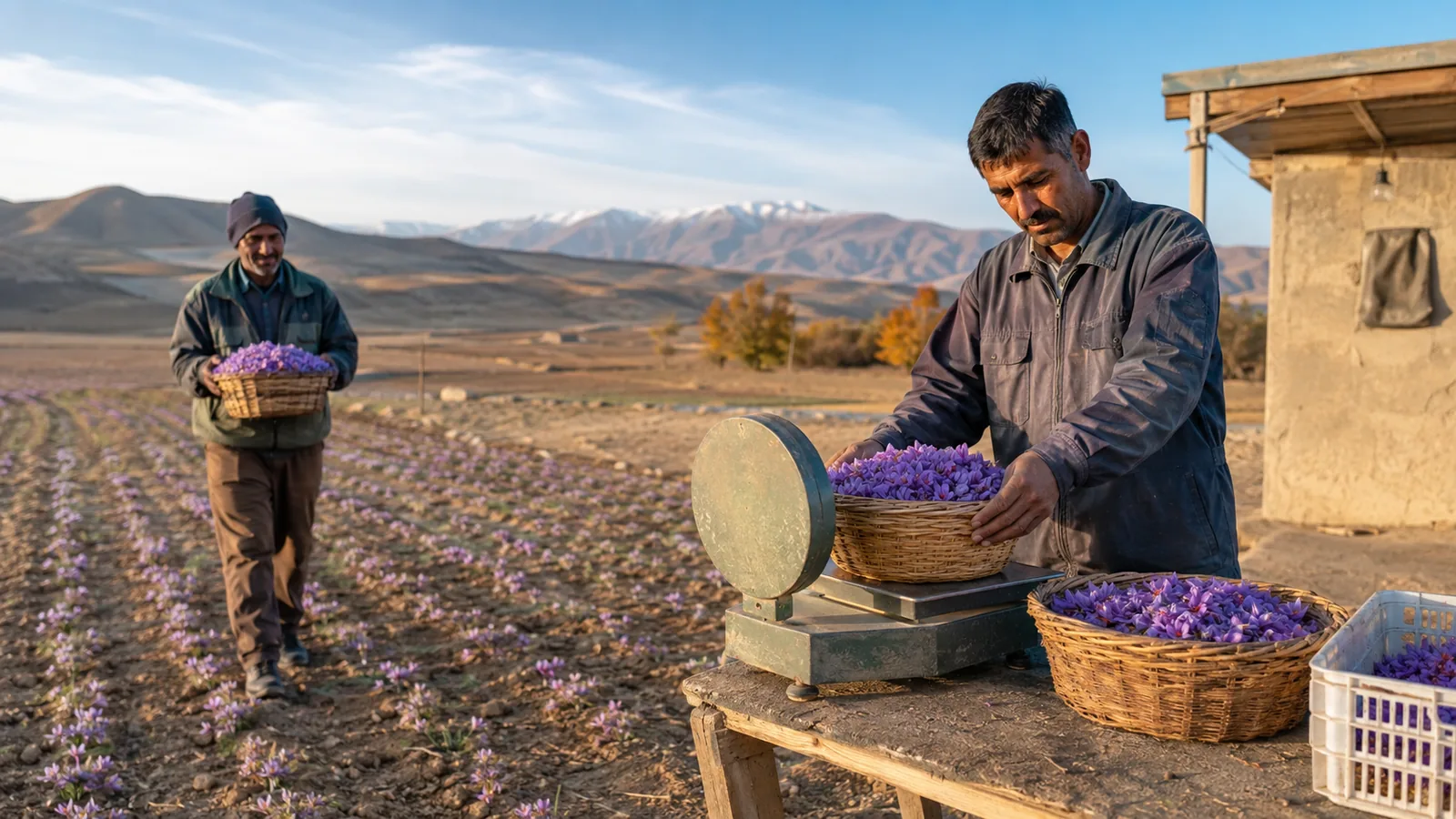
Jafari linked harvest timing before sunrise with the quality of this expensive product. Early picking is common in warm saffron regions because flowers are fresh, crews avoid the day’s heat and prolonged sun exposure is limited.
The timing is not an absolute rule under every condition. The University of Vermont’s saffron flower harvesting guidance recommends morning picking and notes that growers in hot climates often begin before sunrise. It also advises waiting until flowers are dry when heavy dew, rain or snow is present. Clean, dry flowers and prompt handling matter more than a clock time alone.
From flower to finished saffron
Harvesting and separation are different jobs. Pickers remove fresh purple flowers without damaging the leaves, then carry them in clean, shallow containers. Indoors, workers separate the three red stigmas from petals and yellow stamens.
The stigmas must then be dried consistently, cooled and protected from moisture, light and contamination. A 45 percent field-production gain would lose much of its value if flowers were crushed, separation was delayed or drying varied from batch to batch.
Mahallat’s wider agricultural identity
The historical account described Mahallat as a centre of flower, plant and stone production. It reported a population of about 55,000 and roughly 2,600 farmers. These are undated figures, so they describe the source period rather than the present population or workforce.
Saffron fits a region already associated with horticulture, but it has a different labour calendar from ornamental flowers. Its autumn bloom, small dried yield and concentrated hand work require separate planning, buyers and processing controls.
Where Mahallat is
Mahallat lies in the south of Markazi Province, southwest of Tehran. The source placed it about 262 km from Tehran and around 33°54′ north, 50°27′ east, with a reported elevation of 1,820 metres.
It described the area as adjoining Isfahan and Golpayegan to the south, Khomein and Arak to the west, and Delijan to the east. Those geographic references help explain Mahallat’s inland, elevated growing context.
The surviving area statement—“37.2079 square kilometres,” said to equal 1.7 percent of the province—is internally malformed. It may contain reversed digits or broken punctuation, but there is not enough evidence on the page to repair it safely. The reported relative density of 21 people likewise lacks a stated unit and census year.
How Mahallat compares with regional saffron expansion
Saffron cultivation has expanded beyond the major Khorasan provinces into central Iran. An official Iranian agricultural report on saffron in neighbouring Isfahan Province described 1,462 hectares and an expected average near 6 kg per hectare in its stated year, with harvest moving from colder to warmer districts.
That separate report does not verify Mahallat’s 45 percent increase, but it provides credible historical context for regional growth and a similar order of yield. Different years and places should not be treated as a direct ranking.
What would verify the production increase
A complete statistical record would identify the crop year, previous-year output, whether 175 kg was forecast or final, harvested area, dry-weight method and data-collecting office. It would also separate bearing fields from newly planted hectares.
For employment, the record should distinguish registered operators, individual seasonal workers, person-days and full-time-equivalent jobs. For geography, it should cite an official boundary area and census year rather than preserve damaged numbers.
The value of this historical snapshot
The headline and core figures remain useful as a record of saffron production in Mahallat: 45 percent reported growth, 175 kg, 35 hectares, 114 operators and intensive harvest work. They show why a compact saffron area can create a busy seasonal chain.
They should be quoted with Ahmad Reza Jafari’s attribution and described as undated historical figures. Used that way, the report documents Mahallat’s diversification without pretending to be a current forecast or a fully audited agricultural census.

![Exporting Saffron to Turkey + Price Guide [Complete 0 to 100]](https://img.rowhanisaffron.com/20260827003933/saffron-export-turkey-quality-inspection.webp)



