


Pure saffron tastes distinctly bitter, with a light drying or astringent sensation. Its aroma can seem honeyed, floral, hay-like or earthy, but the threads themselves should not taste sweet. That contrast—fragrant nose, bitter taste—is characteristic of saffron. It is useful as a warning sign, not a complete authenticity test.
What does pure Iranian saffron taste like?
The most reliable short description is bitter, slightly astringent and aromatic. Picrocrocin is the compound most closely associated with saffron’s bitter taste. Safranal contributes much of the familiar aroma, while crocins are responsible for its colouring strength.
People describe the aroma and flavour in different words: floral, musky, honey-like, grassy, hay-like, earthy, mushroom-like, warm or faintly marine. Those are sensory comparisons, not separate ingredients. The balance also changes with origin, drying, age, storage and how much saffron is used.
A strand that is sugary is suspicious because genuine dried saffron is not naturally sweet. However, bitterness alone cannot prove authenticity. Safflower, dyed plant fibres or a mixture containing only some real saffron may still confuse a home test.
How colour, aroma and taste work together
Colour
Whole saffron stigmas are deep red. Depending on the commercial style, some yellow or pale style tissue may remain attached. Iranian trade names often include Negin, Sargol, Pushal and bunch saffron; the older article translated these imperfectly as “super gem, gem, straw and bunch.” The amount of red stigma versus pale style differs by cut, but colour alone does not establish grade or purity.
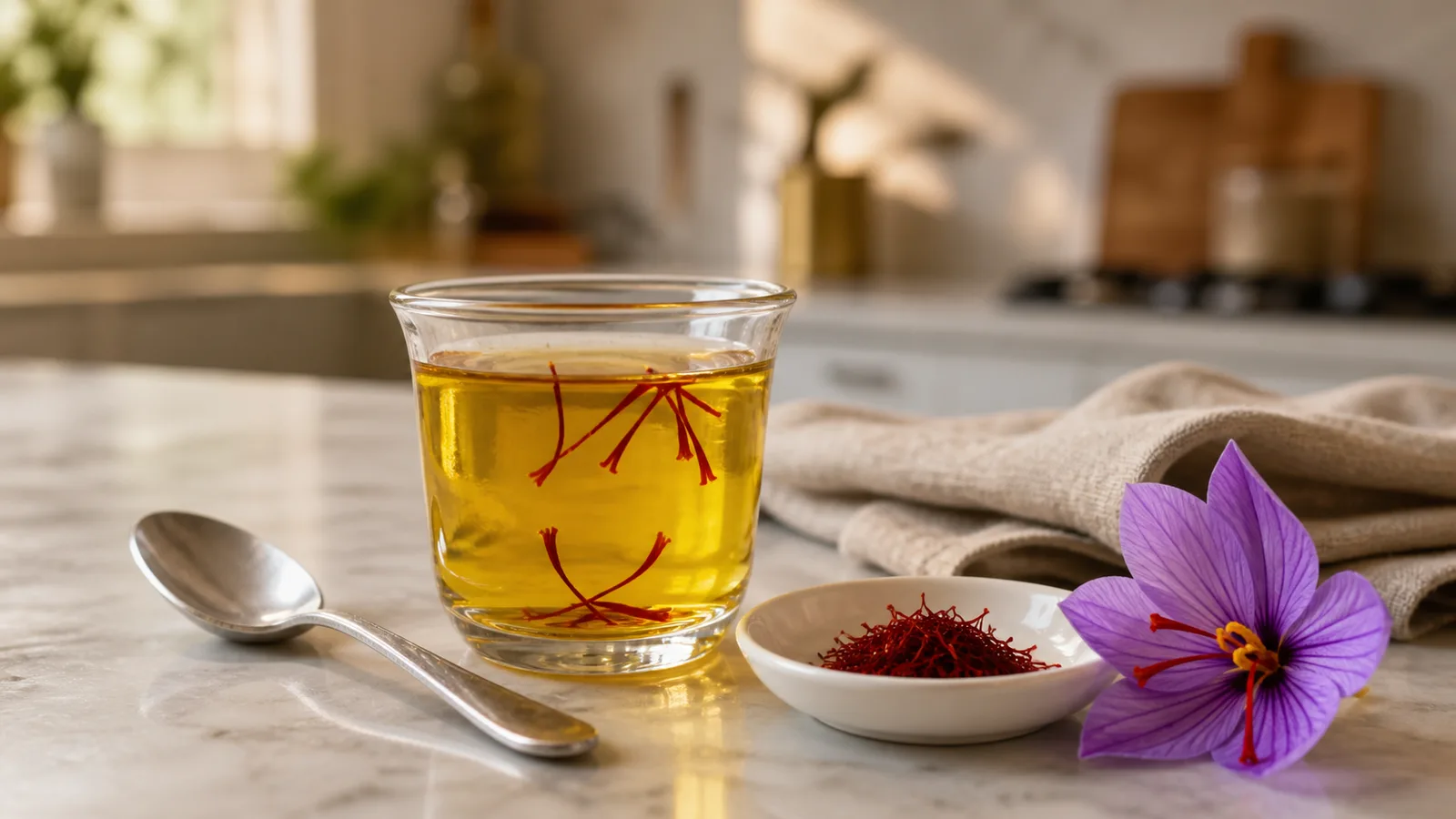
When real threads are steeped in warm water, colour normally spreads gradually into a clear golden-yellow infusion. The threads do not need to become colourless immediately. An instant, aggressively red plume can indicate added dye, although infusion speed varies with grinding, water temperature and thread condition.
Aroma
Good saffron has a concentrated but not candy-like fragrance. Honey, vanilla, dry hay, alfalfa and tobacco are all comparisons used in sensory descriptions. A flat aroma may reflect age, heat, light exposure or poor packaging rather than counterfeiting. An artificial perfume note is a reason to investigate further.
Taste
The taste should be bitter rather than sweet. Use saffron in a normal infusion or dish instead of chewing an unknown product as an authentication test. Food safety and identity cannot be confirmed by the tongue.
What recognised standards actually measure
The current ISO 3632-1:2025 specification applies to dried saffron in filaments, cut filaments and powder. Codex’s CXS 351-2022 standard covers dried saffron and related requirements, while recognised laboratory methods assess moisture, foreign matter, floral waste and the absorbance associated with picrocrocin, safranal and crocin.
The previous article quoted “over 230 units” for colour, “20–50 units” for safranal and “more than 80 units” for picrocrocin. Those values resemble measurements used in earlier grading discussions, but a number without the exact standard edition, test method, sample preparation and laboratory report is not meaningful to a shopper. It should not be treated as something a person can judge by looking at the packet.
A package may state a grade or reference ISO 3632, but printing the standard’s name is not proof that the lot was tested. Ask for a traceable certificate that identifies the batch, laboratory, date and method.
What pure saffron threads look and feel like
- Shape: stigma filaments widen toward one end. They are not perfectly identical, but they should not look like uniformly cut plastic strips.
- Surface: dry threads are matte to lightly lustrous, not greasy. Oil added to increase weight may leave a translucent mark on plain paper.
- Condition: some breakage is normal in a delicate dried spice. Broken threads do not, by themselves, prove age or fraud.
- Dryness: the product should be dry and free-flowing, without damp clumps or visible mould.
- Cleanliness: there should be no obvious dust, unrelated plant pieces or artificial colour transfer.
Common forms of counterfeit or adulterated saffron
Substitutes may include safflower petals, coloured maize silk or other plant fibres. The old article also listed saffron’s pale style tissue and coconut strands. Some adulteration uses sugar, honey or salts to add weight; other methods use oil or synthetic dye. Powder is harder to inspect visually than intact filaments.
Possible warning signs include:
- a sweet taste or sticky surface;
- oil marks on paper;
- threads with an implausibly uniform shape;
- strong colour released instantly into cold water;
- a very low price with no traceable origin or lot information;
- claims of testing without a batch-specific report.
No single home trick is decisive. A sophisticated adulterated sample can pass a visual or water test. For an important purchase, traceability and independent laboratory evidence are stronger than internet demonstrations.
Does freshness change the taste?
Yes. Aroma compounds are volatile, and light, heat, air and moisture gradually weaken the spice. Older saffron may still colour food while smelling less vivid. That does not make it counterfeit, but it lowers sensory quality.
Store saffron in a clean, airtight, food-safe container in a cool, dark and dry cupboard. Opaque glass or metal protects it better than a transparent jar left in sunlight. A wooden container can absorb or contribute aromas and is not automatically the best choice. Avoid refrigerating an often-opened jar where condensation can enter.
How to assess a purchase at home
- Check the seal, seller, harvest or packing date, country of harvest and lot number.
- Inspect the filament shape, dryness and cleanliness under good light.
- Smell a small sample; look for a strong natural saffron aroma, not perfume or sweetness.
- Steep a few threads in warm water and watch for a gradual golden infusion.
- Taste the prepared infusion in a normal culinary quantity: it should be bitter and lightly astringent, not sugary.
- For high-value or wholesale lots, request independent test results.
Price can be a clue because harvesting and separating saffron is labour-intensive, but an expensive packet can still be poor or false. Use price alongside origin, traceability, the physical product and evidence. Our guide to buying authentic saffron covers those checks in more detail.
The simple answer
Pure, good Iranian saffron smells rich and complex but tastes bitter, not sweet. Its colour develops into a clear gold rather than behaving like instant red dye. Those features can help you notice a problem; only traceability and appropriate laboratory testing can confirm that a valuable lot meets a recognised standard.

![Exporting Saffron to Turkey + Price Guide [Complete 0 to 100]](https://img.rowhanisaffron.com/20260827003933/saffron-export-turkey-quality-inspection.webp)



