


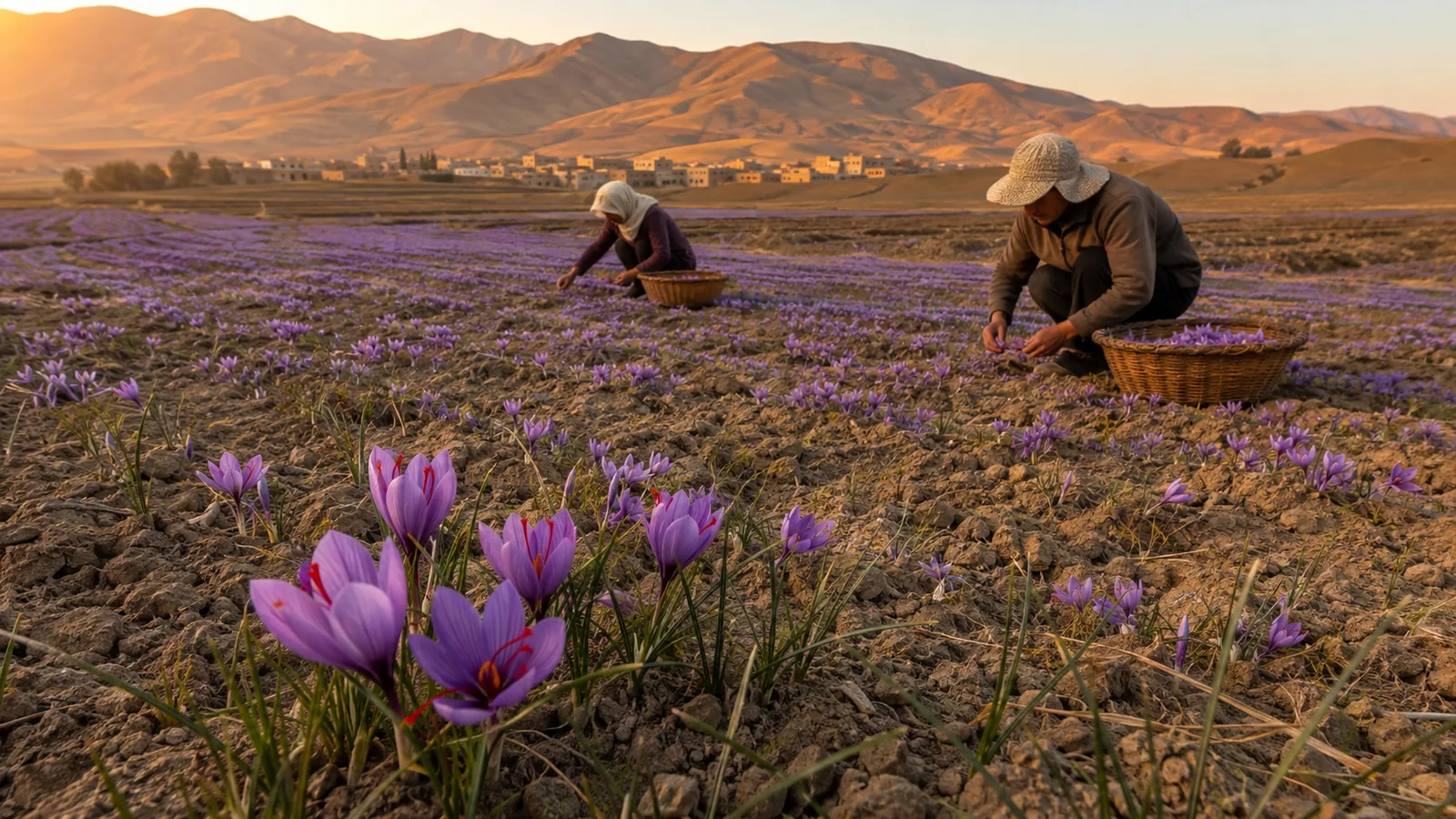
Where is saffron grown? Most of the world’s saffron is cultivated in Iran, especially in the Khorasan provinces, but established regional production also exists in Kashmir, Afghanistan, Spain, Greece, Italy and Morocco. Smaller farms and trials operate in other temperate, dry-summer regions. What connects successful areas is not a country name alone: growers need healthy corms, excellent drainage, a workable autumn flowering season and enough skilled labour to pick and process every flower quickly.
Where is most saffron grown today?
Iran is the largest producer by a wide margin. The UN Food and Agriculture Organization’s profile of the qanat-based saffron farming system in Gonabad describes Iran as producing more than 90% of the world’s saffron. Exact annual shares move with weather, planted area, yield estimates and the year being compared, so a permanent figure such as 93% should not be treated as timeless.
Where is saffron grown in Iran?
The concentration in Iran does not mean every Iranian province produces equally. Razavi Khorasan and South Khorasan form the historic commercial centre, with places such as Torbat Heydarieh, Gonabad, Qaen and Ferdows strongly associated with cultivation and trade. Production has also expanded into North Khorasan and provinces including Isfahan, Yazd, Kerman, Fars and parts of western and north-western Iran.
Khorasan combines an arid to semi-arid climate, dry summers, cold-season growth and long local experience in irrigation, corm management, flower picking and drying. Those advantages are practical, not mystical: quality still depends on the field, crop year, harvest timing and post-harvest work.
Where is saffron grown in the world outside Iran?
Kashmir, India
Kashmir saffron—often called kesar—is associated especially with the Pampore area of Jammu and Kashmir. India’s Agricultural and Processed Food Products Export Development Authority lists Kashmir Saffron as a registered geographical indication, with the Agriculture Production Department of Jammu and Kashmir as the registered proprietor.
Kashmir’s cool winters and comparatively dry upland fields can suit the crop, but changing rainfall, irrigation access, corm health and urban pressure all affect output. A geographical indication identifies a protected origin; it does not mean every saffron sold using an Indian-looking label was grown there.
Herat, Afghanistan
Western Afghanistan, particularly Herat Province, has developed a recognised saffron sector. FAO’s regional geographical-indications platform describes Herat-Bastan Saffron as a product whose characteristics are linked to its environment and production practices.
Herat shares the dry continental pattern found in several successful saffron regions. The crop has also been promoted as a high-value alternative in rural development programmes, although farm-level results still depend on water, labour, planting stock and access to processing and markets.
La Mancha, Spain
Spain has a long saffron tradition centred on Castilla-La Mancha. The Spanish Ministry of Agriculture records Azafrán de La Mancha as a protected designation of origin. Hot, dry summers and cool winters suit the corm’s cycle, while the protected specification ties the name to a defined place and method.
Spain is also an important trading and packing market. That distinction matters: saffron can be imported, processed or packaged in Spain without having been grown in La Mancha. Check the stated origin and any PDO mark instead of inferring origin from the seller’s address.
Kozani, Greece
Greek saffron is closely linked to the Kozani region in Western Macedonia. The European Commission’s profile of Krokos Kozanis PDO says Greek saffron under this designation comes from Kozani and describes drained, medium-fertility soil with a warm temperate climate.
Harvest begins in autumn and remains highly manual. Flowers are picked, the red stigmas are separated, and drying has to be controlled carefully. The PDO demonstrates a real regional production system, not merely a historic association with the crocus.
Italy and Morocco
Italy has several small but established saffron regions, including L’Aquila in Abruzzo and San Gimignano in Tuscany, both known for protected regional products. Morocco’s best-known growing area is around Taliouine in the Anti-Atlas, where altitude, dry conditions and local knowledge support production.
These industries are far smaller than Iran’s, but volume is not a direct measure of quality. Regional reputation, a protected name or an attractive story should still be followed by checks on freshness, purity, storage and traceability.
What countries grow saffron on a smaller scale?
The list of saffron growing countries extends well beyond the major regions. Saffron is also grown commercially or experimentally in parts of Türkiye, Azerbaijan, China, Pakistan, France, Australia, New Zealand, the United States and other temperate areas. The scale ranges from established local clusters to a handful of specialist farms. “Grown in the country” can therefore mean anything from a recognised regional industry to a small trial plot.
Lists that include Singapore, Malaysia, Taiwan, Japan or Germany as major saffron producers often mix cultivation with importing, trading, research or very small horticultural projects. A country can sell, pack or study saffron without being a meaningful source of the world’s crop. Production claims should identify a crop year and a source rather than circulate an undated list.
What determines where saffron grows?
Crocus sativus follows a seasonal cycle that differs from many garden crops. Corms are generally dormant through summer, produce leaves and flowers in autumn, remain active through the cooler season and then die back in spring. The exact calendar shifts with latitude, altitude and local temperature.
- Summer: a warm, relatively dry dormancy period reduces rot pressure.
- Autumn: moisture and falling temperatures help initiate growth and flowering.
- Winter: leaves remain active where cold is not extreme or prolonged.
- Spring: foliage feeds replacement corms before it yellows naturally.
“Mild winters and hot summers” is only a broad summary. Established regions include high-elevation places with cold winters. Drainage, timing and the severity of freezes matter more than one climate label.
Soil and field conditions
The essential soil requirement is drainage. Saffron corms are vulnerable when water remains around them, particularly during warm weather or dormancy. A sandy loam can work well, but heavy soil can also be used if its structure, slope and drainage are genuinely suitable. Simply calling for a sand-and-clay mixture is not a reliable field specification.
- Choose open ground with good sun and air movement.
- Avoid hollows where cold air or rainwater collects.
- Test soil before making pH or fertiliser decisions.
- Use clean, firm corms from a traceable source.
- Plan crop rotation and sanitation around local soil-borne disease risk.
- Match irrigation to soil moisture and growth stage rather than a fixed calendar alone.
For field preparation, planting depth, corm health and seasonal care, see our detailed guide to saffron cultivation and growing conditions.
Can saffron grow in Australia?
Yes. Parts of southern Australia have the cool-season growth and relatively dry summer pattern saffron needs, and specialist farms do operate there. Site selection remains local: a Mediterranean-style regional climate does not guarantee that a low, waterlogged or humid field will work.
Australian growers also have to consider biosecurity rules for planting material. Moving corms between countries or regions can be restricted because they may carry pests or diseases. Use legally sourced stock and follow the relevant state and national requirements.
What is a saffron growing zone?
There is no single worldwide “saffron growing zone.” Garden hardiness zones describe average winter minimum temperature; they do not capture summer rainfall, soil drainage, humidity or the timing of autumn frost. Two gardens in the same numbered zone can give saffron very different conditions.
For a home plot, judge the microclimate. A raised, sunny bed against a warm wall may drain and warm better than the surrounding garden. In a wet-summer climate, pots or covered beds can make moisture easier to control. In a very cold region, deep freezing and repeated freeze-thaw cycles may require local protection or a different site.
Why Iran and Khorasan dominate saffron production
Climate is only part of the answer. Saffron requires enormous amounts of hand work during a short flowering period. Every flower yields just three red stigmas, and those stigmas need prompt separation and careful drying. Regions that already have trained workers, corm supplies, buyers, processing knowledge and trade infrastructure can produce at a scale that a new growing area cannot quickly copy.
The crop uses less irrigation than many summer crops in some Iranian systems, but “low water” does not mean no water. Establishment, autumn growth and corm development still depend on soil moisture. FAO’s Gonabad case highlights how qanat irrigation supports saffron under severe water scarcity; it should not be read as proof that the crop thrives through neglect.
Saffron farming is also not minimal effort. The field may remain in place for several years and corms multiply underground, yet growers still manage weeds, nutrition, pests, diseases, irrigation, harvest crews, stigma separation and drying. Labour is one reason the finished spice is expensive.
Does growing country determine quality?
Origin matters because climate and local practices shape a crop, but it does not create a guaranteed quality hierarchy. Excellent and poor lots can come from the same country. A useful evaluation looks at the actual batch: clean red threads, characteristic aroma and taste, appropriate moisture, recent harvest/packing information, traceable handling and—where needed—credible laboratory results.
Be cautious with claims that one country always produces “the best” saffron or that another country’s product is automatically inferior. Protected names such as Azafrán de La Mancha and Krokos Kozanis define origin and production requirements; they do not make every unrelated regional comparison for the buyer.
Where saffron is grown versus where it is sold
International supply chains can separate farming, drying, grading, packing and retail across several countries. The location printed most prominently on a website or package may identify the brand or distributor rather than the farm. If geographical origin matters, look for an explicit country-of-origin statement, lot traceability and the rules behind any geographical indication.
The question “where is saffron produced?” therefore needs a precise definition: the farm where flowers were harvested is the agricultural origin, while drying, packing, export and retail may happen somewhere else.
Current production statistics also need careful reading. One dataset may count dried spice, another harvested area, and another exports—which can include re-exported goods. Our saffron production statistics guide explains why year, unit and source must travel with any number.
The short answer
If you ask where saffron is cultivated, the short answer is across a wide belt of temperate and dry-summer regions, but most commercial production is concentrated in Iran, especially Khorasan. Kashmir, Herat, La Mancha, Kozani, L’Aquila and Taliouine are other important regional names. Successful cultivation depends on far more than latitude: corm health, drainage, seasonal moisture, autumn weather, harvest labour and fast, careful drying all determine whether a promising field becomes good saffron.

![Exporting Saffron to Turkey + Price Guide [Complete 0 to 100]](https://img.rowhanisaffron.com/20260827003933/saffron-export-turkey-quality-inspection.webp)



