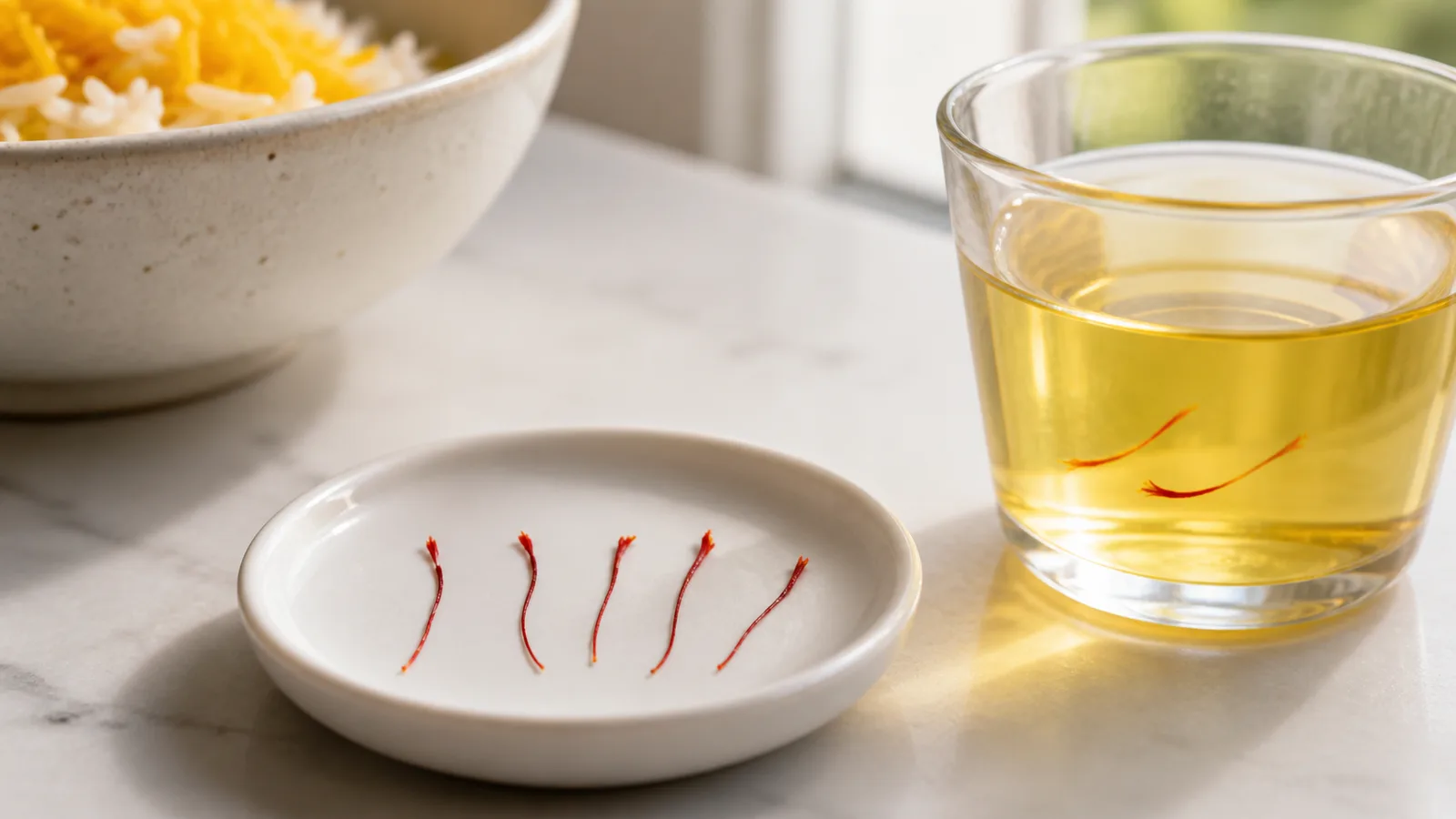
There is no well-established list of ordinary vitamins or minerals that every person must avoid with saffron. The research on saffron supplement interactions is limited, and most possible pairings have never been tested directly. The combinations that deserve the most caution are those that may push in the same direction—toward bleeding, lower blood pressure or blood sugar, drowsiness, or serotonin-related effects—or that sit beside a prescription medicine with a narrow safety margin.
That is different from saying every theoretical interaction is dangerous. For a healthy adult using saffron as a culinary spice, the exposure is not the same as a concentrated extract. If you use saffron capsules, gummies, liquid extract or a medicinal dose, show the exact product and your complete supplement-and-medicine list to a pharmacist, doctor or other healthcare provider before adding another active product.
What not to mix with saffron without individual advice
The practical answer to “what not to take with saffron” depends on why you take each product, its dose, your health conditions and your medicines. Questions about saffron interactions with other supplements need the same context. The groups below are review-first combinations, not proof that a harmful interaction will occur.
St. John’s wort, 5-HTP and SAM-e
Saffron extracts have been studied for mood, but claims that saffron simply “increases serotonin” are too certain. Direct clinical studies of saffron combined with St. John’s wort, 5-HTP or SAM-e are lacking. Even so, stacking several products promoted for mood is not a sensible experiment, especially for someone taking an antidepressant or living with bipolar disorder.
NCCIH warns that St. John’s wort itself has a high interaction burden: it can weaken many medicines, and combining it with certain antidepressants can cause serious serotonin-related effects, including serotonin syndrome. Do not assume adding saffron makes that combination safer. Agitation, tremor, diarrhea, sweating, fever, a rapid heartbeat, confusion or muscle rigidity after a new mood-product combination needs urgent medical advice.
Saffron and blood thinners: ginkgo, high-dose vitamin E and other bleeding-risk products
Saffron is often called a “blood thinner” online, but the human evidence is mixed. A search for “saffron blood thinner” should not be treated as a clinical conclusion. In a one-week randomized study of 60 healthy volunteers, 200 or 400 mg saffron tablets did not change the measured coagulation or anticoagulation factors. That short result cannot rule out every interaction, every extract or use in a person already taking an anticoagulant.
A single case report described nose and gum bleeding after a saffron supplement was used with rivaroxaban. One case cannot establish frequency or causation, but it supports caution. Ginkgo and high-dose vitamin E also have recognized bleeding concerns; fish oil, garlic and other products may matter depending on dose and the rest of the regimen. If you take warfarin, rivaroxaban, apixaban, aspirin, clopidogrel or another anticoagulant or antiplatelet medicine, have a bleeding disorder, or are approaching surgery, do not add a saffron supplement or another bleeding-risk supplement without the clinician managing that risk.
Products intended to lower blood pressure
A meta-analysis of eight trials found that saffron supplementation lowered systolic pressure by about 0.65 mmHg and diastolic pressure by about 1.23 mmHg on average; the authors said these small changes may not be clinically important. The evidence does not show that saffron plus magnesium or potassium routinely causes fainting, and those minerals are not automatic saffron contraindications.
Review the combination if you already have low blood pressure, recurrent dizziness or fainting, or take blood-pressure medicine alongside several products marketed to lower pressure. That is the context needed to answer “can you take saffron and magnesium together?” Measure the effect rather than relying on the label’s promises. Do not change prescribed treatment to accommodate saffron.
Diabetes supplements and other blood-sugar products
Saffron has produced small average changes in glucose outcomes in some trials, while findings and certainty vary by population. Bitter melon, berberine, concentrated cinnamon and other supplements may also be marketed for blood-sugar control. A direct harmful interaction with saffron has not been demonstrated, but combining several glucose-lowering products is harder to predict—particularly alongside insulin or diabetes medicine.
Someone using glucose-lowering treatment should ask the treating clinician how and when to monitor before adding saffron. Sweating, shaking, confusion, weakness or a fast heartbeat can be signs of low blood sugar and should not be managed by guessing which supplement to remove.
Melatonin, valerian, L-theanine and other calming products
There is no established direct interaction between saffron and magnesium, L-theanine or melatonin, and no clinical rule that they must always be separated. That means “can you take saffron and L-theanine together?” remains an evidence-gap question, not an automatic yes. Using L-theanine and saffron together may still be impractical if both contribute to drowsiness or dizziness. The same absence of evidence applies to many multi-ingredient sleep blends.
Introduce only one new product at a time. Do not drive or operate equipment if the combination changes alertness. Persistent insomnia should be assessed rather than treated by continually adding calming supplements.
Ashwagandha, rhodiola, turmeric and curcumin
Searches such as “can you take saffron and ashwagandha together?” or “can saffron and L-theanine be taken together?” have no universal yes-or-no answer because direct trials are missing. The same is true for rhodiola and most saffron–turmeric or saffron–curcumin combinations. Review is more important when products share a purpose, contain several unnamed blends, or sit beside thyroid, mood, blood-pressure, glucose or anticoagulant medicine.
Do not infer safety from the fact that both ingredients are plants. Check each product independently, then check the complete stack.
Iron supplements and vitamins A, C, D and E: claims that need correcting
Evidence does not support the claim that saffron blocks iron absorption or that everyone must space an iron supplement away from saffron. There is also no good evidence that normal doses of vitamins A, C or E “cancel” saffron’s antioxidant properties. Those rules should not be invented from laboratory antioxidant language.
Iron and fat-soluble vitamins have their own dosing, deficiency and toxicity considerations. Follow the reason they were prescribed or recommended. High-dose vitamin E deserves separate bleeding-risk attention, and high-dose antioxidant supplements may be unsuitable with some cancer treatments, but that is not a saffron-specific cancellation effect.
Prescription medicines can be the more important interaction
A 2025 review of saffron and cytochrome P450 enzymes reported effects on CYP1A1/2, CYP3A4 and CYP2E1 in the available evidence. The authors also stressed that the clinical importance and interaction-producing dose still need research. This is a signal for pharmacist review, not permission to predict a drug-level change from a website article.
Take extra care with medicines that have a narrow therapeutic index or serious consequences if their level changes, including warfarin, digoxin and cyclosporine. Antidepressants, anticoagulants, blood-pressure and diabetes medicines also need context-specific review. Include prescription drugs, over-the-counter products, vitamins, herbal extracts, gummies, powders and teas on the same list; an interaction check is incomplete when half the products are omitted.
The FDA’s supplement guidance notes that problems are more likely when people combine supplements, mix supplements with medicines, take excessive amounts or substitute supplements for prescribed treatment. It also advises discussing benefits and risks with a qualified health professional before use.
How to check a saffron combination before taking it
- Identify the form. Record whether it is culinary threads, stigma powder, crocin, a standardized extract, a gummy or a multi-ingredient blend.
- Copy the complete label. Include every active ingredient, amount per serving, serving size and suggested frequency.
- List the rest of the regimen. Add prescriptions, nonprescription medicines, vitamins, minerals, herbs, teas and occasional products.
- State the reason for each one. Two products aimed at the same symptom may duplicate effects without adding benefit.
- Ask a pharmacist a specific question. “Is this exact product compatible with these doses and conditions?” is more useful than “Is saffron safe?”
- Add one change at a time. If a reaction occurs, this makes the likely cause easier to identify.
Saffron supplement side effects still matter without an interaction
A 2026 systematic review of human safety reports found saffron generally well tolerated, with gastrointestinal problems the most frequent adverse effects and usually mild and self-limiting. Higher-dose or prolonged medicinal use still warranted clinical monitoring. A reaction to one product can also come from another ingredient, contamination or a dose that differs from the label.
Stop the new supplement and seek prompt advice for persistent vomiting, severe dizziness, unusual bleeding, a marked mood change or worsening symptoms. Rash, facial or throat swelling, difficulty breathing, fainting, severe confusion or a suspected serotonin reaction needs urgent care. Pregnancy, breastfeeding, childhood, complex illness and planned surgery call for individual guidance before medicinal saffron use; our fuller guide explains when to avoid saffron or ask for clinical advice.
How to store saffron at home and keep it identifiable
Keep culinary threads in a tightly closed container, away from heat, moisture and direct light. Leave supplements in their original labelled packaging so the ingredient list, lot number, expiry date and directions remain available if a pharmacist or clinician needs them. Do not combine different capsules or powders in one unlabelled jar.
The safest answer
Supplements to avoid with saffron are not defined by a single universal blacklist. The clearest reason to pause is a plausible overlapping effect, a medicine that makes a mistake consequential, or missing information about a concentrated multi-ingredient product. St. John’s wort and other mood stacks, bleeding-risk products, and combinations aimed at blood pressure or blood sugar deserve particular scrutiny.
If no direct interaction has been documented, say “unknown” rather than “safe” or “dangerous.” Bring the exact labels to a pharmacist, keep prescribed treatment unchanged, and distinguish normal culinary saffron from an extract. For cooking rather than supplementation, our whole-thread saffron range shows the food products currently available.