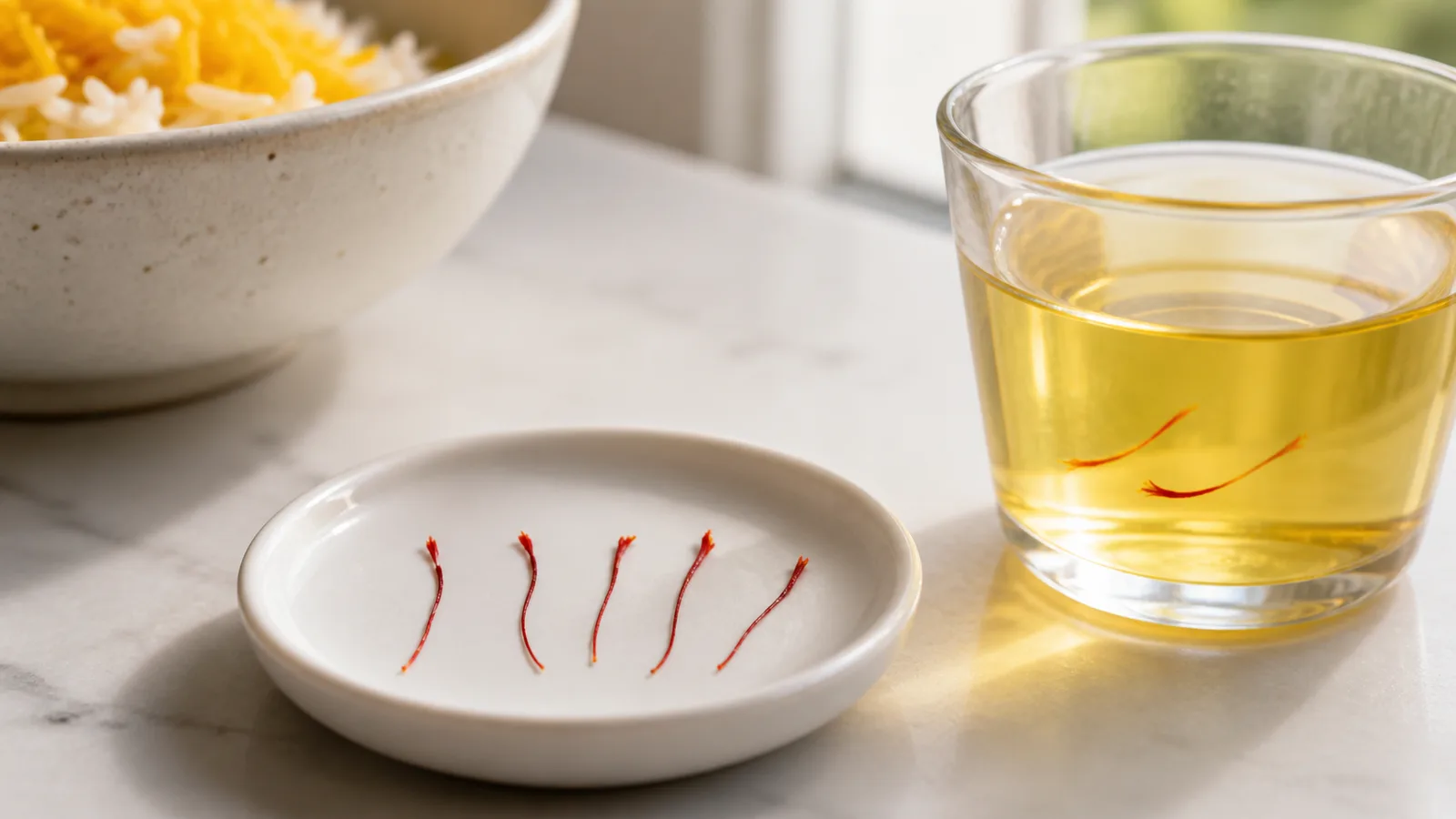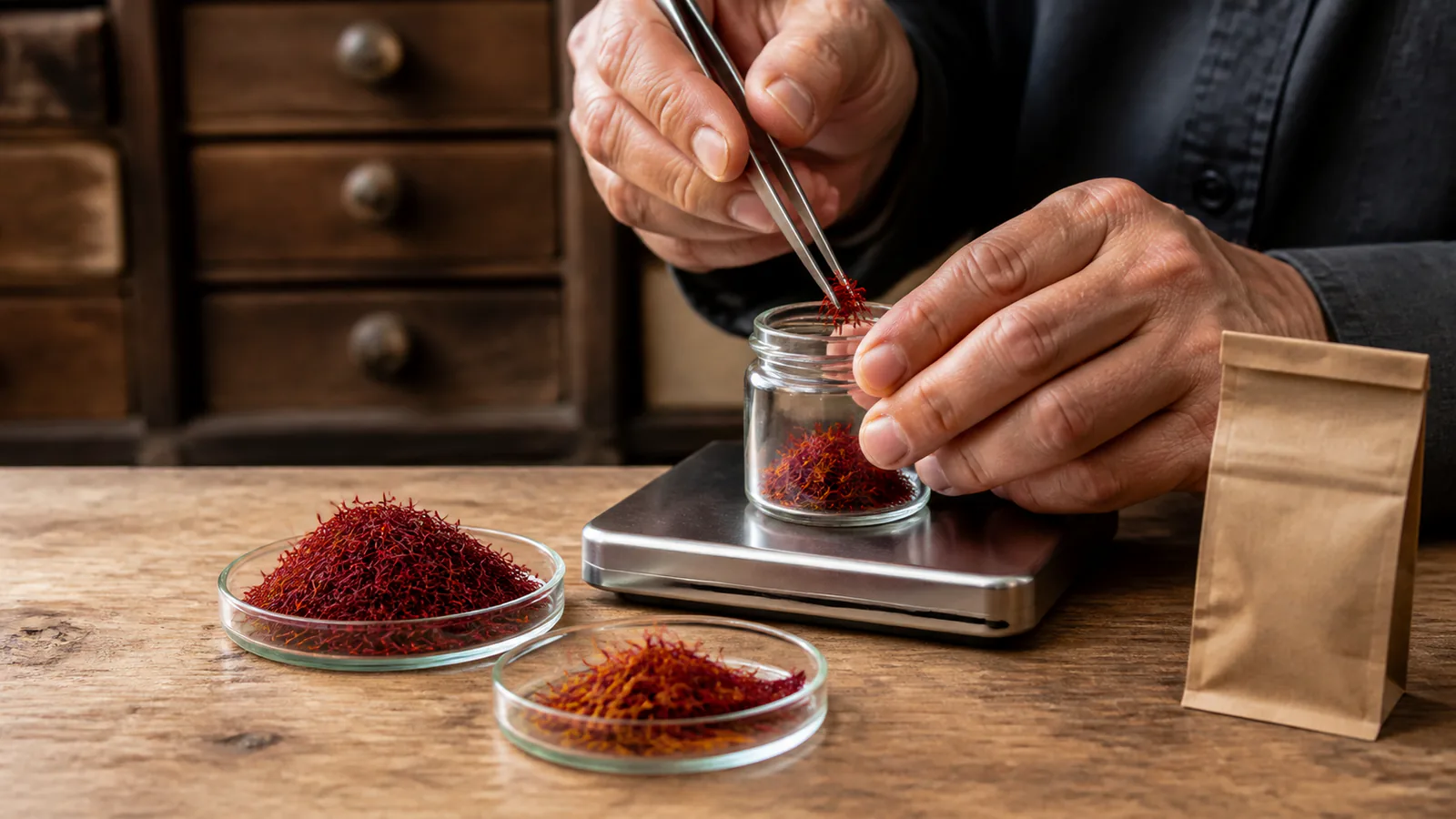
There is no single permanent original saffron price. Authentic saffron is sold by weight, form, tested quality, origin, harvest, order size, currency and destination. The most reliable current price is therefore the price attached to a specific traceable product on the day you buy it—not an old global price range copied without a date.
That does not make the market arbitrary. A seller should be able to explain what the product is, how much it weighs, why it has that grade or trade description, and what evidence supports its purity.
What is the price of original saffron today?
Start with a like-for-like retail quote. Check the same currency, net saffron weight, thread form, origin, packaging, taxes and delivery terms. Then calculate the price per gram:
price per gram = total saffron price ÷ net grams of saffron
Do not include the shipping charge in the product calculation if you are comparing local shelf prices, but do include it when comparing the actual amount you will pay. For Rowhani’s currently available pack sizes, use the live prices on the saffron products page. Those checkout prices are more useful than a static number in an article because exchange rates, freight and inventory change.
An earlier version of this guide quoted broad ranges of US$5,000–10,000 per kilogram and US$10–15 per retail gram. Such figures can describe particular markets or moments, but they are not a current universal tariff and should not be used as a promise.
Why original saffron is expensive
Each saffron flower produces only three stigmas, and the crop is picked and separated by hand within a short harvest window. The volume shrinks sharply when fresh floral material is dried. An ISO overview estimated that about 250,000 flowers are required for one kilogram of saffron, although agricultural yield varies. Read ISO’s explanation of saffron quality and labor.
Iran is the center of world production. FAO reported in 2025 that the country produces roughly 85–90% of global saffron and that cultivation supports hundreds of thousands of smallholder livelihoods, particularly in Khorasan Razavi and South Khorasan. See FAO’s saffron value-chain update.
The retail price must cover more than the flower. Careful drying, sorting, testing, food-safe packing, storage, export paperwork, payment costs and transport all sit between the field and the customer.
The factors that change saffron price
Thread form and red-stigma proportion
Long, clean, predominantly red threads are usually priced above a whole-filament bundle that retains more yellow or pale style. Powder can be convenient, but intact threads are easier for a buyer to inspect and powdered products have historically presented a greater adulteration risk. Broken threads are still saffron when genuine; appearance affects trade value even when the kitchen use is similar.
Measured quality
Color, aroma and flavor strength cannot be proved by a photograph. The current ISO 3632-1:2025 specification covers saffron in filament, cut-filament and powder forms. The companion testing system is used to assess identity and relevant quality characteristics.
The Codex saffron standard also sets composition and quality expectations, including characteristic color, odor and flavor, limits for moisture and foreign matter, and provisions for labeling and contaminants. A laboratory result does not create a single world price, but it gives buyers a stronger basis for comparing lots.
Origin, harvest and traceability
Origin can affect climate, cultivation practice, trade reputation and logistics. It is not enough to say one country is always “best.” A traceable, properly dried lot from a careful producer can outperform poorly stored material with a more prestigious label.
Harvest size matters as well. Weather, irrigation, labor availability and the area reaching productive age alter supply. Freshness and storage then affect what remains of the original aroma and color potential.
Wholesale versus retail scale
A kilogram bought under a commercial contract and a one-gram consumer jar are different products. Small packs carry more packaging, fulfillment and transaction cost per gram. A very low bulk quote should not be compared directly with a tested, sealed retail pack delivered internationally.
Currency, freight and destination costs
Iranian farmgate discussions may be in rials or tomans, export contracts in another currency, and retail offers in dollars or euros. Exchange-rate movement alone can change the apparent international price even when the local crop value is stable. Import rules, duties, taxes and delivery costs then differ by destination.
How prices can be set at the source in Iran
A source report published on this site in September 2020 described one South Khorasan procurement mechanism. Vahid Ziaeian Ahmadi, then identified as director of the province’s Rural Cooperative Organization, said experts priced submitted saffron after laboratory examination and that three laboratories were active in the province.
The same dated report said 2,858 kilograms had been purchased that year through contract arrangements, including 210 kilograms associated with Birjand. It also described saffron receiving a commodity-exchange code and warehouses being established so eligible product could be stored and sold through a more formal market.
These figures preserve the historical report; they are not current procurement totals. The useful principle is still relevant: at producer level, laboratory classification, purchase contracts, approved warehouses and organized trading can help turn a physical lot into a documented market offer. They do not impose one permanent price on every grade, province or sales channel.
How to judge whether a price is credible
- Confirm net weight. Compare saffron, not the combined weight of spice and packaging.
- Identify the form. Whole filaments, separated red stigmas, broken threads and powder should not be compared as if identical.
- Ask what “grade” means. Trade names such as Negin describe presentation, but testing provides stronger evidence.
- Check traceability. Origin, lot or packing details and a responsible seller should be visible.
- Look for condition. Threads should be dry, characteristic and free from mustiness, clumping and obvious foreign matter.
- Treat extreme bargains cautiously. Low price is not proof of fraud, but it should prompt questions about form, moisture, age, purity and actual weight.
High price is not proof of authenticity either. An attractive jar, “organic” wording or a country name cannot replace identity and quality controls.
The practical answer
The original saffron price is the current, per-gram cost of a specific authentic lot under stated sales terms. Compare equivalent weights and forms, check evidence of purity and traceability, and use live product prices for the date and destination of purchase. Historical farmgate figures help explain how the Iranian market developed, but they should never be mistaken for today’s retail quote.