


Isfahan saffron export potential begins with a credible crop, but it is realised only when the product can move from a named farm lot to a buyer with its quality and origin intact. Isfahan has become an important producer outside the three Khorasan provinces; its harder task is turning that production into repeatable, higher-value trade.
Isfahan’s place in Iranian saffron production
The 2025 report described Isfahan as Iran’s fourth-ranking saffron-producing province. Earlier figures from the provincial Agricultural Jihad organization support that position while showing why every number needs a date. In 2021, Iran Agriculture News Agency reported more than 1,600 hectares and over 9,000 kilograms of output, up by 150 hectares and 200 kilograms from the previous year.
The same official report gave an average of 5.6 kilograms per hectare and identified Tiran and Karvan, Natanz, Najafabad, Aran and Bidgol, Shahin Shahr and Meymeh, Ardestan and Kashan as leading areas. The dated Isfahan production record is useful evidence of the province’s growth, not a current-season total.
Where Isfahan saffron is grown
The earlier English page named Natanz, Tiran and “Karun.” The correct county name is Tiran and Karvan, also transliterated from Persian as Tiran and Korun. Najafabad belongs in the leading group as well. These districts occupy different elevations and local climates, so harvest timing and yield vary even within the province.
Azan village, near Meymeh, has a particularly strong local reputation. The source report described more than 250 hectares under saffron in the wider Meymeh area, including about 150 hectares in Azan. Our account of saffron picking in Azan gives the village-level context. The old article also associated Isfahan saffron work with more than 6,000 people; without a stated survey period or definition, that should be read as a reported employment estimate rather than a permanent full-time job count.
Why the crop suits parts of Isfahan
Saffron is a perennial corm crop with irrigation concentrated at particular stages rather than throughout summer. That can make it attractive in dry areas, but “low water” does not mean no water. Field selection, drainage, healthy corms, timely irrigation and labour at flowering still determine whether a planting is viable.
Isfahan’s production story is therefore local, not a promise that any dry parcel will succeed. Established districts have farming experience, labour and post-harvest knowledge that a new site may lack. Before planting, a grower needs a soil and water assessment, a realistic corm plan and a buyer route, not only a comparison with water-intensive crops.
The real barriers to Isfahan saffron export
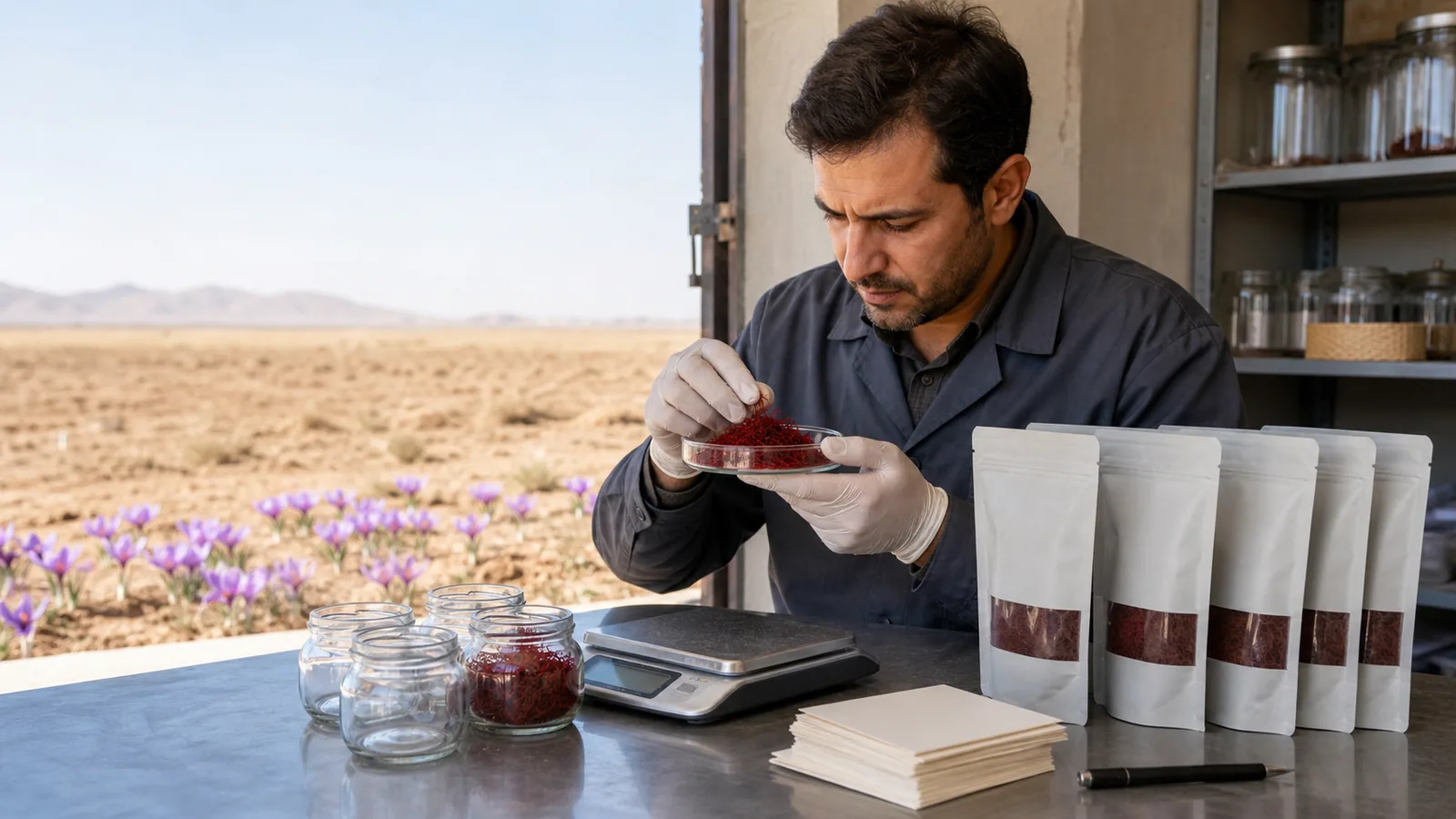
The original article focused on weak packaging and processing. Both matter, yet neither works alone. An export-ready lot needs:
- a traceable country and place of harvest;
- a consistent product form and agreed grade;
- representative laboratory results for the lot;
- clean drying, storage and handling records;
- packaging suited to the buyer, shelf life and transport conditions;
- compliant labels and documentation for the destination market;
- a price that includes testing, packing, freight, payment and customs costs.
An attractive retail box cannot rescue inconsistent threads or missing documents. Equally, excellent bulk saffron may earn little recognition if another company performs the grading, packaging and customer work.
Bulk sales, foreign brands and origin
The source report said traders in Afghanistan bought Iranian saffron in bulk, repackaged it and sold it under their own names. That claim was not accompanied by shipment or labelling records, so it should not be repeated as a blanket accusation. Afghanistan produces its own saffron and also participates in regional trade.
There is an important distinction between a distributor’s brand and a harvest origin. A company may legally sell imported saffron under its own brand while accurately declaring origin under the rules that apply. The commercial problem for an Isfahan producer is losing visibility and margin; misleading origin claims are a separate compliance problem that needs evidence.
This difference is explored in our report on Iranian saffron sold through global brands. The durable response is traceability and buyer recognition, not assuming that every foreign label conceals the same supply route.
Packaging should start with the customer
A restaurant supplier, food manufacturer and gift retailer need different pack sizes and information. Exporters should decide who will use the product before choosing the container. For wholesale trade, tamper evidence, barrier performance, lot identification and easy sampling may matter more than decoration. Retail packaging must also fit local language, food-labelling and net-content requirements.
Good packaging protects saffron from moisture, light, contamination and crushing. It should make the lot easier to identify, not hide it behind vague claims such as “the world’s finest.” The old article used that phrase without comparative test data, so it has been removed.
What national trade data can tell Isfahan exporters
Customs datasets do not normally isolate Isfahan-grown saffron after it has joined national shipments. World Bank WITS data for HS 091020 does, however, show the variety of markets reporting imports from Iran. In 2024, the European Union, Spain and China were among the largest reported destinations by value or quantity. The WITS record for Iranian saffron trade can be filtered by reporting market.
Those national figures demonstrate demand for Iranian origin, but they do not prove how much came from Isfahan. A provincial exporter needs its own shipment records and customer data before claiming a share of that market.
A practical route from field to export buyer
The first step is consistency within the lot: agreed picking practice, prompt stigma separation, controlled drying and clean storage. Next comes measurement. The exporter and buyer should agree which specification and tests apply, who samples the lot and what happens if results fall outside the contract.
Packaging and market access come after that foundation. A producer group can pool suitable lots, share testing and packaging capacity and approach buyers with repeatable volumes. Branding should name what can be proved—harvest area, product form, batch and test results—instead of leaning on unqualified superlatives.
The opportunity behind the challenge
Isfahan’s saffron sector has genuine advantages: established growing districts, a crop suited to carefully chosen dryland conditions and a body of farming experience outside Khorasan. The 250-hectare Meymeh figure, Azan’s local identity and the province’s fourth-place ranking show a meaningful production base.
Export growth will come from keeping more of the value attached to that base. Reliable processing, evidence-led quality, destination-ready labels and direct buyer relationships matter more than decorative packaging alone. That is how Isfahan saffron can arrive in another market as a product with a known history, rather than an anonymous red thread.

![Exporting Saffron to Turkey + Price Guide [Complete 0 to 100]](https://img.rowhanisaffron.com/20260827003933/saffron-export-turkey-quality-inspection.webp)



