


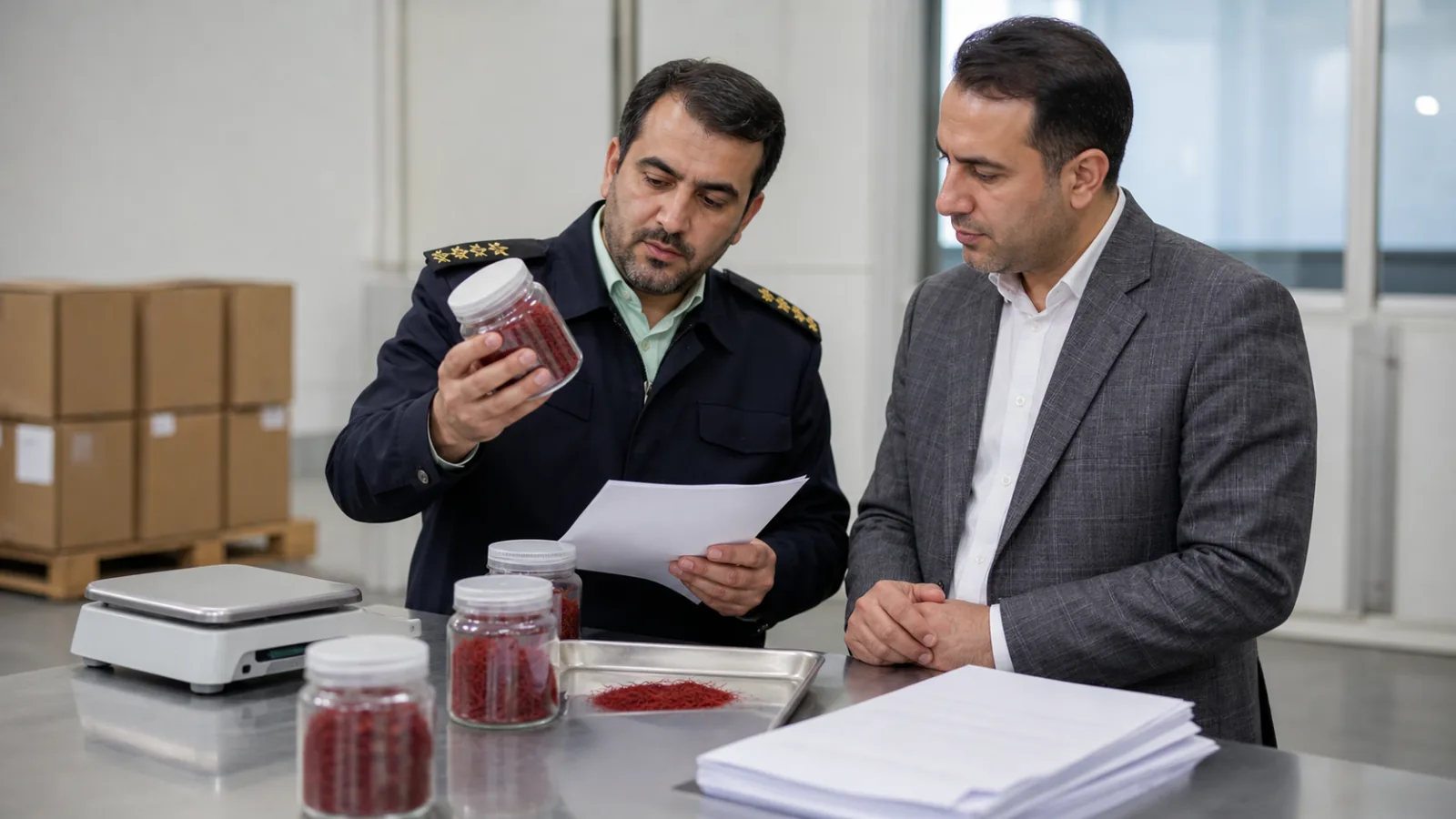
The title “Saffron, the most prominent producer of Khorasan Razavi” preserves an awkward translation. The historical report actually says that Khorasan saffron was the leading export commodity recorded by Khorasan Razavi Customs during the first half of the reporting year. A crop is not a producer; the province’s growers, processors and exporters produced and traded it.
Masoud Atefi, identified as the Khorasan Razavi customs supervisor, reported 47 tonnes of saffron exported in packages over 30 grams, valued at US$67,303,066. Both the period and the figures are historical. They are useful for understanding the province’s trade basket, not for quoting a current export volume or saffron price.
What the customs report recorded
Atefi said the 47-tonne saffron total represented a 113 percent increase in weight and a 122 percent increase in value compared with the same part of the previous year. Those rates imply that the earlier period was much smaller, but the source does not provide its raw saffron weight and value for independent checking.
The “packages over 30 grams” description is a customs reporting band. It does not prove that every shipment was loose bulk saffron, nor does it establish grade or quality. A 31-gram pack and a multi-kilogram commercial lot can fall on the same side of that threshold while serving very different buyers.
Dividing US$67,303,066 by 47,000 kilograms gives an average declared value of about US$1,432 per kilogram. That calculation is not a retail price. Customs value can reflect a mix of grades, forms, contracts, destinations and valuation terms, and it does not reveal how much a farmer received.
Saffron’s place in the provincial export basket
The report gave total Khorasan Razavi merchandise exports of about 1.034 million tonnes worth US$761 million for the same half-year. Export weight was said to be one percent higher and value seven percent higher than in the corresponding prior period.
On those figures, saffron represented roughly 8.8 percent of the province’s declared export value while accounting for only a tiny share of physical weight. That contrast explains why saffron could lead the list by value without being a major part of provincial tonnage.
It is also why a headline about Khorasan saffron should not be confused with the entire customs account. The US$761 million figure covered all reported merchandise, not saffron alone.
Imports and the US$595 million trade balance
Khorasan Razavi imports were reported at 187,000 tonnes worth US$166 million. The source said import weight had fallen by 13 percent and value by six percent compared with the same period a year earlier.
Subtracting US$166 million in imports from US$761 million in exports gives the positive US$595 million trade balance stated in the article. That arithmetic is internally consistent. It is a customs balance for the province’s reported merchandise trade, not a measure of saffron-industry profit or household income.
The old English translation also mentions US$26.573 million in “luggage exports” through border markets, but the names of the facilities are badly damaged as “Coal Movers and taxpayers.” Without the original Persian line or a recoverable customs table, those place names cannot be repaired safely. The amount remains an attributed historical figure rather than a basis for a new route claim.
The four leading products in the old list
Saffron in packages over 30 grams ranked first, at US$67,303,066. The next item is translated as “unlicensed flooring,” valued at US$42,494,781; the product wording is not reliable enough to modernise. Tomato paste followed at US$19,697,757, then fresh poultry eggs at US$17,313,914.
Preserving the amounts while labelling the damaged product name is safer than silently substituting a commodity. The list shows that saffron led the reported values, but it does not tell us the number of exporters, margins, grades, rejected shipments or final retail markets.
Where Khorasan Razavi goods were going
Afghanistan, Turkmenistan, the United Arab Emirates, Iraq and Tajikistan were named as major destinations for Khorasan Razavi exports in the first half-year. The wording refers to the province’s overall export basket. It does not prove that each of those countries received the same amount of saffron, or even that saffron was shipped to every one of them during the period.
That distinction is easy to lose when a saffron headline sits above a general customs paragraph. Product-level destination claims need a table that pairs the commodity, customs code, weight, value, destination and time window.
How to read an old saffron export figure
A reliable comparison begins by keeping five items aligned:
- the exact six-month or annual reporting period;
- the customs code and whether threads, cut threads or powder are included;
- the package-size band used by the source;
- net shipment weight and declared customs value;
- the destination or exit customs office being measured.
Changing one of those definitions can create an apparent rise or fall that is not like-for-like. Currency movement can also increase dollar or rial values without the same change in physical volume, while a shift toward a different grade can move average value per kilogram.
For broader context, our saffron production statistics article separates production, export and country-level measures. Exporters should also check the current official requirements relevant to their shipment rather than relying on a 2018 news item; our guide to the terms for Iranian saffron exporters explains what must be verified at the time of trade.
Package size is not a quality certificate
International saffron trade depends on product identity, hygiene, quality, labelling and traceability. Codex work on a saffron standard distinguishes forms such as filaments, cut filaments and powder and treats consumer protection and fair trade as central reasons for standardisation.
A customs line for packages over 30 grams answers a statistical classification question. It does not replace sampling, testing or lot documentation. A responsible exporter still needs to connect the packed product to its origin, processing record, laboratory results where required and destination-market documents.
What the historical report proves—and what it does not
The data supports a clear conclusion for its period: saffron led the listed Khorasan Razavi export commodities by declared value, and the provincial merchandise trade balance was positive. The visible arithmetic for total exports, imports and the US$595 million balance fits together.
It does not establish a current export total, a modern buyer list or a universal saffron price. It also cannot repair the damaged border-market names or the second product label without better source data.
That careful reading preserves why the page remains useful for people searching for Khorasan saffron. The original numbers and entities stay intact, while the article makes clear which values were reported, which were derived and which details remain unresolved.

![Exporting Saffron to Turkey + Price Guide [Complete 0 to 100]](https://img.rowhanisaffron.com/20260827003933/saffron-export-turkey-quality-inspection.webp)



