


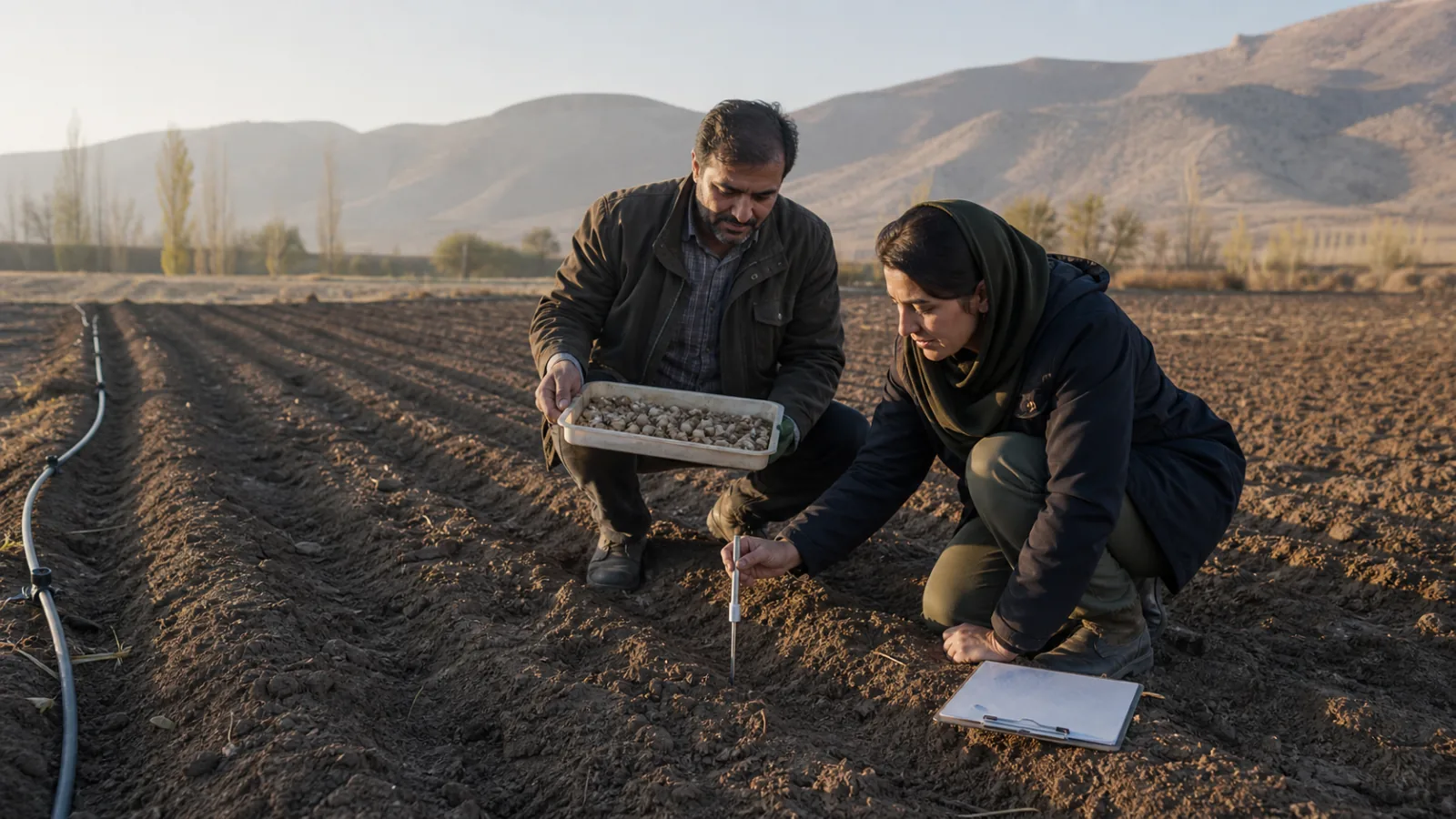
Planting saffron in Isfahan Province was already established beyond a handful of trial plots when this historical report was published. Mehdi Haddad, then horticulture director at the provincial Agricultural Jihad Organization, put the planted area at 709 hectares and named Natanz, Tiran and Karvan, and Shahin Shahr and Meymeh among the recognised production areas.
Those figures describe the reporting period, not the province’s current acreage. Their lasting value is in the pattern they reveal: Isfahan is not one uniform saffron zone. Temperature, elevation, soil, water and market access vary enough that planting dates and field decisions must be made locally.
What the original Isfahan report said
Haddad linked saffron expansion to changes in the province’s crop pattern. He said production was used mainly inside Iran and had not yet reached a provincial export programme, although private companies were selling Isfahan saffron in other provinces.
The report also said growers had not received a dedicated planting facility or finance package. Instead, coordination with Khorasan provinces helped them obtain saffron corms and some cultivation equipment. That is a historical account of support at the time; it does not establish which grants, loans or supply arrangements are available now.
Its strongest quality language needs caution. Haddad was quoted as saying Isfahan saffron had better colour and flavour than Mashhad saffron because Isfahan growing areas were cooler, and that buyers in Mashhad paid more for it. The page preserves that attributed claim, but temperature alone does not prove superior quality. No sample set, laboratory method, grade, harvest year or price record was supplied.
Why location inside Isfahan changes the plan
Research indexed by FAO’s AGRIS database examined saffron’s temperature thresholds across Isfahan Province. It found that the likely timing of flowering and pre-flowering irrigation shifts with geography and elevation. The study estimated roughly a month’s delay in an important temperature threshold from west to east, with suitable flowering windows stretching from the first half of October into late November across different areas.
That evidence supports a practical rule: do not copy one calendar date across Natanz, Meymeh, Tiran and every other district. Use local weather records, field temperature and the previous seasons’ emergence dates. A farmer should know when the plot normally leaves summer dormancy and how quickly the soil responds to irrigation.
Our article on mechanised saffron planting in Isfahan’s cities discusses equipment and row preparation. Machinery can improve consistency, but it cannot correct a poorly chosen field or an unsuitable date.
Check soil and water before buying corms
Saffron needs drainage. Light-to-medium soil with useful organic matter is generally easier to manage than a waterlogged or compacted field, but texture alone is not enough. Inspect for restrictive layers, test how the plot drains after irrigation and obtain a soil analysis before deciding on amendments.
Water quality deserves the same attention. Research on saffron under saline irrigation found declining yield as salinity increased and described the crop as salt-sensitive under the tested conditions. That makes a water test essential in arid and semi-arid parts of the province. A crop can use water at selected stages and still perform poorly if the available water carries too much salt.
These checks should happen before a large corm order. Otherwise, the most expensive input is placed into a field whose main constraint has not been solved.
Select and document planting corms
Saffron is propagated with corms, not seed. Planting material should be firm, correctly identified and free from obvious rot, serious wounds or suspicious decay. Record the supplier, source region, delivery date, size class and any inspection or treatment applied.
The old Isfahan report’s coordination with Khorasan was about access to planting material and equipment. It should not be read as proof that every Khorasan corm is healthy or that origin alone guarantees yield. Traceability and condition matter more than a geographic label.
Keep different consignments in labelled trial sections where practical. If emergence or disease differs, the grower can identify which lot was affected instead of treating the whole field as one unknown batch.
Build the field around a multi-year crop
A saffron field is not planted for a single harvest. Mother corms produce replacement corms, and their position and density change over time. Row spacing, depth, soil preparation and access routes therefore affect several years of weeding, irrigation, harvest and eventual lifting.
Planting depth should protect corms while allowing reliable emergence, but it should be validated for the local soil and equipment. “Deeper” is not automatically better: excessive depth can delay or reduce emergence, while shallow planting may expose corms to temperature stress and crowding near the surface. A small measured comparison is safer than applying one translated number to an entire farm.
Before planting, map the field and decide how workers will enter during the short flowering period. Compacted paths, turning space and access to clean containers are part of the design, not details to add after flowers appear.
Manage irrigation by crop stage
Saffron is often chosen where water is constrained, but it is not a no-water crop. Pre-flowering irrigation, autumn growth, winter rainfall and spring daughter-corm development all need to be considered together. The Isfahan phenology study specifically linked irrigation timing to regional temperature patterns.
A responsible schedule starts with soil moisture and local weather rather than a fixed provincial date. After irrigation, check whether water reaches the intended root zone and whether low areas stay wet too long. Record the date, amount and response. Those notes become more valuable than memory when flowering shifts from one season to the next.
Measure quality instead of comparing provinces
Colour, aroma and flavour are affected by the crop, harvest timing, stigma separation, drying, storage and sample condition. A claim that one province is categorically better than another cannot be supported by cooler weather or buyer anecdotes alone.
For Isfahan growers, the useful path is lot-level evidence. Keep harvests separate by field and date, dry them with a repeatable process, protect the threads from moisture and light, and test representative samples through an appropriate laboratory when making grade or authenticity claims. The result can then be tied to a real lot rather than a regional slogan.
The distinction between growing a good crop and building a recognised market is explored in our article on branding saffron from Isfahan. A province does not gain an export reputation simply because more hectares are planted.
A preservation-first planting checklist
- Confirm the field is in a locally suitable thermal zone and review several years of weather.
- Test soil texture, drainage, fertility and salinity; test irrigation water as well.
- Buy traceable, healthy corms and keep source lots identifiable.
- Trial depth, density and irrigation timing before scaling an unfamiliar system.
- Map rows, worker access and harvest logistics before planting.
- Record emergence, flowering, dried yield, corm health, labour and costs by plot.
- Support quality and price claims with defined grades, lot records and testing.
The 709-hectare historical figure shows that saffron had found a place in Isfahan agriculture. The safer lesson is not to plant wherever the provincial name applies. Planting saffron in Isfahan Province works best when each field is treated as its own climatic, soil and business decision, and when expansion follows evidence from that field.

![Exporting Saffron to Turkey + Price Guide [Complete 0 to 100]](https://img.rowhanisaffron.com/20260827003933/saffron-export-turkey-quality-inspection.webp)



