


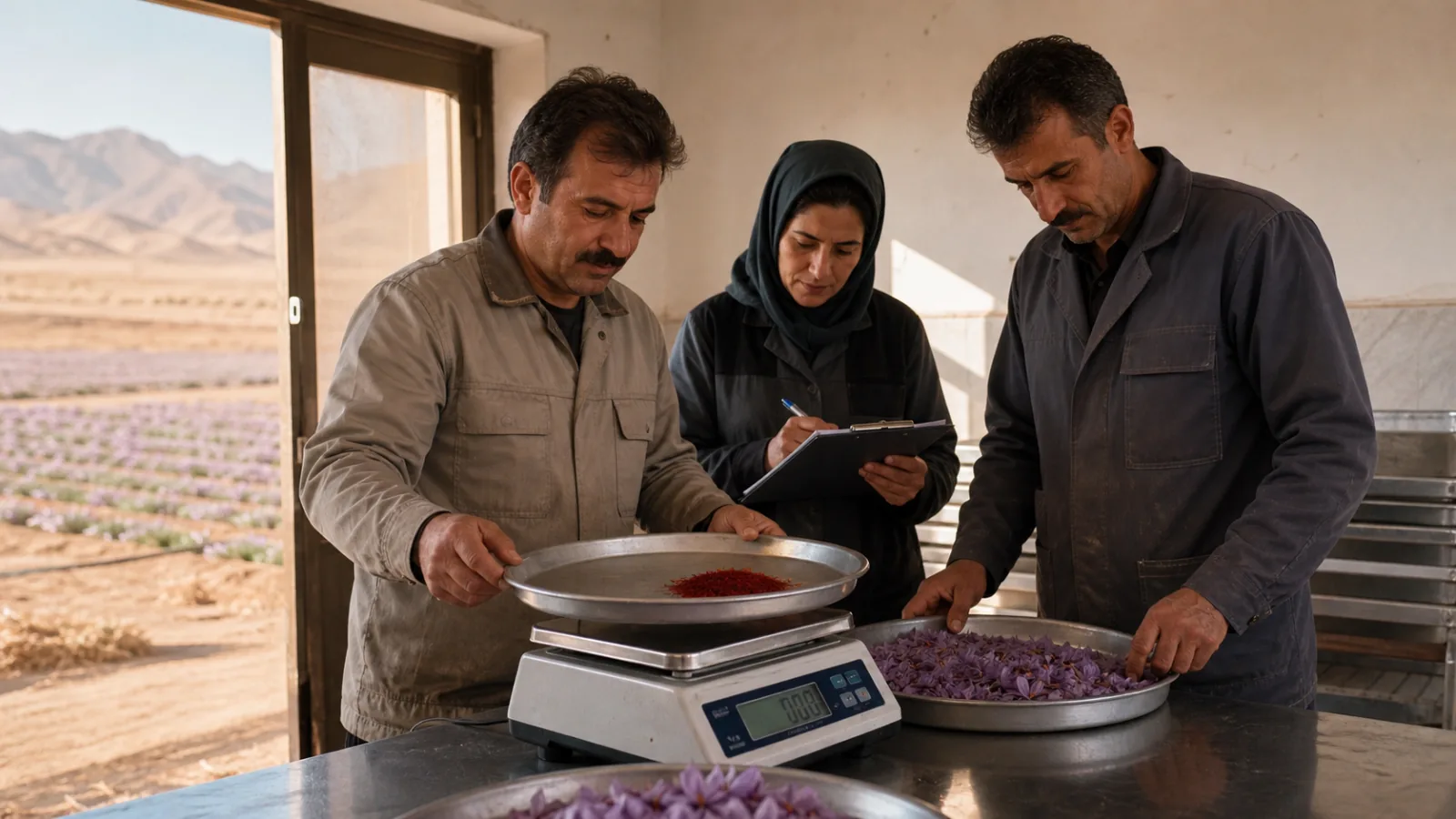
How many saffron of South Khorasan this year are picked up? In the historical forecast preserved on this page, the answer was 56 tonnes of dried saffron from an estimated 15,114 hectares. The figure was attributed to Hashem Valipour Motlagh, then head of the South Khorasan Agricultural Jihad Organization.
“This year” refers to the reporting period, not the current season. The English source contains a damaged crop-year reference, and the post was published in 2018. These numbers are therefore an archival provincial forecast. They should not be used as a present production total, price guide or promise of yield.
The South Khorasan forecast at a glance
Valipour Motlagh said the crop survey was not yet complete, but officials expected close to 15,114 hectares of saffron and a harvest of 56 tonnes. Qaen County accounted for the largest stated area, at 4,449 hectares. That is just under 30 percent of the provincial area in the forecast.
The report put the number of saffron operators at about 36,500. Harvesting was said to begin in late October and continue into early December. Saffron from the province was distributed around Iran, with Khorasan Razavi, Tehran and Sistan and Baluchestan specifically named.
The original English text says “Tehran, Iran and Baloochestan,” which appears to insert the country name where a conjunction belongs. It also splits 15,114 into “15 tons and 114 hectares” in its opening sentence. The consistent reading elsewhere in the same report is 15,114 hectares, not 15 tonnes of land.
What 56 tonnes means per hectare
A simple division of 56,000 kilograms by 15,114 hectares gives about 3.7 kilograms of dried saffron per hectare. That is a derived provincial average, not a reported yield from every farm. Some fields would have been newly planted or immature, while others would differ in corm density, stand age, water, soil, weather and harvest management.
The distinction is important because a regional total can hide large differences between fields. A farmer cannot use the provincial average alone to estimate a new plot. The useful comparison is the farm’s own flower count, dried-stigma weight and costs over several seasons.
The report also gave a previous harvest of 54.6 tonnes from a land figure damaged in translation as “15,14 hectares.” There is not enough evidence to reconstruct that area confidently. The output number can be preserved as reported, but calculating a precise year-on-year yield change from the damaged denominator would create false accuracy.
Qaen’s role in the provincial total
Qaen’s 4,449 hectares made it the largest named saffron area in the announcement. That fits the broader historical importance of Qaenat within South Khorasan’s saffron economy. Still, the 56-tonne figure applied to the province as a whole, not to Qaen alone.
For a wider account of acreage, output and the province’s place in Iran’s crop, see saffron production in South Khorasan Province. Keeping the scopes separate prevents a provincial forecast from being mistaken for a county result.
How the harvest period affects the result
A harvest running from late October to early December does not mean every field flowers for that entire period. Elevation, local temperature, irrigation timing and the field’s condition influence when flowers emerge. A short peak can put pressure on picking crews, separation rooms and drying capacity.
Provincial production is counted as dried saffron, so post-harvest handling matters. Flowers need to reach a clean separation area promptly. Stigmas should be separated consistently, dried under controlled conditions and protected from moisture, light and contamination. Poor handling can reduce the amount or quality of saleable product even when the field produces many flowers.
Our guide to saffron processing in South Khorasan follows that part of the value chain. The 56-tonne forecast is best understood as the end of a sequence that begins with field records and finishes with stable, traceable dried lots.
What farmers should record
A related Tasnim report from South Khorasan stressed the value of a field record for each plot. The practical information includes water and soil analysis, planting date, corm source and characteristics, planting depth, irrigation, fertiliser, pests and disease, unusual heat or frost, flowering dates and observed losses.
For harvest and business decisions, the same record should continue through:
- daily flower weight and the part of the field picked;
- crew hours for picking and stigma separation;
- drying batch, method, time and temperature;
- dried-stigma weight by traceable lot;
- quality grade, rejected material and storage conditions;
- buyer, pack size, sale date and actual price received.
These records make a provincial statistic useful at farm level. They show whether a low result came from flowering, labour, drying or marketing rather than treating every loss as one problem.
Understanding the 2,630-billion-rial income forecast
The official forecast expected saffron operators in South Khorasan to receive 2,630 billion rials. This was a projected aggregate income figure for that period. The report does not state the pricing method, grades, sale channels or whether the number meant gross farm receipts rather than profit.
If divided mechanically by the forecast 56 tonnes, it implies about 47 million rials per kilogram. If divided by 36,500 operators, it gives about 72 million rials per operator. Neither calculation describes what an individual grower actually earned. Farms differed in area and output, prices varied by grade and timing, and costs still had to be paid.
For that reason, the income total should not be converted into a present-day business promise. A useful farm budget separates gross sales from corm, water, soil preparation, labour, drying, packaging, storage and finance costs.
Why the old numbers still matter
The forecast captures the scale and organisation of a major saffron region: tens of thousands of operators, a long harvest across varied sites, Qaen as the largest named area, and product moving to several domestic markets. It also demonstrates the limits of a headline total. The survey was provisional, parts of the translation are damaged, and an average cannot stand in for a farm record.
So the concise historical answer remains 56 tonnes expected from 15,114 hectares. The responsible answer adds the date, the attribution and the uncertainty. That protects the value of the South Khorasan record without presenting an old forecast as this year’s harvest.

![Exporting Saffron to Turkey + Price Guide [Complete 0 to 100]](https://img.rowhanisaffron.com/20260827003933/saffron-export-turkey-quality-inspection.webp)



