


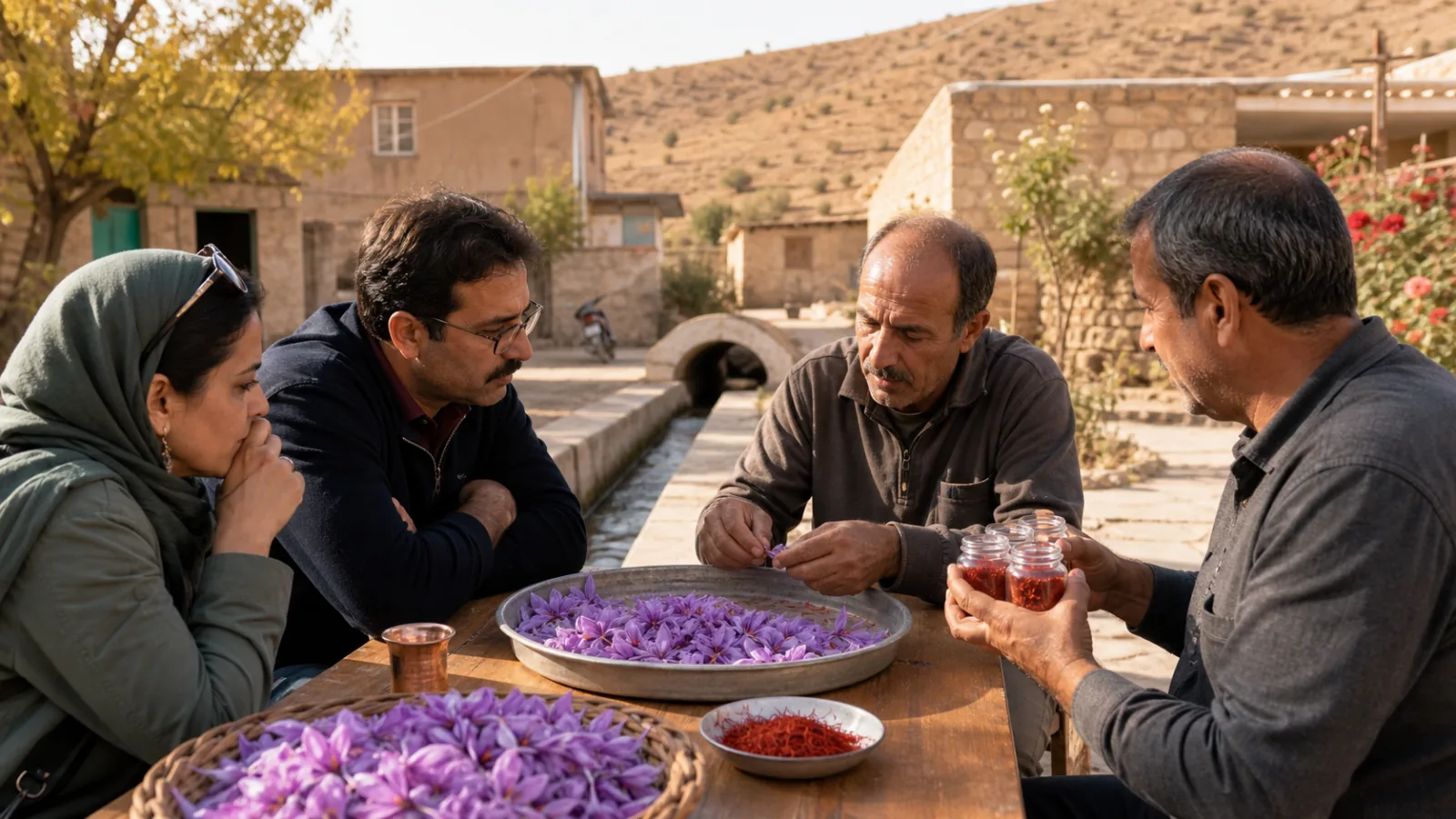
The historical story behind “Saffron festival and cheap tourism” is the first announced saffron-and-tourism festival in Azan, a village in the Meymeh area of Isfahan Province. Organisers scheduled it for 19 December and presented it as a meeting point for farmers, residents and visitors. Their plan combined crop education, local heritage and an affordable rural visit rather than a luxury tourism package.
This page is a record and interpretation of that announcement, not a current event listing. Anyone planning a visit should confirm present-day dates, access and opening arrangements locally. The old report does not establish that the festival still runs on the same date or in the same form.
What the Azan saffron festival was meant to do
Mohammad Reza Ebrahimi, identified in the report as head of Azan’s Islamic village council and chairman of the first festival, described several connected aims. The event would encourage consideration of saffron where water-intensive crops were difficult to sustain, help farmers improve production and quality, and bring attention to the practical problems facing rural producers.
It was also intended to create an enjoyable village gathering. Organisers wanted to recognise leading saffron growers, share scientific and local knowledge, introduce harvesting and processing methods, discuss hygienic packaging and present Azan’s history and culture to visitors.
The phrase “cheap tourism” in the title is awkward English. In context, it refers to accessible, lower-cost rural tourism built around the village’s existing farms, landscape and cultural places. It does not mean that the community, its produce or its heritage has little value.
Azan’s farming story in the original report
Ebrahimi said saffron had been cultivated in the village for 48 years by the time of the announcement. He divided Azan’s farmland broadly among saffron, Mohammadi roses and other crops, including barley, wheat, almonds and barberry. The combination matters because the proposed festival was about a working agricultural community, not a decorative field created solely for visitors.
The report recorded more than 80 hectares of saffron in an Agricultural Jihad land-insurance programme and estimated annual output above 250 kilograms. It also said individual plots were small and scattered. Those figures describe the period of the announcement; they are not current statistics. Dividing 250 kilograms by 80 hectares gives a rough reported average above three kilograms per hectare, but the source does not provide field-level records or explain whether the area and output cover exactly the same farms.
A proposed local company would help coordinate land and mechanised planting of saffron corms and Mohammadi roses. The old translation calls them “corn saffron” and gives an unclear account of the land arrangement. The defensible meaning is that organisers saw fragmented plots as a barrier and wanted more coordinated field work. It does not support a claim that consolidation or mechanisation was completed.
Water, qanats and claims about quality
Azan’s organisers linked saffron with more careful use of land and water. They also credited fertile soil and water from local qanats for the crop’s quality. Qanats are not merely scenery: they are long-established systems for moving groundwater through dry landscapes, and their maintenance is part of the agricultural story visitors need to understand.
FAO’s account of Iran’s qanat-irrigated agricultural heritage describes saffron, pomegranate and other crops as parts of living systems that connect water knowledge, family farming and rural livelihoods. Its separate description of the Gonabad saffron system also notes how fields, local architecture and harvest-season landscapes can support tourism. Azan is a different place, but the principle is relevant: agriculture and tourism work best together when the water system and the farming community are treated as the subject, not as a backdrop.
The village report compared Azan saffron favourably with saffron from Qaenat and mentioned an analysis showing “purity above 86%,” together with superior colour and aroma. No laboratory, method, certificate or grading standard was supplied, and purity is not established by one unexplained percentage. These should remain attributed promotional claims, not verified quality findings. Modern authenticity and quality claims require traceable sampling and recognised tests.
What visitors were invited to discover
The festival plan reached beyond saffron. It proposed introducing Azan as one of Isfahan Province’s old villages, drawing attention to Mount Kahro and presenting the shrine of Imamzadeh Seyyedeh Saleh Khatoon, described in the report as the sister of Imam Reza. These places carry religious, natural and community meaning that should be explained respectfully rather than used as props for a sales event.
A good rural visit can be simple: walk with permission along an appropriate farm route, listen to a grower explain the crop calendar, see how flowers are separated or threads are packaged, buy from an identified producer and spend time at local cultural sites. It does not require intrusive access to working fields or a crowded stage programme.
Visitors looking for the broader provincial context can also read about the Saffron Festival in Isfahan. Azan’s story is more specific: one village used saffron, roses, qanats and local landmarks to frame its own festival idea.
How a saffron festival can help farmers
A festival creates value only if farmers can participate on fair terms. Product stalls should name the producer, grade and net weight clearly. Demonstrations should distinguish traditional practice from tested quality controls. If samples are sold, clean handling, sealed packaging and lot identification matter more than decorative claims.
The original programme also called for better collection, processing, packaging, branding and scientific knowledge. Those are sensible priorities, but a festival cannot solve them in one day. Organisers can make progress by giving growers useful workshop time, inviting qualified processing and testing specialists, and recording questions that need follow-up after the visitors leave.
A practical event checklist
- Publish the confirmed date, route, parking and accessibility information before inviting visitors.
- Keep tourists out of active picking lanes unless a farmer has prepared a supervised area.
- Pay farmers or demonstrators fairly for time, samples and educational work.
- Label products with producer, origin, grade, weight and contact details.
- Use food-safe separation, drying and tasting areas.
- Explain the qanat and water limits without claiming that saffron needs no irrigation.
- Measure farmer sales, visitor feedback and local costs after the event.
That last step prevents visitor numbers from becoming the only measure of success. A crowded festival can still fail if growers bear the cost, traffic damages fields or buyers leave without understanding the product.
Keeping the page honest for searchers
Search data shows that this page has appeared for “saffron festival” and, unexpectedly, for “Rafsanjan saffron production.” The source article is not about Rafsanjan. It concerns Azan in the Meymeh area of Isfahan Province, so changing the story to chase that mismatched query would make the page less accurate and less useful.
The page has also earned privacy-hidden impressions and a click, including recent visibility near the top of results. For that reason its established title, URL and core Azan language remain unchanged. The improvement is clarity: dates are historical, production figures are attributed, promotional quality claims are bounded and a prospective visitor is not led to believe that an old festival date is a current booking.
A festival that belongs to the village
Ebrahimi’s announcement had a coherent idea beneath its damaged translation. Saffron could give farmers a reason to exchange knowledge, residents a reason to celebrate their village, and visitors a reason to understand the landscape rather than pass through it.
That is the durable meaning of the saffron festival and cheap tourism proposal. Its strongest version is modest, well organised and locally led: accurate information, respectful access, traceable products and benefits that remain with the people maintaining the farms, roses, qanats and cultural places that visitors came to see.

![Exporting Saffron to Turkey + Price Guide [Complete 0 to 100]](https://img.rowhanisaffron.com/20260827003933/saffron-export-turkey-quality-inspection.webp)



