


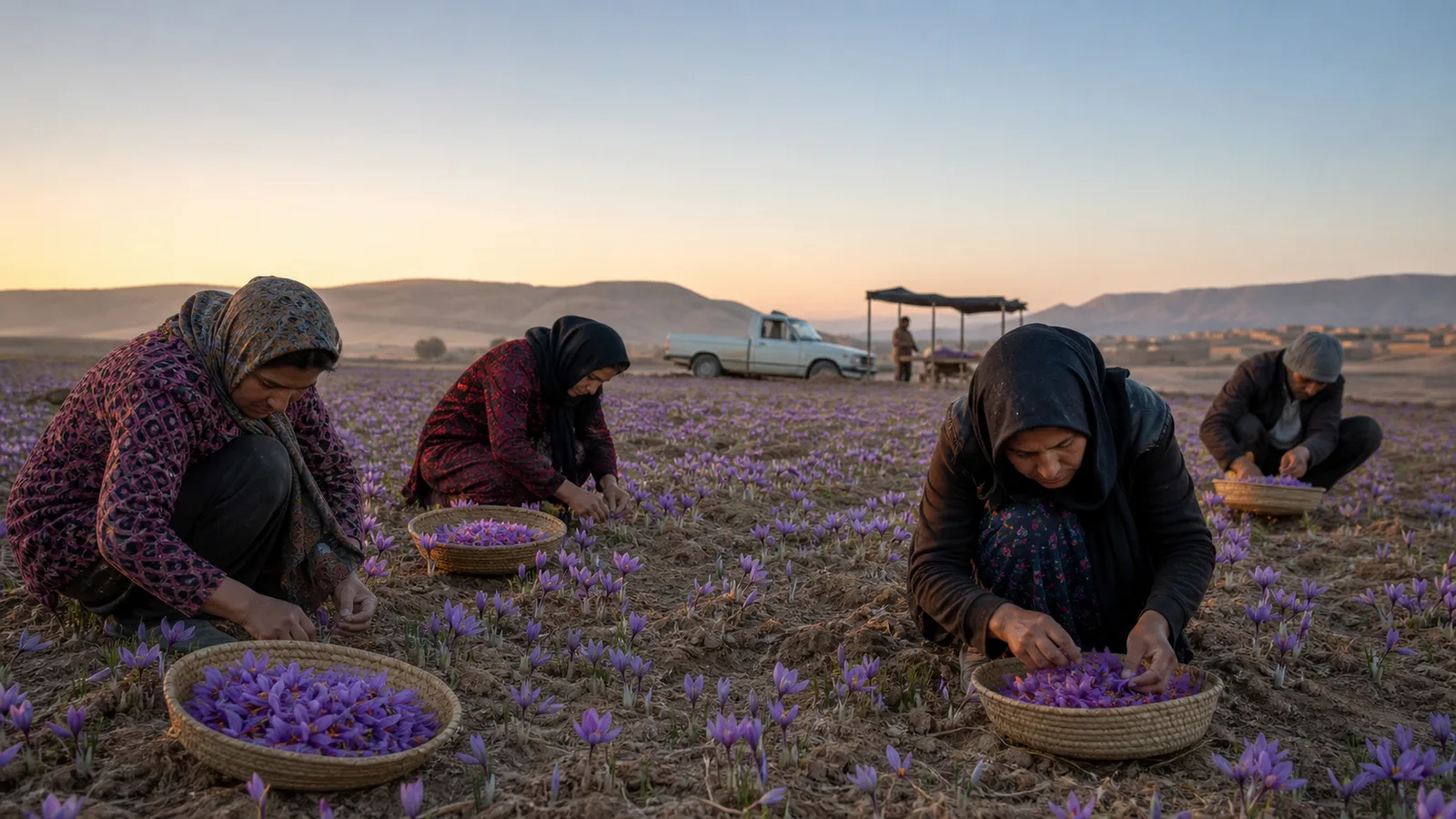
Torbat-e Heydarieh is widely described as the saffron capital of Iran because cultivation, seasonal labour and trade all meet there at unusual scale. The city lies about 145 kilometres south of Mashhad in Razavi Khorasan, within Iran’s best-known saffron-producing region. During harvest, flowers arrive from nearby fields and the local market becomes a meeting point for growers, buyers and processors.
The title is descriptive, not an exclusive legal designation. Other Iranian districts have deep saffron traditions, and newer producing areas have developed their own local centres. Vamnan village in Golestan is one of them. Looking at both places shows why “capital” can refer to national scale in one case and a smaller regional hub in another.
Why Torbat-e Heydarieh is associated with saffron
Saffron shapes the area’s agricultural calendar. Flowering lasts only a short time, and open flowers lose quality if they sit in the field. Families and seasonal workers therefore begin early, move quickly through the rows and send the crop for stigma separation and drying soon after picking.
The older report behind this article described a roughly 45-day period in which Torbat-e Heydarieh’s market becomes a saffron sales centre for surrounding parts of Razavi Khorasan. Another period report placed the broader harvest from early November through the end of December. These descriptions are compatible as a general season and a more concentrated market peak; actual dates shift with location, temperature and rainfall.
A crop that creates concentrated seasonal work
Saffron is labour-intensive even though the dried product is light. Fields must be checked repeatedly, flowers collected by hand, stigmas separated and the crop dried and packed. An old local account cited 220 person-days of work per cultivated hectare and 70,000 direct jobs, with further indirect work. The source did not define whether “jobs” meant unique workers, seasonal positions or accumulated workdays, so those numbers should be read as an indication of labour intensity rather than a current employment count.
Why the area figures do not match
One source described 8,000 hectares of saffron, while another claimed 30,000 hectares and more than 50 tonnes of dried output. They cannot safely be presented as measurements of the same place and year. “Torbat-e Heydarieh” can mean the city, county or a wider production and trading zone; planted area also changes over time.
Independent mapping illustrates the problem. A university study indexed by FAO AGRIS used Landsat 8 imagery and estimated about 19,503 hectares of saffron in its defined Torbat-e Heydarieh study area. That is neither 8,000 nor 30,000 hectares, because the method, boundary and date differ. A useful current statistic must name all three.
The source also gave an Iranian national output of 1,500–1,700 tonnes. That figure appears corrupted and conflicts with the scale of the same report, so it is not repeated as fact. The sound conclusion is narrower: Iran is a major saffron producer, Razavi Khorasan is a central production province, and Torbat-e Heydarieh is one of its most important growing and trading centres.
From field to the Torbat market
The harvest has several time-sensitive stages:
- Flowers are picked early, often before strong sun opens them fully.
- They are moved in shallow, clean containers to avoid crushing and heat.
- Red stigmas are separated from petals and yellow style material.
- The saffron is dried under controlled conditions, then protected from moisture, light and foreign odours.
- Lots are weighed, assessed and sold to processors, packers or traders.
Speed alone does not determine quality. Clean handling, careful separation, controlled drying and lot traceability matter as much as the place name. A buyer should still ask for product-specific evidence rather than assuming that every batch from a famous district is identical.
Vamnan: Golestan’s “red gold” centre
Farther north, Vamnan—also transliterated as Wamnan—is a village in Azadshahr County in the Alborz mountain area of Golestan Province. The source report said villagers had cultivated saffron there for several years and that the crop had become important enough for Vamnan to be called Golestan’s “red gold pole,” meaning a regional production centre.
The account focuses on the harvest rhythm. Villagers enter the fields before sunrise and may continue sorting flowers late into the day so the delicate crop is handled before it wilts. It also says saffron changed household economics. That is best understood as an attributed local observation: the source provides no household-income survey, production series or audited quality comparison.
Quality needs evidence, not a slogan
The source called Vamnan saffron among the country’s highest quality. Origin and mountain conditions may shape a crop, but a broad reputation is not a laboratory result. Quality depends on the harvested part, drying, moisture, cleanliness, storage and the individual lot. The village’s stronger story is therefore not an unprovable national ranking; it is how a new crop created intensive seasonal work and a local identity around careful harvesting.
Two different scales of Iranian saffron
Torbat-e Heydarieh represents an established production and trading ecosystem: large growing areas, a concentrated seasonal market and layers of processing and commerce. Vamnan represents a smaller mountain community using the same crop to build household income and a place in Golestan’s agricultural economy.
Both depend on the same discipline once flowering begins. Pick promptly, protect the flowers, separate cleanly, dry consistently and keep each lot traceable. Those practices—not a disputed hectare count or an honorary title—are what carry regional reputation into the finished saffron.

![Exporting Saffron to Turkey + Price Guide [Complete 0 to 100]](https://img.rowhanisaffron.com/20260827003933/saffron-export-turkey-quality-inspection.webp)



