


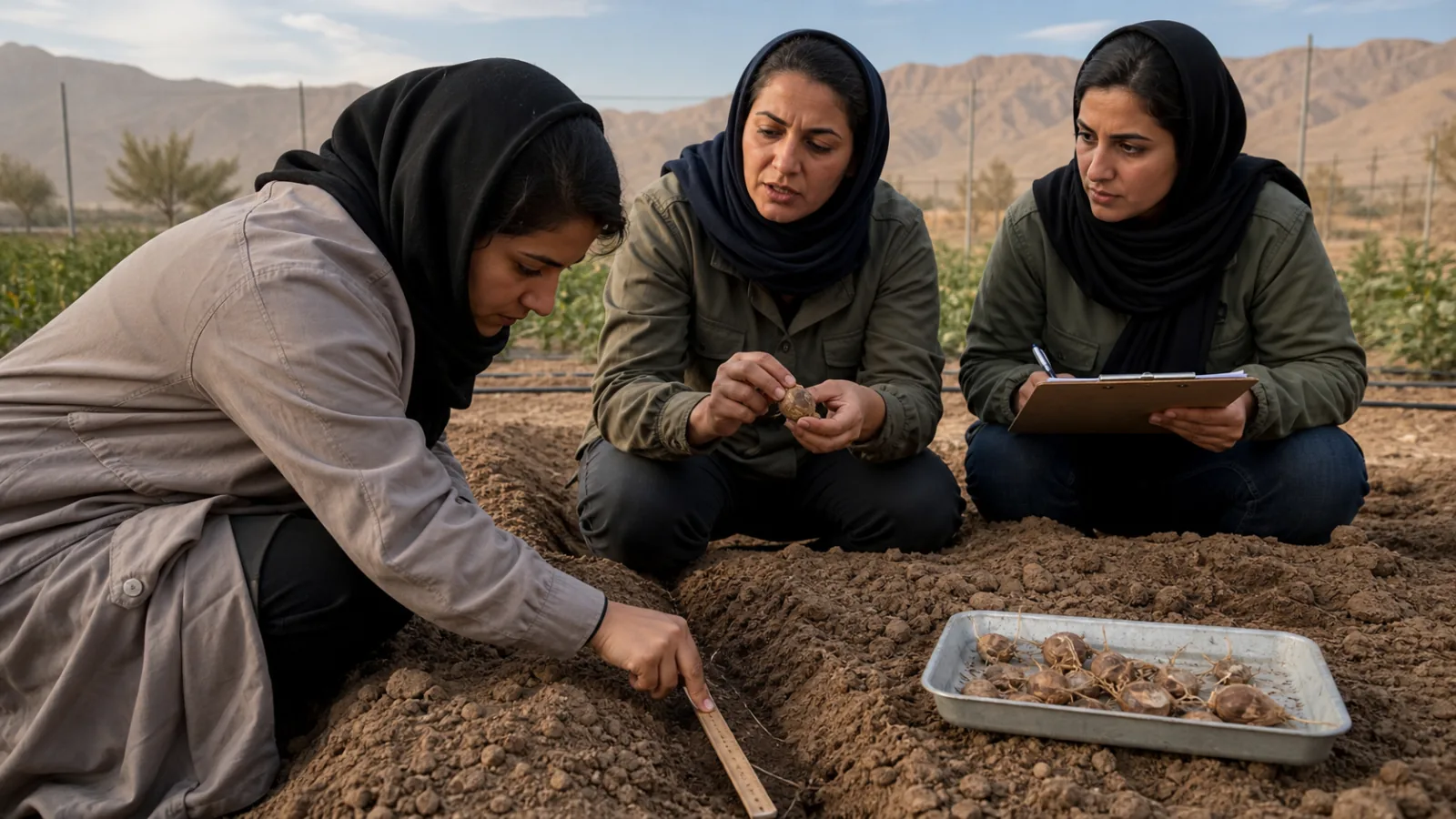
Saffron planting training in Bushehr began as a practical trial at the Gonaveh Technical and Vocational Training Center. The historical report described women agricultural trainees planting the crop for the first time at the centre. It was a useful experiment, not proof that every coastal field in the province would be productive.
That distinction matters in Bushehr. Saffron can tolerate a dry summer, but flowering and leaf growth happen in the cooler part of the year. Temperature, drainage, soil moisture and the quality of the planting corms all influence the result. A training plot should therefore teach people how to test a site and keep records, rather than simply repeat that saffron is a profitable or low-water crop.
What the Gonaveh training programme did
Ahmad Liravi, then director of the Gonaveh Technical and Vocational Training Center, said the centre had identified local potential for saffron cultivation and organised a course for its women trainees. The participants used suitable land at the training centre to practise planting under the guidance of instructors.
The original English version calls the participants “female teachers” in one sentence and “agricultural training apprentices” elsewhere. The consistent meaning is that women at the Gonaveh centre took part in a vocational agriculture course. The report does not provide the plot size, number of corms, planting date, harvest result or a multi-year yield record.
It also predicted that investment could turn Gonaveh and Bushehr into saffron-producing areas. That was an aspiration attached to an early trial. It should not be presented as a result that had already been achieved.
Why a Bushehr site needs to be tested carefully
Saffron is often associated with arid conditions, yet “dry” is not a complete site description. The crop’s corms are dormant through summer and resume growth as conditions change. Successful flowering depends strongly on temperature, and the corms need well-drained soil when they are actively growing.
Guidance from UMass Extension describes warm summers and cool-season growth as part of saffron’s cycle, while stressing light-to-medium, well-drained soil. The University of Vermont’s saffron programme makes the same practical point: prolonged standing water can rot corms. Those principles are particularly important when testing a warm coastal location where heat, humidity and soil conditions may differ from Iran’s established saffron districts.
Before planting, instructors should compare the plot’s monthly temperature pattern, drainage after irrigation or rain, soil texture, salinity risk and available cool-season light. Our guide to weather conditions for planting saffron explains why a provincial label is less useful than measurements from the actual field.
What a useful saffron course should teach
A good vocational course connects each field decision to an observable result. The aim is not to memorise one planting depth or one irrigation timetable for every location. Trainees should understand what to inspect, how to record it and when local evidence justifies a change.
1. Identify genuine saffron corms
Culinary saffron comes from Crocus sativus. It is propagated by corms, not seed. Trainees should learn to recognise healthy, firm planting material and reject corms showing rot, deep wounds or suspicious decay. They should also understand the danger of confusing true saffron crocus with unrelated plants sometimes called “autumn crocus.”
2. Assess the plot before preparing it
Digging a few inspection holes after irrigation can reveal slow drainage, compacted layers and uneven wet spots. A soil test provides better guidance than appearance alone. If the site remains waterlogged, adding valuable corms does not solve the underlying problem.
3. Design a measurable trial
Divide the training plot into labelled sections. Record corm source and size, planting date, depth, spacing and soil treatment for each section. If the course compares two methods, change one important variable at a time. Otherwise, a difference in flowering cannot be traced to a cause.
4. Plan irrigation from the field, not a slogan
Saffron may require less irrigation than some alternative crops, but it is not a no-water plant. The correct timing depends on climate, soil and rainfall. Overwatering a poorly drained bed can be as damaging as leaving actively growing plants without adequate moisture. Our broader saffron cultivation checklist covers the decisions that should be reviewed together.
5. Follow the crop beyond planting day
A planting demonstration is incomplete if the class never returns. Trainees should record emergence, flowering dates, flower count, disease or pest losses, harvest labour, dried-stigma weight and the condition of daughter corms. One season may show whether the plants survived; several seasons give a clearer picture of whether the system is worth expanding.
How to judge whether the training succeeded
The first measure is learning: can participants inspect corms, prepare a well-drained bed, document irrigation and recognise a problem early? The second is field performance. Useful records include the proportion of corms that emerged, flowers per trial section, dried saffron produced, labour hours and losses during drying or storage.
Economics should come after those measurements. A budget needs the cost of corms, soil work, irrigation, labour, drying, packaging and replacement of failed material. Revenue is not profit, and a high retail price does not mean a small trial automatically has a profitable route to market.
The training centre’s educational purpose also has value beyond immediate yield. A well-run plot lets participants practise crop observation and basic enterprise planning in a controlled setting. If the Bushehr trial performs poorly, accurate records still teach which constraint mattered. That is more useful than hiding a weak result.
A responsible next step for Gonaveh
The 2018 report captured an encouraging moment: women trainees in Gonaveh were trying a new crop with institutional support. The safest continuation would be a series of small, documented trials across genuinely different local sites, followed by a comparison of flowering, corm health, labour and costs.
Only fields that show repeatable results should move toward commercial scale. In that form, saffron planting training in Bushehr is not a promise that the province will become a major producer. It is a practical way to find out where the crop fits, teach sound field skills and protect new growers from investing on optimism alone.

![Exporting Saffron to Turkey + Price Guide [Complete 0 to 100]](https://img.rowhanisaffron.com/20260827003933/saffron-export-turkey-quality-inspection.webp)



