


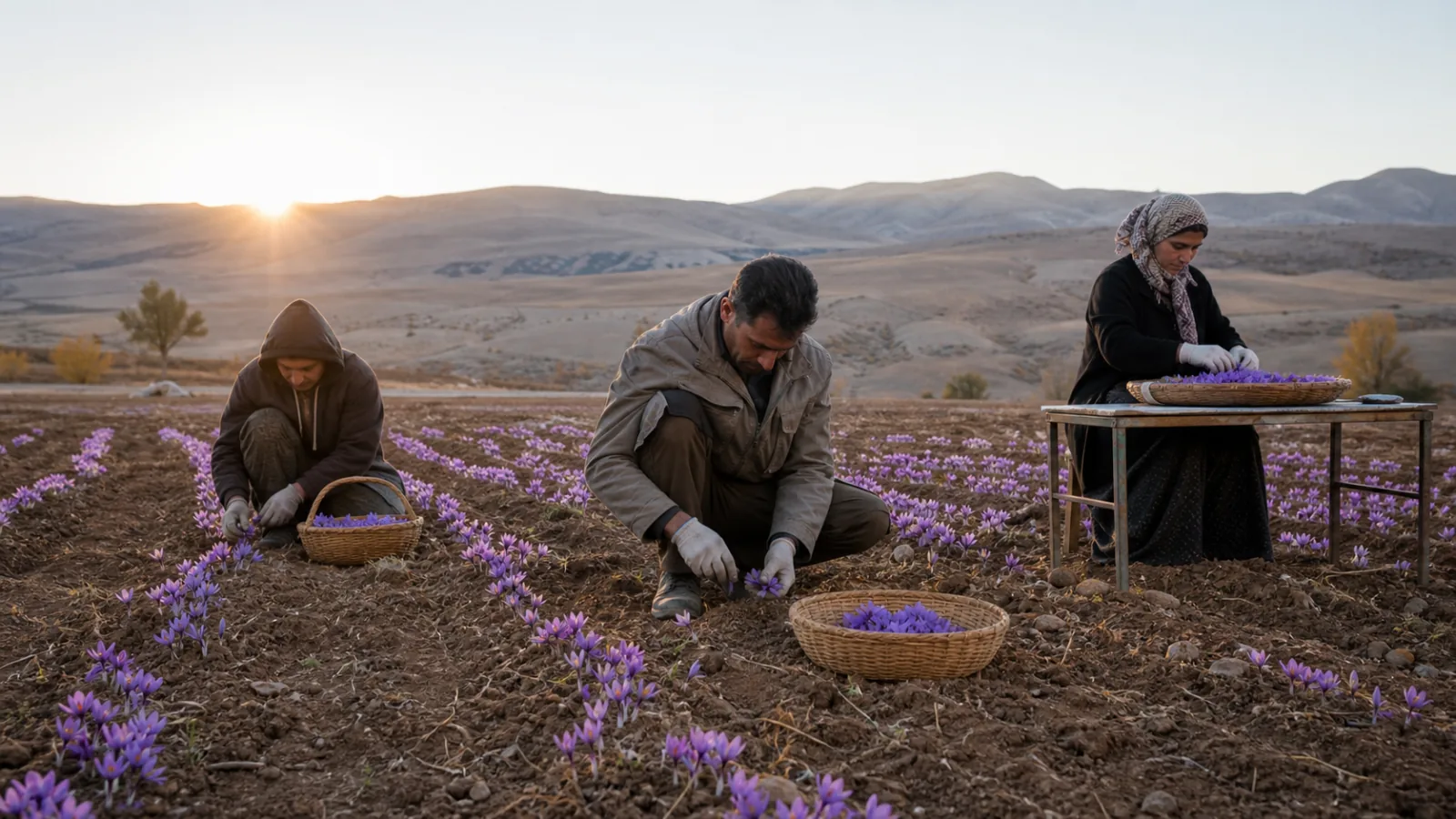
A historical report on saffron harvesting from Kermanshah Province farms recorded a small but rapidly expanding crop. At the time of the report, provincial officials expected about 200 kilograms of dried saffron from 80 hectares. The figures are useful as a snapshot of an emerging production area, but they should not be read as a current forecast or a guaranteed yield for every farm.
The report also shows why harvest planning matters. Saffron flowers arrive in a short, labour-intensive window. Picking, separating the stigmas and drying them all affect the final quality. A grower who expands the planted area without preparing for those jobs can lose value even when the field flowers well.
What the Kermanshah report recorded
Afshin Safavi, then deputy director for crop production improvement at the Kermanshah Agricultural Jihad Organization, said the province’s saffron area had risen by 18 percent to 80 hectares. He expected those fields to produce about 200 kilograms during that season.
Those two numbers imply an average of roughly 2.5 kilograms per hectare. That is only an arithmetic reading of the report. It is not a benchmark for an individual field: stand age, corm size, soil, irrigation, weather, flower-picking speed and drying practice can all change the amount of saleable dried stigma.
Safavi placed the start of picking in the second ten-day period of Aban in the Iranian calendar, with work continuing to the end of November. In a western Iranian province with varied elevation and temperature, the precise opening day would naturally differ from one site and season to another. Flower emergence, rather than a fixed calendar date, is the practical signal.
Where saffron was being grown
The official said saffron was present in most parts of Kermanshah Province. The report excluded Qasr-e Shirin and the warmer parts of Sarpol-e Zahab because local conditions were considered unsuitable. That distinction is important. A crop described as suitable for a province is not automatically suitable for every county, valley or field within it.
The organisation was using demonstration plots of about two to three hectares in each participating county. Their purpose was to let farmers see the crop under local conditions before committing more land. This is still the sensible way to approach a relatively new production zone: test a representative plot, record its performance over more than one season, and expand only when the agronomy and the market both work.
A separate Kermanshah plan later discussed a much larger provincial target. Our account of the proposed 250 hectares of saffron in Kermanshah explains that expansion target. The present article stays with the earlier 80-hectare harvest and what it meant on the ground.
How the harvest window should be managed
Saffron flowers are best treated as a perishable crop. Pickers need to move through the field frequently while flowering is active, gather clean flowers carefully and keep the containers shaded and ventilated. Flowers should not be compressed into deep, warm piles while they wait for processing.
Separation is delicate work. The red stigmas must be removed cleanly, with as little yellow style or unrelated flower material as the chosen grade allows. Drying should begin promptly under controlled, hygienic conditions. Excess heat can damage sensory quality, while insufficient or uneven drying can make storage unreliable.
The Food and Agriculture Organization’s account of Iran’s qanat-based saffron farming system emphasises that cultivation depends on practical local knowledge across planting, care and harvest. FAO has also highlighted post-harvest practice and product integrity as central to saffron quality. In other words, the harvest does not finish when the flowers leave the field.
A practical harvest-day sequence
- Check flowering before allocating pickers; do not rely solely on the previous year’s date.
- Pick during the cool part of the day and use clean, shallow containers.
- Move flowers quickly to a clean separation area protected from sun, dust and moisture.
- Separate stigmas consistently for the intended grade.
- Dry them with a repeatable time-and-temperature method suited to the equipment.
- Cool the dried saffron before sealing it in clean, food-safe packaging.
- Label each lot so the field, harvest date and drying batch can be traced.
This sequence is more useful than a fixed labour quota. Flower density changes from day to day, and a field can reach its peak quickly. The crew, separation space and dryer capacity need to match the busiest day rather than the seasonal average.
Water saving does not mean no irrigation
The original report linked saffron expansion to replacing crops with higher water demand. That can be a reasonable regional objective, but saffron is not a no-water crop. Rainfall, soil water, field drainage and the timing of irrigation still influence establishment, flowering and daughter-corm development.
Research catalogued by FAO’s AGRIS database shows that irrigation scheduling and mother-corm size affect stigma yield and the formation of replacement corms. Growers in Kermanshah therefore need a site-specific programme, not a schedule copied unchanged from a different province. The question is how to use water well at the crop’s important stages, not how to remove water from the plan.
What the support programme actually offered
The Kermanshah report described public support for low-water-demand crop replacement. Its English translation appears to confuse saffron corms with grapes in one sentence; the surrounding passage clearly concerns saffron cultivation. It also recorded assistance valued at 80 million rials for obtaining planting corms. The wording does not establish whether that sum applied per farmer, per plot or under a particular funding arrangement, so it should not be treated as a current entitlement.
Safavi said saffron area had grown from six hectares in 2011 to 80 hectares in the reporting year, with notable expansion after the Iranian year 1391. Those numbers describe the programme’s historical trajectory. Anyone considering a crop change now should obtain current information directly from the relevant provincial agricultural office and prepare a farm budget that includes corms, land preparation, irrigation, weeding, harvest labour, separation, drying, packaging and routes to market.
What farmers should learn from the 80-hectare harvest
The strongest lesson is not that every Kermanshah field should grow saffron. It is that expansion was being tested county by county, with warm areas excluded and demonstration plots used to build local evidence. That approach protects farmers from treating a provincial success story as a field-level promise.
Before planting more land, compare several seasons of flower and dried-stigma records, calculate the busiest day’s labour requirement, confirm drying capacity and identify a buyer or packing route. A good harvest plan connects the field to the finished lot. When those parts are ready together, saffron harvesting from Kermanshah Province farms can produce value without asking one short flowering season to carry assumptions it cannot support.

![Exporting Saffron to Turkey + Price Guide [Complete 0 to 100]](https://img.rowhanisaffron.com/20260827003933/saffron-export-turkey-quality-inspection.webp)



