


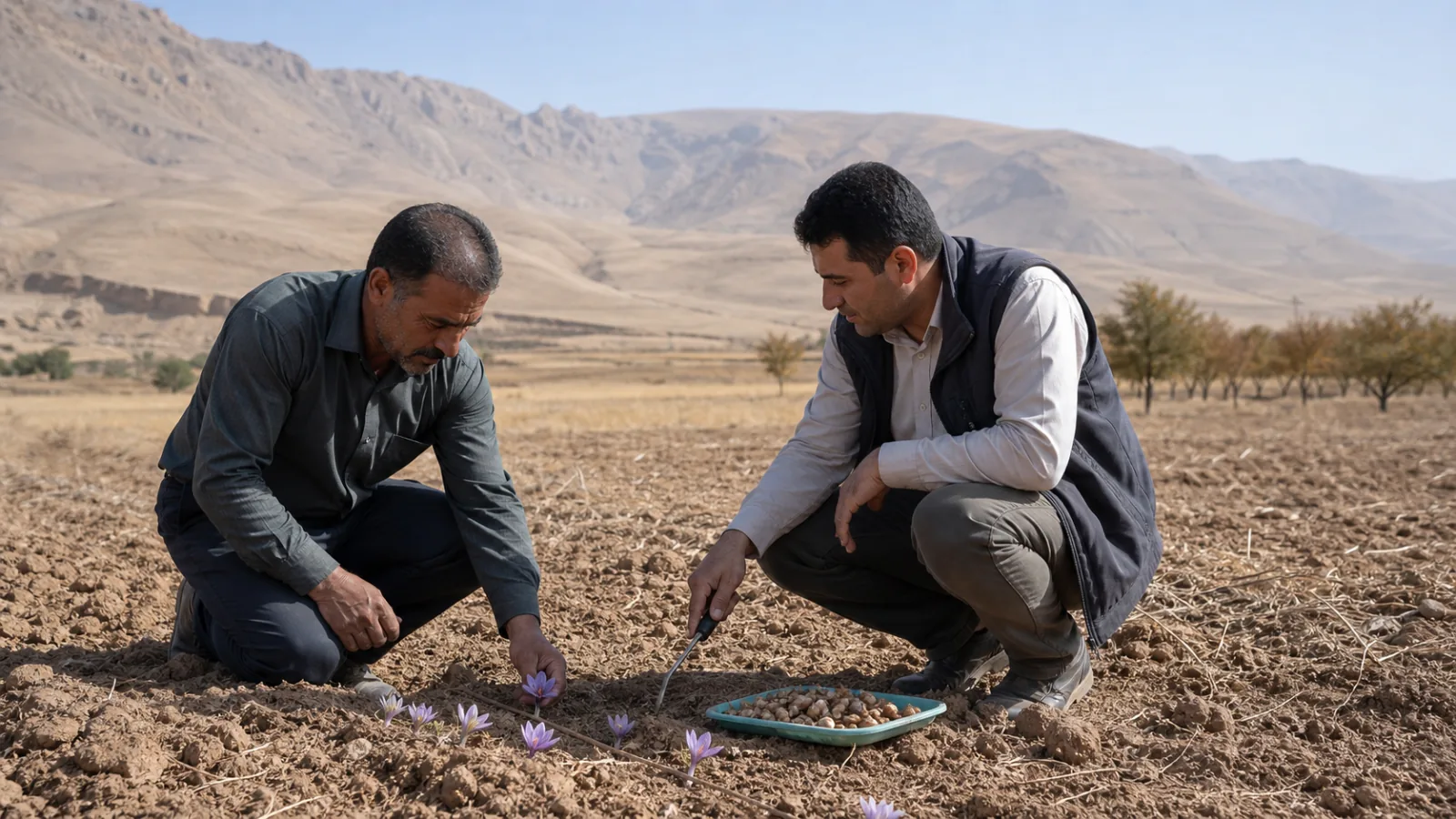
A proposal to plant saffron in Fars province grew out of a decade of drought and the need to use water and soil more carefully. A historical provincial report presented saffron as one option in a broader change of cropping pattern, with Estahban already supplying most of Fars’s crop and several other counties beginning to plant it.
The proposal was not simply “replace wheat with saffron.” It called for scientific site selection, suitable planting material, farmer finance and a planned route to market. Those safeguards still matter because a crop that uses relatively little water can fail if the field, labour or economics are wrong.
Why saffron entered the Fars crop plan
The report described drought as a long-running threat across Fars. Agricultural planners were looking for crops that could produce higher value with less irrigation than some established field crops. Saffron’s summer dormancy and cool-season growth made it a candidate.
That comparison needs careful language. Saffron is not a no-water crop, and wheat is not equally water-intensive in every system. Rainfall, irrigation method, yield and local soil determine the result. The FAO’s description of Iran’s qanat-based saffron system supports the broad point that saffron can suit severe water scarcity, while also showing that reliable irrigation and local knowledge remain part of production.
Estahban’s place in the historical plan
Nasser Ranjbar, then responsible for horticulture with the Agricultural Jihad service in Estahban, said the county had about 500 hectares under saffron and represented more than 85% of Fars’s planted area. The same report later gave 410 hectares for Estahban in the previous season. These figures describe different reporting points and should not be combined as if they were one current total.
Ranjbar said Estahban growers had more than 50 years of experience with saffron. The damaged English version used unrelated words such as “depositary farmers” and “jailbreak”; these were translation errors, not types of grower or cultivation.
He also said nine other Fars counties had recently joined the planting pattern. The provincial section named Estahban, Sepidan, Eqlid, Safashahr, Bavanat, Abadeh, Marvdasht, Firuzabad, Fasa and Shiraz as producing areas at the time. Because Safashahr is a city within Khorrambid County, the number of names and the number of county units do not align neatly in translation.
How much land and saffron were reported?
Heshmatollah Sadeghi, a medicinal-plants specialist with Fars Agricultural Jihad, said the provincial saffron area had reached about 600 hectares. He also gave 530 hectares for the preceding season, including 410 hectares in Estahban, and said the new-year development target was 630 hectares.
For output, he reported about 1,600 kilograms in the prior year, of which roughly 1,300 kilograms came from Estahban. The forecast for the new harvest was 2,300 kilograms. A separate contemporary report carried a forecast closer to 2,500 kilograms, which illustrates why year, cut-off date and preliminary status need to travel with an agricultural statistic.
The longer-term proposal aimed for 1,000 hectares within three years. The article also described a 100-hectare year-over-year increase and estimated annual provincial income at about 150 billion rials. Every one of these figures is historical. None should be read as Fars’s current area, harvest or income.
Saffron is dormant in summer, not independent of water
Both officials emphasised that saffron is dormant during summer, when many other crops are actively using water. Ranjbar’s translated statement said it needed no water “at all” and that autumn and winter rain would irrigate the crop. Sadeghi referred to only two or three irrigations a year.
These remarks describe an advantage and a local practice, not a universal irrigation schedule. Establishment, pre-flowering moisture, seasonal rain, soil texture and the needs of developing corms all matter. A rain-fed result in one Estahban field cannot be promised in another part of Fars. Drainage matters too: standing water can rot corms even when annual water use is modest.
The crop may remain in the ground for several seasons, but the old claim that one planting produces for at least ten years without re-establishment is not a safe planning assumption. Daughter corms multiply, density rises and yields may eventually decline. The University of Vermont’s multi-year saffron guidance advises monitoring annual performance and lifting and replanting when crowding reduces yield.
The cost and finance question
Sadeghi put the historical cost of establishing one hectare at about 20 million tomans and identified access to capital as a major obstacle. He proposed government support, including subsidies for saffron corms. That amount belongs to the period of the report and is not a present budget.
The source also mentioned a saffron price of at least 24,000 tomans, but its unit was lost in translation. A price without weight, grade, date and market level is not usable. Farmers evaluating a new plot need quotations for healthy corms, land preparation, labour, irrigation, drying and packaging, then a realistic sale price for a defined grade.
A farm budget should allow for low or variable first-year flowering. It should also recognise that harvest labour arrives in a narrow window. High value per kilogram does not guarantee a return per hectare after establishment and processing costs.
Markets named in the proposal
The report said Fars saffron reached markets in Gulf countries, Spain, Germany, France, China, Japan and South Korea. It treated export potential as part of the argument for expanding a high-value, low-volume crop.
That destination list does not show shipment volume or prove that every named market bought directly from Fars growers. Export records, quality testing, traceability, packaging and buyer contracts are required to turn a general market opportunity into farm income.
What a responsible expansion plan needs
Before a grower or public programme expands saffron acreage, the proposal should answer practical questions:
- Which fields have suitable drainage, soil depth and seasonal temperature?
- How much irrigation will be available before flowering and during corm growth?
- Where will healthy, traceable corms come from?
- Who will pick and separate flowers on peak days?
- How will saffron be dried, graded and stored consistently?
- Which buyer has agreed specifications, volumes, price basis and payment terms?
- What results from a small trial would justify a larger second phase?
Our guide to preparing ground for saffron covers the field checks that should come before acreage targets.
A proposal worth testing, not a promise
The case for planting saffron in Fars province was grounded in a real problem: prolonged drought and the need for a more water-conscious crop pattern. Estahban’s experience, the spread to other counties and the historical production figures gave officials a basis for further trials.
The proposal becomes stronger when its claims are bounded. Saffron uses water; old prices and subsidies do not define today’s economics; a field may not remain productive for ten years; and export demand must be documented. Careful site trials, multi-year records and committed buyers are what turn the idea from an attractive drought response into a useful farm decision.

![Exporting Saffron to Turkey + Price Guide [Complete 0 to 100]](https://img.rowhanisaffron.com/20260827003933/saffron-export-turkey-quality-inspection.webp)



