


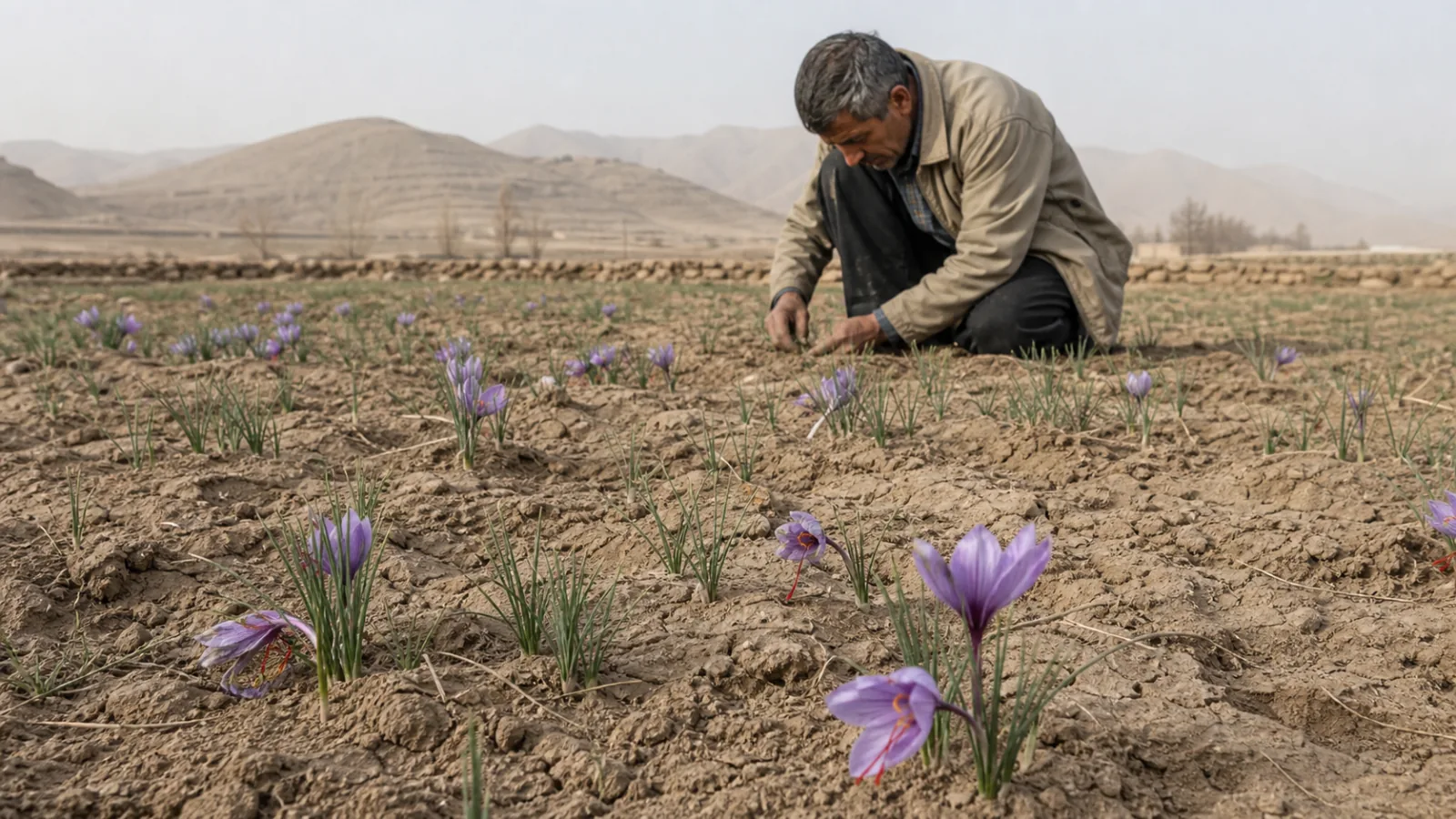
The historical report behind “Destruction of saffron in the city of Rastkhar” describes a severe fall in saffron production after drought, frost and a hard winter. The place name appears in several English spellings—Rastkhar, Rashtkhar and Roshtkhar—while the stored title and URL use Rastkhar. This article keeps that established wording and clarifies what the figures can, and cannot, tell us.
Mohammad Reza Abbaspour, then identified as the local director of Agricultural Jihad, said saffron output had fallen by more than 45 percent. He connected the decline with prolonged drought, reduced rainfall and cold damage during the winter referred to in the report as Iranian year 1392. These are attributed historical observations, not a description of the district’s current harvest.
What happened to saffron in Rastkhar?
According to Abbaspour, the district had produced more than 18 tonnes of dried saffron in years before the drought. The later harvest was reported at about 10.5 tonnes. That is a loss of at least 7.5 tonnes compared with the stated earlier benchmark, or more than 41 percent. The reported “more than 45 percent” decline may have used a different baseline or a more precise unrounded total, but the surviving article does not provide that calculation.
The account also described Rastkhar as the second-largest saffron-producing district in Khorasan Razavi at the time. It placed the local saffron area at more than 5,800 hectares. Those details show why a poor season mattered beyond a single farm: thousands of hectares, irrigation costs and seasonal rural work were exposed to the same weather shock.
Drought and frost affect different parts of the crop cycle
Saffron is often called a low-water crop, but that does not mean it can produce normally without well-timed moisture. The corm remains underground through the year, flowers in autumn and supports leaf growth through the cooler months. Water shortage at a sensitive stage can restrict growth and the following crop, while frost around flowering can damage flowers before the stigmas are collected.
Research on Iranian saffron supports the broader relationship described in the old report. Long-term studies have linked the timing of rainfall and drought—not simply annual rainfall totals—to yield. Other field research has found lower yield where frost days increase and has identified flowering as a particularly vulnerable period.
That does not prove that every tonne lost in Rastkhar came from one weather event. Field age, corm health and density, soil, irrigation practice, nutrition, pests, labour and harvest timing can also change the result. The defensible conclusion is narrower: local officials reported substantial drought and cold damage during that season, and the harvest was markedly below the earlier level they cited.
Why the area and yield figures do not reconcile
The translated report gives three numbers that should be read cautiously: more than 5,800 hectares under saffron, a 10.5-tonne harvest and an average dried-saffron yield of 3.4 kilograms per hectare. If all 5,800 hectares produced 3.4 kilograms, the result would be almost 19.7 tonnes, not 10.5 tonnes.
There are several possible explanations. The average may have applied only to harvested or productive fields, the area may have included young or damaged fields, or one number may have been mistranslated. The source as preserved here does not say which. Rather than forcing the figures to agree, it is more useful to keep each one attributed and acknowledge the gap.
The economics of a damaged saffron season
Abbaspour said many growers were struggling even to cover irrigation costs and described production as uneconomic under the reduced yield. That point is plausible: several cultivation costs are incurred before a farmer knows how many flowers the field will produce. When dried-saffron yield falls, those costs are spread across fewer grams of saleable spice.
The old translation also says Negin saffron traded between “4 million and 400 million to 500 thousand toman” per kilogram. The wording is visibly corrupted and does not support a reliable price range. It should not be quoted as a historical market price, still less used as a current one. Grade, moisture, laboratory quality, transaction size, packaging, currency and date all matter when comparing saffron values.
The report’s suggestion that price “should be tripled” is an opinion attributed to the official, not evidence that the market actually rose threefold. A production shortage can put upward pressure on supply, but price formation also depends on inventories, exports, buyer demand and product quality.
What growers were advised to do
The translated advice is damaged, but its central idea is clear: growers were urged to pay attention to crop nutrition after flowering, irrigation management and late-winter care so plants were better able to tolerate stress. Those decisions need to fit the field rather than follow a fixed calendar copied from another region.
For example, irrigation timing depends on local rainfall, soil drainage, temperature, field age and the stage of crop development. Too little water at a critical stage can reduce performance; inappropriate summer irrigation can create other risks in some production systems. Our saffron irrigation timing guide explains the seasonal decisions in more detail.
Nutrition deserves the same care. A grower should start with field history and soil or plant analysis where available, then use locally qualified agronomic advice. Adding more fertiliser is not automatically better, and it cannot reverse flower damage that has already occurred.
How to assess recovery after a bad season
A single harvest total is only the beginning of a useful diagnosis. Farmers and local planners need consistent field records:
- productive hectares, separated from newly planted or abandoned land;
- flower weight and dried-stigma yield per hectare;
- irrigation dates and volumes, rainfall and frost dates;
- field age, corm density and visible pest or disease damage;
- labour, water, nutrition and processing costs;
- grade-specific sale price rather than one general market figure.
Those records show whether a district recovered because weather improved, because productive area changed or because yield per hectare rose. They also prevent area, production and price figures from being mixed into a conclusion they cannot support.
What this historical report still tells us
The value of the Rastkhar account is not a current production forecast. It is a record of how quickly a major saffron-growing district could be affected when drought and cold coincided. The stated fall from more than 18 tonnes to about 10.5 tonnes was large enough to threaten the economics of farms that had already paid for water and labour.
At the same time, the numerical inconsistency and damaged price sentence are reminders to inspect agricultural reports before reusing them. Period, productive area, yield, grade and currency must line up. Preserving the old figures with their limits gives readers a more honest picture of the reported destruction of saffron in the city of Rastkhar than either discarding the account or presenting every translated number as exact.

![Exporting Saffron to Turkey + Price Guide [Complete 0 to 100]](https://img.rowhanisaffron.com/20260827003933/saffron-export-turkey-quality-inspection.webp)



