


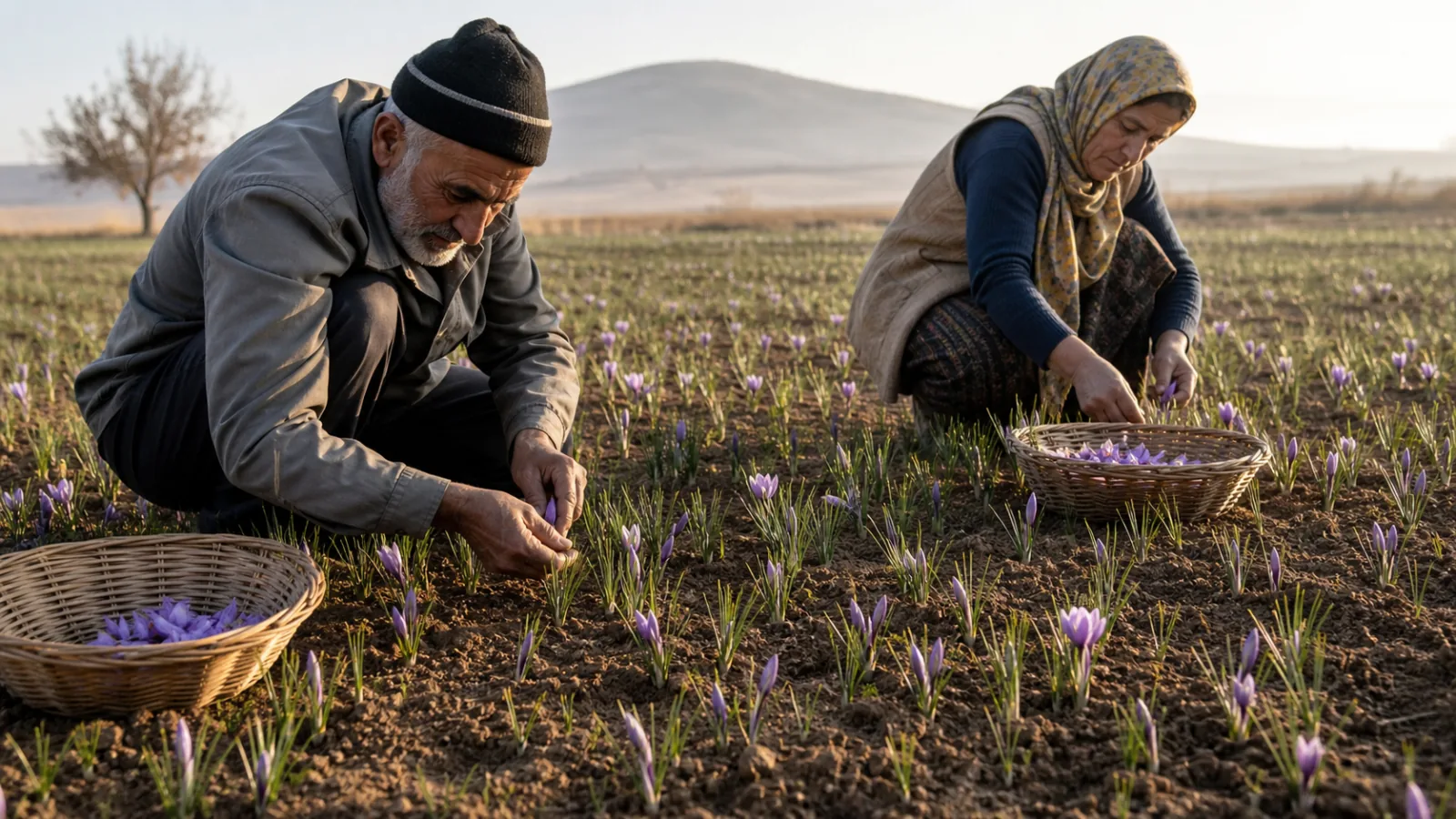
Picking saffron in Sar’ein city is a short, concentrated harvest. Flowers must be gathered while they are fresh, then moved quickly to a clean place where the red stigmas can be separated and dried. A historical local report said the Sar’ein harvest began in mid-October and ended with more than 12 kilograms of dried saffron.
The report attributed the figures to Mohammad Ebrahim Mohammadi, then director of Agricultural Jihad in Sar’ein. It placed more than five hectares under cultivation and described farmers as interested in expanding the crop. These are figures from the reporting period, not current production statistics.
What the Sar’ein harvest report recorded
More than 12 kilograms from a little over five hectares suggests a district-wide average close to 2.4 kilograms of dried saffron per hectare if both rounded figures cover exactly the same farms. That calculation is useful as an approximation, but the source does not provide field-by-field area, field age or the precise final totals needed for a formal yield estimate.
Mohammadi expected saffron cultivation to grow because the regional climate appeared suitable, farmers were interested and the crop offered a potentially valuable return from a relatively small area. The account also praised the aroma, flavour and colour of Sar’ein saffron. Those are attributed local observations; quality cannot be established for every lot without sampling and testing.
The original English translation calls saffron an expensive “herb” with oral and pharmaceutical consumption. Saffron is more accurately described here as the dried stigmas of Crocus sativus, used mainly as a spice and colourant. This article does not infer a medical benefit from the old wording.
Why saffron picking starts early
A saffron flower is delicate, and its value lies in three small red stigmas. Pickers commonly work in the cool morning, often while flowers are still closed or only beginning to open. The aim is practical: protect the stigmas from prolonged sun, dust, trampling and rough handling, and leave enough time for separation on the day of harvest.
Research on harvesting and conservation has found that exposing picked flowers to the sun for only a few hours can reduce colouring strength. The same work found better colour and flavour measures when stigmas were cleaned correctly, while dark storage protected quality over time. A fast harvest therefore matters, but the work after picking matters just as much.
How to pick saffron flowers without damaging them
- Start with clean hands and containers. Shallow, clean baskets or food-safe trays protect flowers better than deep sacks where heat, weight and compression build up.
- Hold the flower low and lift gently. Avoid pulling leaves or disturbing the soil around neighbouring plants. Leaves continue supporting the corm after flowering.
- Keep picked flowers out of direct sun. Place containers in shade and do not leave them at the edge of the field for hours.
- Do not overfill the container. Crushed flowers are harder to clean and may retain heat and moisture.
- Move the crop promptly. Separation should begin in a clean indoor workspace as soon as the day’s flowers arrive.
Wet flowers need particular care. They should not be sealed into an unventilated mass, and soil-contaminated material should be kept away from clean flowers. The objective is not speed at any cost; it is steady handling that protects both the stigma and food hygiene.
Separating the red stigmas
Each flower is opened by hand and the red stigmas are separated from the yellow stamens and purple petals. The point where the stigmas are cut affects the final form: leaving more yellow style increases weight but changes the visual grade. A consistent lot requires a consistent separation method.
The work surface, tools, hands and surrounding air must be clean. Workers should remove damaged flowers and visible foreign matter rather than allowing it into the drying batch. A beautiful field photograph says nothing about hygiene; traceable handling begins at the separation table.
Fresh stigmas contain substantial moisture and cannot simply be packed for sale. Drying must start promptly under a controlled, repeatable process. Different drying methods and temperatures change colour, aroma, bitterness and final moisture, which is why an improvised high-heat treatment can waste careful field work.
Drying and storing the day’s harvest
There is no single household time-and-temperature instruction that suits every dryer, batch thickness and airflow. Producers should use a validated process, a clean food-contact surface and calibrated equipment. The dried material must be protected from reabsorbing moisture during cooling and packing.
Once dry, saffron belongs in a clean, food-grade, tightly closed container away from light, excess heat, moisture and strong odours. Lot labels should connect it to harvest date, field or grower, separation team, drying batch and any quality result. That record is more useful than a general claim that an entire district’s saffron has superior aroma or colour.
Readers who want the full sequence can continue with our guide to harvesting your own saffron. It follows the practical decisions around flowers, stigmas and the small amount of dried spice each planting yields.
What determines the value of a small harvest?
Twelve kilograms may sound modest beside production totals from established saffron regions, but dried saffron represents a large amount of manual picking and separation. Its commercial value cannot be calculated from weight alone. Colouring strength, aroma, bitterness, moisture, cleanliness, stigma form, laboratory compliance, traceability, packaging and the terms of sale all affect the result.
Production cost matters too. Corms, land preparation, irrigation, weeding, harvest labour, separation and controlled drying must be paid for before the lot is sold. Expansion is sensible only when growers have suitable fields, realistic yield expectations, trained labour during the short flowering window and a route to market.
A useful record, not a current forecast
The old Sar’ein report captures an early stage in the district’s saffron development: more than five hectares, over 12 kilograms of dried product and interest in planting more. It does not establish today’s cultivation area, present yield or market price. Those need a dated statement from the responsible local authority.
What remains current is the logic of the harvest. Picking flowers carefully, limiting sun and compression, separating cleanly, drying under control and storing the threads in darkness all protect work already invested in the field. For growers and visitors interested in picking saffron in Sar’ein city, that complete chain—not the act of lifting flowers alone—is what turns a brief autumn bloom into a usable spice.

![Exporting Saffron to Turkey + Price Guide [Complete 0 to 100]](https://img.rowhanisaffron.com/20260827003933/saffron-export-turkey-quality-inspection.webp)



