


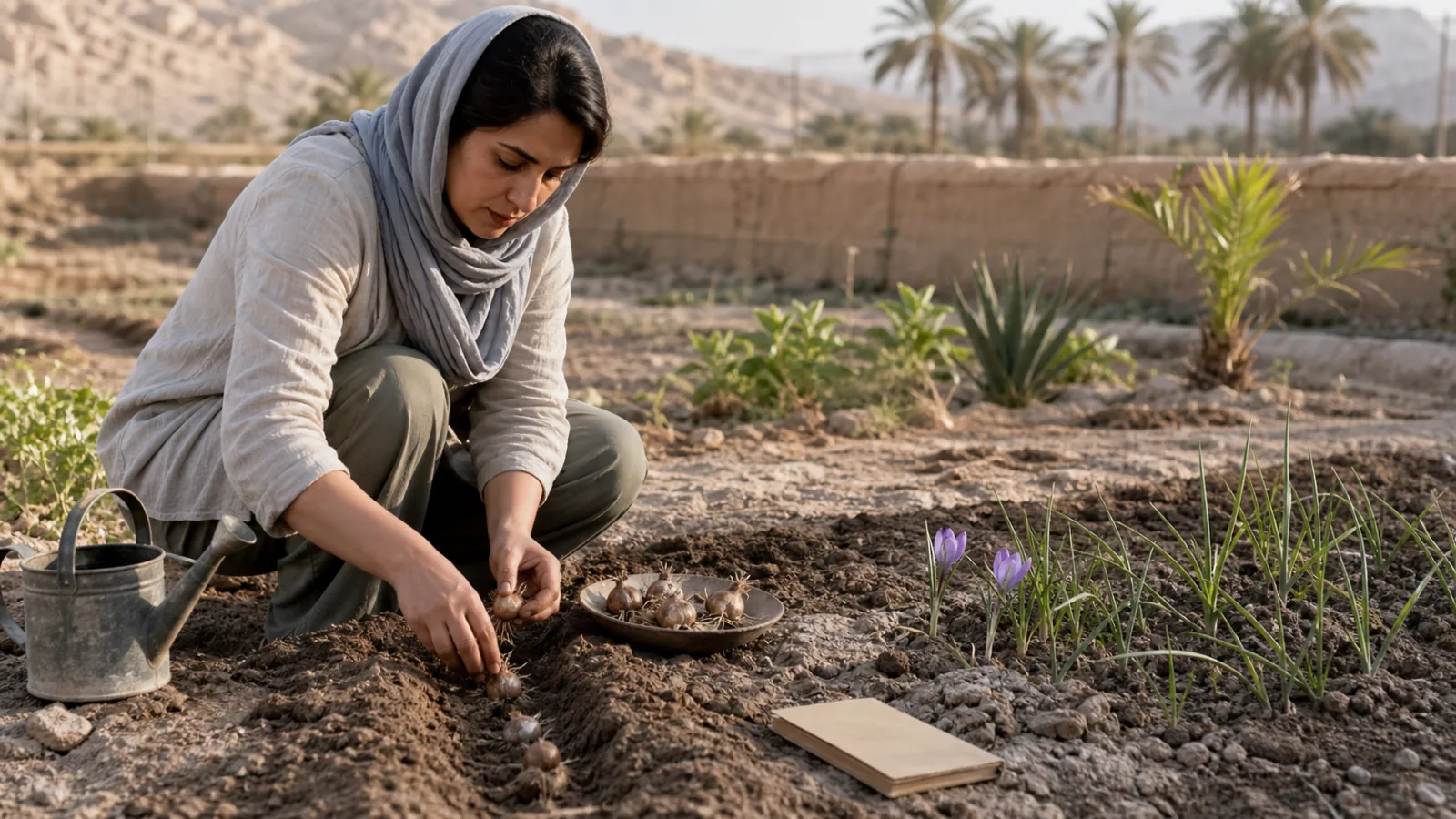
The stored title “Planting saffron in Susan city Bandar Abbas” does not match the surviving report. The article describes a small saffron planting by Nasim Ghamari Tabasi in Fin, a district about 90 kilometres from Bandar Abbas. It does not identify a place called Susan. We have kept the established title and URL because the page is already appearing in search, while making the location clear rather than inventing a geographic correction.
This was a household-scale trial with several saffron corms, not proof of a commercial saffron industry in Bandar Abbas. Tabasi said she planted corms brought from Fadafan, near Kashmar in Khorasan, at the end of September. Buds appeared toward the end of November and at least one flower followed during the date recorded in the source as 5 Dey 1392.
What was planted in Fin near Bandar Abbas?
The old English text repeatedly calls the planting material “onions.” The accurate botanical term is corms. A saffron corm is a compact underground stem that stores energy and produces leaves, flowers and replacement corms. Crocus sativus does not normally set viable seed, so growers propagate it by dividing and replanting corms.
Tabasi’s experiment showed that imported corms could survive and produce a flower under the conditions she provided. She said gardening was a personal interest and that saffron was one of her favourite flowers. After the first bloom, she hoped to expand the planting and was open to using a greenhouse if needed.
That result is encouraging, but narrow. One flowering corm establishes biological possibility at one site; it does not establish reliable yield, commercial quality or profitability across a hot coastal region.
Why the Bandar Abbas climate deserves caution
Saffron’s annual cycle depends on temperature changes. The corm passes through summer dormancy, initiates flowers under warm conditions and then needs cooler conditions for flower emergence. Controlled studies have found flowering to be sensitive to both temperature and duration: excessive incubation heat can interrupt flower development, while the later move to cooler conditions helps trigger emergence.
That matters around Bandar Abbas, where a grower cannot assume that a calendar developed for Khorasan will transfer unchanged. A site in the uplands around Fin can differ from the coast in night temperature, soil and drainage. A courtyard pot, shaded bed, open field and greenhouse also create different root-zone and air temperatures.
Before scaling up, growers should record the conditions of the successful planting rather than relying on the phrase “southern region.” Daily minimum and maximum temperature, soil temperature, planting depth, shade, irrigation, drainage, corm size and the exact flowering date would make the observation repeatable.
How to evaluate a small saffron trial
A sensible trial begins with a limited number of healthy, firm corms from a traceable source. Soft, wounded or mouldy corms can introduce rot and make the result impossible to interpret. The site should drain freely; standing water around dormant or actively growing corms is a different risk from drought.
Keep one record for each bed or container:
- corm origin, size range and planting date;
- planting depth, spacing and soil or growing medium;
- sun exposure and any shade treatment;
- irrigation dates and approximate volume;
- dates of first leaf, bud and flower emergence;
- number of planted corms, flowering corms and flowers;
- pest, rot, heat or leaf-damage observations;
- daughter-corm number and condition at the end of the cycle.
Without the denominator—the number and size of corms planted—a single flower cannot be converted into a flowering percentage. Without several seasons, it is also too soon to know whether replacement corms remain vigorous.
Planting once does not mean working only once
The original report says the planting stage happens in the first year and later years require only crop care and harvest. That captures saffron’s perennial nature but understates the work. A bed may remain in place for several seasons, yet it still needs weed control, carefully timed water, nutrition based on field need, pest and disease monitoring, flower picking, stigma separation and drying.
Corms multiply underground and eventually become crowded. Growers then lift, sort and replant them according to the production system and field condition. A first-year flower is therefore one checkpoint in a longer cycle, not the finish line.
Our guide to saffron cultivation and growing conditions explains the full annual cycle. Site selection should begin with the more basic question covered in choosing and preparing a saffron growing site.
Would a greenhouse solve the heat problem?
A greenhouse can provide control, but it is not automatically cooler than the surrounding air. An unventilated structure in southern Iran can become hotter than an outdoor bed. Useful protected cultivation requires measured temperature, ventilation, shading where appropriate, a suitable growing medium, controlled irrigation and a plan for the corm’s dormancy and flowering phases.
It also adds capital, energy and labour costs. The right comparison is not “greenhouse or failure”; it is whether a protected system produces enough healthy flowers and replacement corms to justify those costs compared with a well-chosen outdoor microclimate.
What the Fin experiment actually established
Nasim Ghamari Tabasi planted several corms from Fadafan and saw them reach bud and flower in Fin during the 1392 reporting period. The observation challenged the assumption that saffron could never flower there, and her interest in expanding the trial was understandable.
It did not prove commercial yield, uniform quality or a general recommendation to plant saffron throughout Bandar Abbas. Those conclusions need replicated plots, measured weather and soil conditions, yield over several years, post-harvest quality results and a realistic cost record.
Read that way, “Planting saffron in Susan city Bandar Abbas” becomes a useful case study rather than a misplaced promise. A careful grower can learn from the curiosity behind the trial while testing climate, corm performance and economics before committing a larger area.

![Exporting Saffron to Turkey + Price Guide [Complete 0 to 100]](https://img.rowhanisaffron.com/20260827003933/saffron-export-turkey-quality-inspection.webp)



