


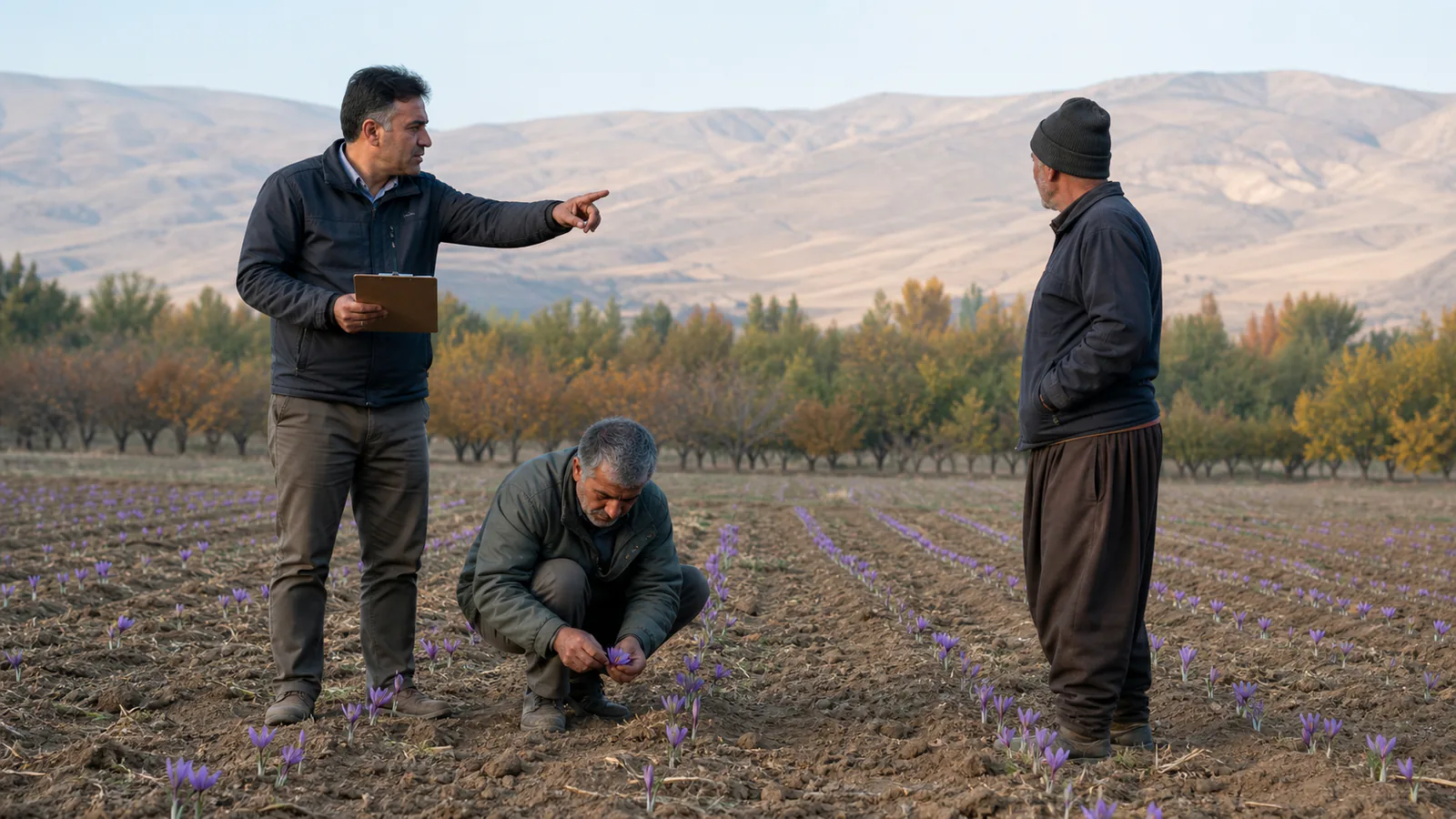
Tuyserkan saffron cultivation reached a reported 15 hectares after starting from a much smaller scattered area. A separate first-planting project in Shahreza expected about 900 grams from its initial harvest and planned a further 10,000 square metres. Both reports presented saffron as a response to water pressure and rural employment needs; neither supplied the later yield, income or water records needed to prove those outcomes.
Read together, the projects show what an expansion announcement can and cannot tell us. Planted area establishes scale. A forecast records an expectation. Only measured bearing area, dry stigma, field inputs and costs reveal how the crop actually performed.
Tuyserkan reported 15 hectares under saffron
Governor Habib Mumivand said that saffron occupied 15 hectares of farmland in Tuyserkan. The translated report also referred to about three scattered hectares in earlier years and described private investment as the driver of the larger area. The most cautious reading is a progression from a small dispersed base toward a 15-hectare programme.
The report does not give a parcel list, common measurement date or bearing-area total. It also does not state whether any old plots had been removed as new ones were added. The 15 hectares should therefore remain a historical official figure rather than a claim about current acreage.
“Revival” was a local policy goal
Mumivand described a long local association with saffron and called for its cultivation to be revived on a broader scale. The source’s machine translation goes further and calls Tuyserkan an origin of saffron culture, but it provides no historical evidence for that distinction. The rewrite preserves the revival argument without turning a local statement into an origin claim.
The meeting framed private investment as an opportunity for Tuyserkan. Officials proposed a working group involving agriculture, natural resources, the local Azad university, the governor’s office, regional water representatives, the private sector and the investor. Its purpose was to coordinate the project and reduce administrative delay.
Agriculture supported more than 14,000 people
The governor said more than 14,000 farmers worked in a local economy strongly dependent on agriculture. Saffron expansion was discussed alongside employment and the national “resistance economy” policy of that period. These points explain why officials cared about the crop; they do not show how many jobs the 15 hectares created.
A credible employment result would record worker-days for planting, field care, flower picking, stigma separation, drying and packing. It would also distinguish family labour, seasonal paid work and permanent employment. Without those definitions, a policy aim should not be rewritten as a job count.
Crop pattern and irrigation were part of the plan
Tuyserkan’s discussion linked saffron with changing crop patterns, modern irrigation and products better suited to water constraints. The source ends with “low-quality products,” an obvious translation failure in context; “lower-water-demand products” is the defensible meaning.
Lower demand is not zero demand. Establishment, flower initiation and corm development respond to timing, soil moisture, density and local weather. A peer-reviewed semi-arid field study of saffron irrigation and corm intensity demonstrates why an alternative-crop plan needs a measured water schedule, not only a low-water label.
The Shahreza pilot began planting in June
In Shahreza, project lead Farajollah Amiri said planting had begun in June of the previous year, with the first crop expected by the end of November. The source does not state the first plot’s area, corm weight, planting density or survival rate, so the schedule cannot be converted into an expected yield per hectare.
Agricultural adviser Bijan Shirahmadi said the team’s assessment found regional potential for saffron cultivation. That conclusion is attributed to the project team. No soil results, temperature record, irrigation analysis or comparative trial was included, so suitability should remain site-specific.
The first clean-harvest forecast was 900 grams
Project director Seyyed Farzad Tabatabai forecast roughly 900 grams of cleaned saffron from the first harvest. “Clean” most reasonably refers to separated, processed stigma rather than fresh flowers, but the report does not define the weighing stage.
The 900 grams remains a forecast because no actual harvest result followed in the source. It also lacks the area denominator needed to compare it with another field. A future record should report dry weight, bearing square metres, flower count, sampling date and moisture basis.
Students planned another 10,000 square metres
Students and instructors at Shahreza’s Naseh Qamshahi Conservatory planned to expand the cultivated area by 10,000 square metres, equivalent to one hectare. The educational setting is a distinctive part of the project: it could give students practical exposure to corm selection, establishment, record-keeping and post-harvest work.
A plan is not a completed hectare. The source gives no later confirmation of land preparation, corm purchase, planting or survival. The one-hectare figure should be labelled as intended expansion until a field record confirms implementation.
“No summer irrigation” needs local context
Amiri described saffron as needing little water and said the field did not require summer irrigation during the region’s water crisis. That statement likely reflects the corm’s summer dormancy and the project’s own schedule. It should not be applied as a universal instruction for every soil, planting date or establishment year.
Farmers need local advice on pre-plant moisture, the first irrigation, autumn rain, drainage and unusual heat or drought. Our broader saffron growing-conditions guide provides a framework, but field decisions still depend on the site.
Family labour is possible, but the work is not effortless
The Shahreza team said the crop did not require sophisticated machinery or a specialist workforce and that family members could handle work from planting through harvest. Small plots can indeed use household labour and simple tools. That does not make skill, time or hygiene unimportant.
Flowers arrive in a short seasonal window and the stigmas need careful separation and drying. A peer-reviewed review of saffron’s commercial quality and processing describes the labour burden and the importance of prompt handling. Family work still has an opportunity cost and should appear in a farm budget.
Seven years without replanting was not a guarantee
The Shahreza report said the field could continue for seven years after establishment, leaving maintenance and harvest rather than annual replanting. A multi-year cycle is plausible in Iranian practice, but its useful length depends on planting density, corm health, daughter-corm crowding, soil, weeds, disease and yield trend.
A field study of dense planting and six-year saffron production in Gonabad found that density affected technical efficiency and field life. Seven years is therefore a planning assumption to monitor, not a maintenance-free promise.
Transport and market value need a full cost record
The project team argued that saffron avoided heavy special transport and could generate valuable output. Dried saffron is compact, but the system still moves corms into the field, flowers quickly to a processing space, and finished product through secure storage, testing and sale.
Likewise, being a high-value spice does not guarantee a profitable plot. A useful budget includes land preparation, corms, irrigation, weed and disease management, picking, stigma separation, drying, packaging, finance, losses and the price actually received for a documented grade.
What the next regional report should measure
For Tuyserkan and Shahreza, the next update should separate:
- total planted area, new area and mature bearing area;
- corm source, health, size, density and survival;
- irrigation timing and measured water volume;
- fresh flowers, dry stigma and moisture basis;
- household and paid labour by task;
- quality test, grade and sale format;
- gross revenue, full cost and net return; and
- planned hectares versus fields actually established.
Those records would let readers test the programme’s water, employment and income goals instead of repeating them. They would also show whether a training plot can scale without losing corm health or post-harvest quality.
Two early programmes, not final outcomes
Tuyserkan’s strongest historical fact is the reported expansion to 15 hectares and the multi-agency effort behind it. Shahreza’s is the first-planting sequence: June establishment, a November harvest target, a 900-gram forecast and a planned one-hectare educational expansion.
Both records are encouraging, but neither closes the loop. Keeping their forecasts, local judgements and policy goals clearly labelled protects the genuine value of the articles—and leaves room for measured results to improve the story later.

![Exporting Saffron to Turkey + Price Guide [Complete 0 to 100]](https://img.rowhanisaffron.com/20260827003933/saffron-export-turkey-quality-inspection.webp)



