Spain bought 13 tonnes of Iranian saffron in packs over 30 grams during the first half of the year covered by this customs report. That made it the largest recorded buyer in Iran’s bulk-pack category. At the same time, exports in smaller retail-ready packs fell, raising a familiar trade question: where does the value of origin, testing and branding remain?
The report dates from 2016 and its dollar values, growth rates and country rankings are historical. They should not be used as a current saffron price or live shipment total. They do, however, show the sharp difference between selling a traceable ingredient in commercial packs and selling a finished product ready for a shop shelf.
What counted as bulk saffron
Iranian customs statistics in the source divided shipments by package weight. Packs over 30 grams were treated as bulk, while the retail-ready comparison covered packs from 10 to 30 grams. These are statistical categories; a 31-gram pack is not automatically an industrial shipment, and a small pack is not automatically a branded consumer product.
During the six-month period, bulk-pack export volume increased by more than 60 percent from the comparable period a year earlier. Its reported value rose by about 85 percent. In contrast, both volume and value for 10-to-30-gram packs declined by more than 30 percent.
The reported export value
Total saffron trade for the half-year was reported at approximately US$78 million. Bulk packs accounted for just under $36 million, while retail-ready packs accounted for just under $42 million. Those two figures are values for the category, not prices per kilogram.
The source also said the average price associated with bulk packs was more than $200 higher than in the previous comparable period, while the price associated with 30-gram packs rose by about $20. The old English translation does not state the calculation basis clearly enough to turn either change into a dependable unit price. Preserving the numbers without inventing a denominator is safer than presenting a false quotation.
Spain led bulk purchases
Spain’s 13-tonne purchase placed it first among buyers of Iranian saffron in packs over 30 grams. The United Arab Emirates, Afghanistan, China and Italy followed at a considerable distance, according to the report.
Spain has a long-established saffron packing and trading sector. Buying Iranian saffron in bulk is not evidence of wrongdoing: food businesses routinely source ingredients and pack them for their markets. The important controls are truthful origin information, lot traceability, compliant labels and evidence that the material meets the agreed specification.
The retail-pack market looked different
For retail-ready saffron, the United Arab Emirates was the leading customer with more than 18 tonnes. Saudi Arabia and China each bought about four tonnes during the six months covered by the report.
A smaller pack can carry more processing, packaging and brand value, but only if customers want that format and trust the label. Packaging in Iran does not by itself guarantee a stronger return; the pack still needs suitable design, language, legal information, distribution and shelf placement for the destination market.
Where Iranian saffron was sold
The report listed nearly 35 destinations: Pakistan, China, Japan, Argentina, Germany, Spain, Australia, Afghanistan, the United Arab Emirates, the United Kingdom, the United States, Italy, Bahrain, Belgium, Thailand, Taiwan, Turkey, Singapore, Sweden, Switzerland, Saudi Arabia, Oman, France, Qatar, Canada, Kuwait, Poland, Malaysia, Hungary, Mauritius, the Netherlands, Hong Kong, India, South Africa and Greece.
A long destination list demonstrates reach, not equal demand in every market. Country totals may also include product later re-exported. To understand today’s trade, a buyer or saffron exporter needs current customs data with a defined commodity code, period, net weight, value and reporting country.
Protecting origin and quality in a bulk sale
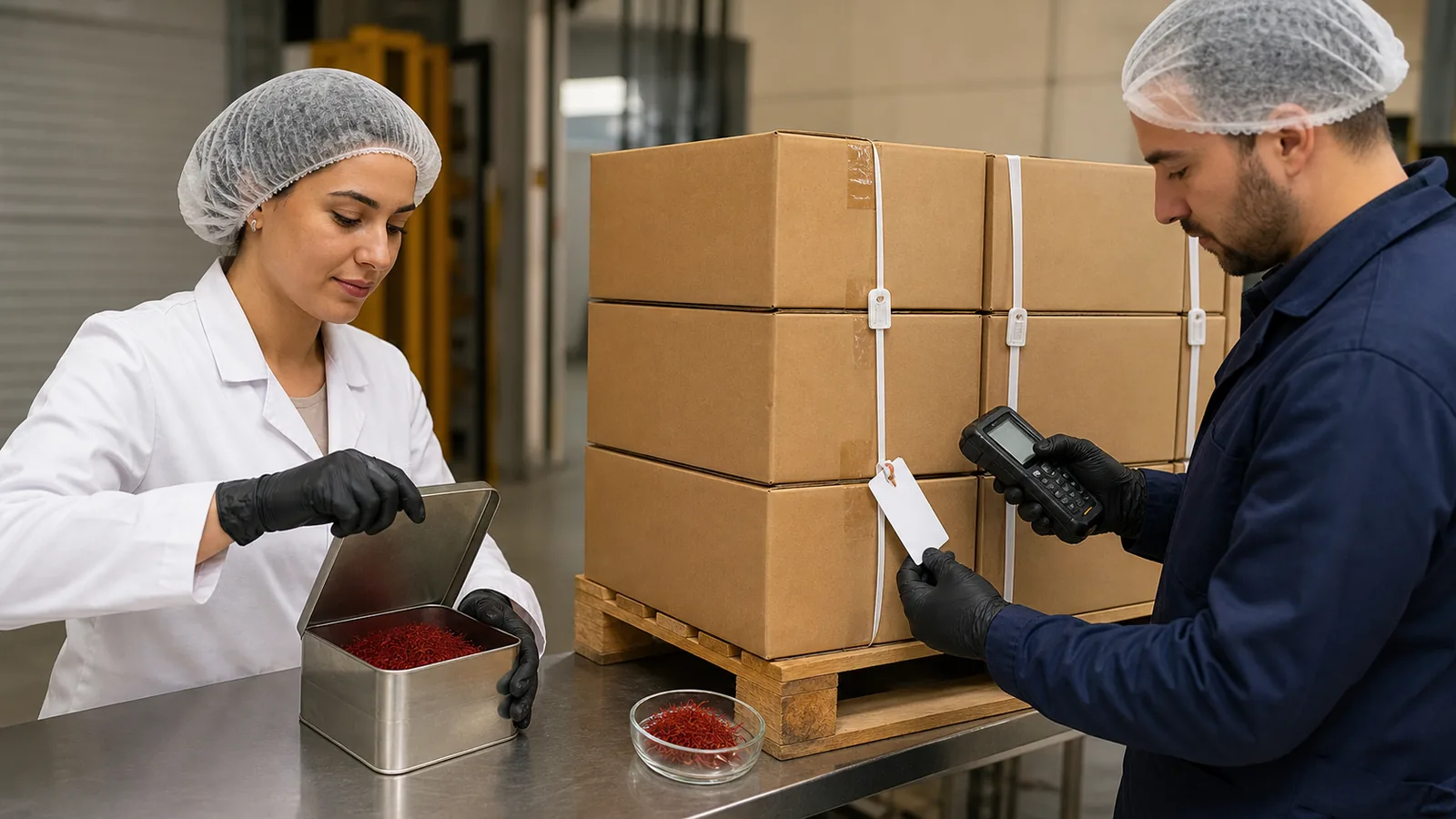
Commercial packs should remain linked to the crop through a documented lot. A useful export file includes:
- producer or collection records and declared origin;
- harvest period, processing site and lot code;
- net weight and packing configuration;
- ISO 3632 results for colouring strength, aroma, bitterness and moisture;
- food-safety and adulteration tests required by the destination;
- a retained sample and agreed acceptance procedure; and
- the Incoterm, freight, insurance and payment terms.
These records allow a packer in Spain or elsewhere to work efficiently without making the saffron anonymous. They also let the buyer compare like with like. A low quotation for an unspecified grade cannot be judged against a tested, traceable lot.
Saffron in Portugal
The legacy address refers to saffron in Portugal, although Portugal did not appear in the destination list published in this historical report. The article therefore does not establish a Portuguese market volume, price or shop. That absence should not be filled with an invented number.
A Portuguese business considering Iranian saffron can still use the report’s lesson. Ask whether the offer is bulk ingredient or retail-ready stock, verify the true origin and lot, check current EU food and labelling requirements, and calculate the delivered cost. Our wholesale saffron guide provides a fuller buying checklist, while saffron production statistics separates current context from old trade snapshots.
Volume is only part of export value
The six-month data showed rapid growth in larger packs and contraction in smaller ones. That does not make one format universally better. Bulk can serve established processors efficiently; retail-ready packs can retain more work and brand ownership at origin. The right choice depends on the customer, specification and distribution channel.
In either format, the durable value comes from the same foundations: accurate origin, careful processing, verifiable quality, compliant documentation and a buyer who can trace the product after it leaves Iran.
Sources and context
- The 13t, 60%/85% growth, 30% decline, $78m/$36m/$42m values, Spain/UAE/Saudi Arabia/China rankings and destination list preserve the original 2016 ISNA report based on Iranian customs statistics; all are presented as historical.
- ISO 3632-1:2011 and ISO 3632-2:2010 cover saffron specifications and testing.
- European Commission: Food information to consumers legislation.