


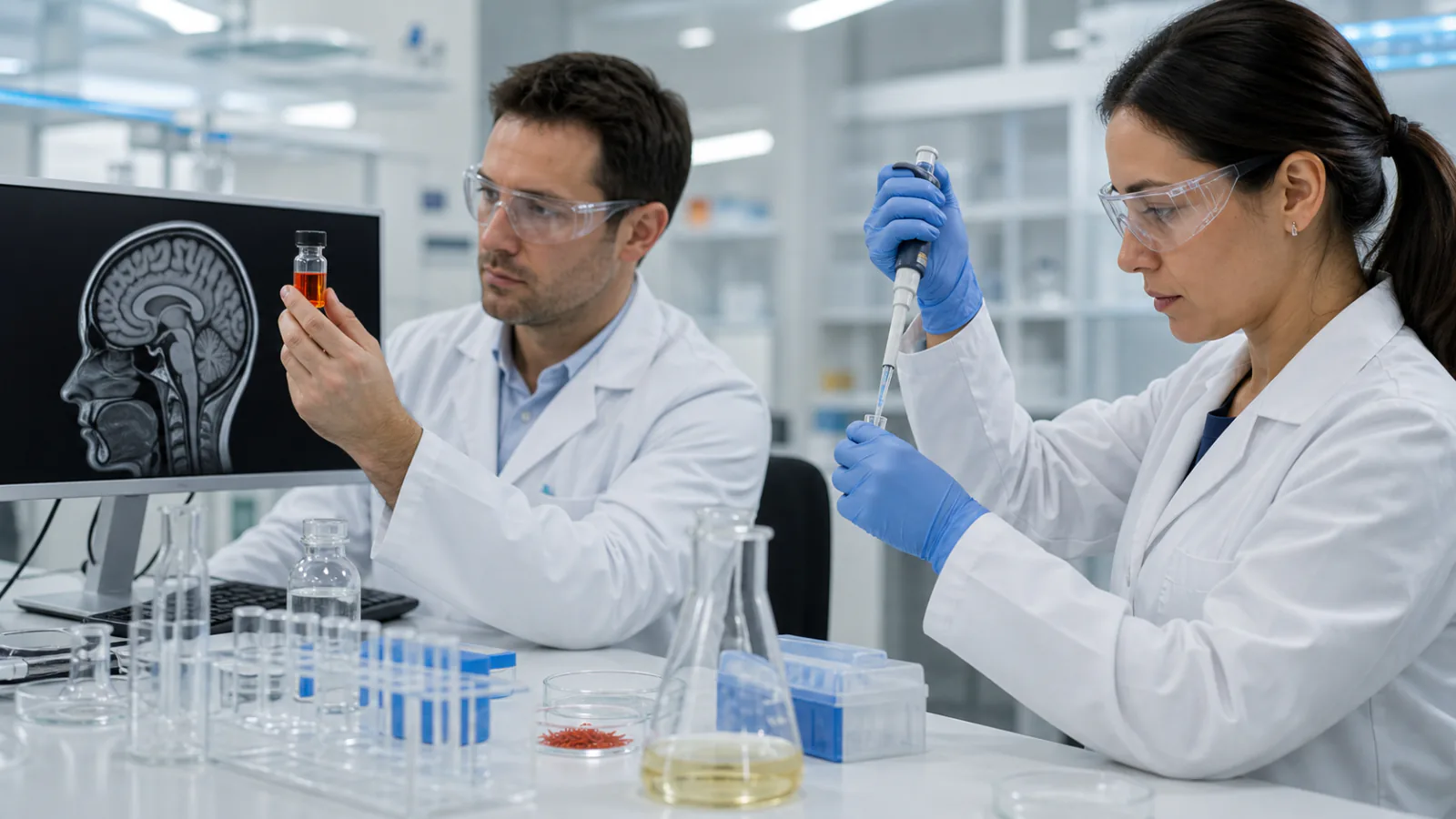
Research on crocin, saffron and memory is promising but not conclusive. A well-cited Mashhad University study found that crocin and saffron extract improved maze performance in rats after experimentally reduced blood flow to the brain. The experiment did not show that culinary saffron restores human memory or treats dementia.
Human trials have since investigated standardised saffron preparations in mild cognitive impairment and Alzheimer’s disease. Results justify further research, but the evidence base remains small and at risk of bias. Anyone with new or worsening memory problems needs medical assessment rather than a self-prescribed spice or supplement.
Crocin, Saffron and Memory: What the Research Shows
What is crocin?
Crocin is a family of water-soluble carotenoid compounds that gives saffron much of the golden colour released during blooming. It is related to crocetin, while safranal contributes strongly to aroma. These constituents can be isolated and studied at defined concentrations.
“Crocin,” “saffron extract” and culinary saffron are not interchangeable. An experiment may use purified crocin, a chemically characterised extract or an intraperitoneal injection—an exposure that cannot be reproduced by adding an unknown pinch to tea.
The Mashhad rat study behind the original report
The older news item discussed a paper from Mashhad University of Medical Sciences led by researchers including Seyed Ahmad Mohajeri. The study, published in Phytotherapy Research, was reportedly recognised at a science and technology festival after receiving 52 citations at that time.
The 2012 paper on crocin and memory after chronic cerebral hypoperfusion used adult male rats. Researchers permanently occluded the common carotid arteries to reduce cerebral blood flow, then injected crocin or saffron extract. Spatial learning and memory were measured in the Morris water maze.
Treated groups reached the hidden platform faster, travelled a shorter distance and spent more time in the target area than untreated hypoperfused rats. Those are meaningful results within that model. They do not represent recovery of a person’s memories, and permanent artery occlusion in a rat is not equivalent to every cause of human cognitive decline.
Why reduced brain blood flow was studied
Chronic cerebral hypoperfusion can contribute to vascular injury and cognitive impairment. Experimental models let researchers study oxidative stress, inflammation, neuronal damage and behaviour under controlled conditions. Crocin has been investigated because it can affect oxidative and inflammatory pathways in laboratory systems.
A proposed mechanism is not a clinical outcome. Antioxidant activity in a test system does not prove that taking more antioxidants improves memory, and the brain tightly controls which compounds reach neural tissue.
What human cognitive trials have found
A 2020 systematic review of randomised trials identified five studies with 325 participants. Four involved people with mild cognitive impairment or Alzheimer’s disease; one involved cognitively healthy participants. Saffron groups showed promising results on cognitive and functional measures compared with placebo or common symptomatic medicines.
The review’s caution is crucial. The studies were small and potentially at high risk of bias. Different preparations, limited replication and modest sample sizes prevent a firm conclusion that saffron is equivalent to approved treatment. The authors called for larger, lower-bias trials.
A broader 2024 systematic review of neurological and psychiatric trials also found signals for cognition and mood, while combining studies with different populations and outcomes. A pooled result can show a research direction; it does not tell an individual which product, if any, is appropriate.
What the research does not prove
- Crocin has not been established as a cure for memory loss or dementia.
- Culinary saffron has not been shown to prevent Alzheimer’s disease.
- A rat injection dose cannot be converted directly into a human supplement dose.
- A patented purification method or tablet does not prove clinical efficacy.
- A citation count measures scholarly attention, not whether a treatment works.
Patents, tablets and university research
The original report said crocin had been purified and patented at Mashhad University, that a tablet was under development, and that production would begin after necessary health-ministry permission. Those were future-facing statements. A patent protects an invention; regulatory permission, manufacturing quality and clinical evidence are separate requirements.
The article also mentioned continuing work on depression, diabetic retinal oedema and osteoarthritis. Each condition needs its own defined product, trial design, outcome and safety assessment. A positive result in memory research cannot be transferred to the retina or joints.
Similarly, the report suggested crocin might supplement existing depression treatment and improve happiness. Clinical mood research exists, but a person should not combine concentrated saffron or crocin with antidepressants without discussing interactions and monitoring with a prescriber.
Why memory symptoms need diagnosis
Memory difficulty can arise from sleep loss, depression, anxiety, medicines, thyroid disease, vitamin deficiency, infection, hearing problems, stroke, head injury or neurodegenerative disease. Sudden confusion, weakness, speech change or a severe new headache may signal an emergency.
Gradual changes also deserve attention when they interfere with work, medication, finances, cooking, driving or familiar tasks. A clinician can take a history, review medicines, test cognition and decide whether laboratory testing or imaging is appropriate.
If you are considering a saffron or crocin supplement
- Do not use it to replace assessment or prescribed dementia, stroke or psychiatric care.
- Identify whether the product contains whole saffron, an extract or purified crocin.
- Check the defined amount, other ingredients, batch testing and responsible manufacturer.
- Ask a clinician or pharmacist about pregnancy, bleeding risk, blood-pressure effects and medicine interactions.
- Avoid products that promise to reverse dementia, restore memory or work like an approved drug.
How to judge the next study
Look for a preregistered randomised trial with a clearly analysed preparation, adequate sample size, credible placebo or comparison, validated cognitive outcomes and enough follow-up. The report should show adverse events, withdrawals and funding as carefully as its positive results.
The strongest future evidence would reproduce findings across independent teams and connect cognitive scores to daily function. Until then, the Mashhad study remains an important preclinical step, and early human trials remain encouraging rather than definitive. Crocin is worth studying; it is not a reason to promise restored memory.

![Exporting Saffron to Turkey + Price Guide [Complete 0 to 100]](https://img.rowhanisaffron.com/20260827003933/saffron-export-turkey-quality-inspection.webp)



