Buying bulk saffron for a European brand begins with traceable origin, tested quality and control over every handoff. A polished label cannot compensate for an unidentified lot. The trade report behind this article made the same point from another angle: Iranian saffron was sometimes shipped in bulk and later sold under brands established elsewhere.
Published in 2017, the report described a market facing harvest-season speculation, weak coordination and informal cross-border movement. Its figures are historical, not current quotations or production totals. They are still useful because the commercial problem remains recognisable: growers need a fair route to market, while buyers need evidence that the saffron inside a pack is what its label promises.
Why European brands bought Iranian saffron in bulk
Iran has long supplied a large share of the world’s saffron. The original account said some Iranian product reached Spain without an Iranian consumer brand attached, after which established European businesses packaged and presented it to their own customers. It also referred to saffron moving through Afghanistan and onward to China and India, including informal “suitcase” trade.
Those statements should be read as observations from the 2017 interview, not as a description of every shipment or today’s trade rules. The report’s claim about a zero-percent Afghan tariff is especially time-sensitive. Tariffs, sanctions, origin rules and customs procedures change; an importer should confirm the current position for the actual origin, destination and customs code before ordering.
Bulk trade itself is not a quality defect. It is a normal supply format for food manufacturers, packers and private-label brands. The risk appears when the chain of custody is vague, the origin changes on paper, or a buyer relies on colour and aroma alone instead of lot-specific testing.
The production figures in the report
The interview cited more than 90,000 hectares of saffron cultivation in Iran, concentrated mainly in South Khorasan and Razavi Khorasan. It placed average dry-saffron yield at roughly 3.5 to 4 kilograms per hectare and discussed planning for exports of 350 tonnes. It also mentioned a policy aspiration to lift average yield to 10 kilograms per hectare.
That 10-kilogram figure was a target, not a guaranteed farm result. Yield varies with corm health, planting density, field age, climate, irrigation, soil, pests, harvest labour and drying losses. A commercial forecast should be based on verified local records rather than a national ambition.
The report also named Fars, Isfahan, Kerman, Yazd, Zanjan and North Khorasan among provinces where saffron cultivation was developing beyond the two principal Khorasan regions. Its wider claim was that production had spread across 23 provinces. For current national context, consult our saffron production statistics rather than treating the 2017 numbers as live data.
Harvest-season pressure on growers
Saffron flowers arrive within a short window. Picking, stigma separation and drying cannot simply be postponed while a grower waits for a better offer. The National Saffron Council representative quoted in the report argued that speculators used this pressure to buy cheaply at the opening of the harvest, creating a market imbalance that worked against producers.
Monitoring farm economics was proposed as one response. In practical terms, stronger alternatives include transparent grades, documented lot weights, access to working capital, cooperative processing, secure storage and more than one qualified buyer. These measures do not set a guaranteed price, but they reduce the need to accept an opaque offer under time pressure.
What a serious bulk buyer should specify
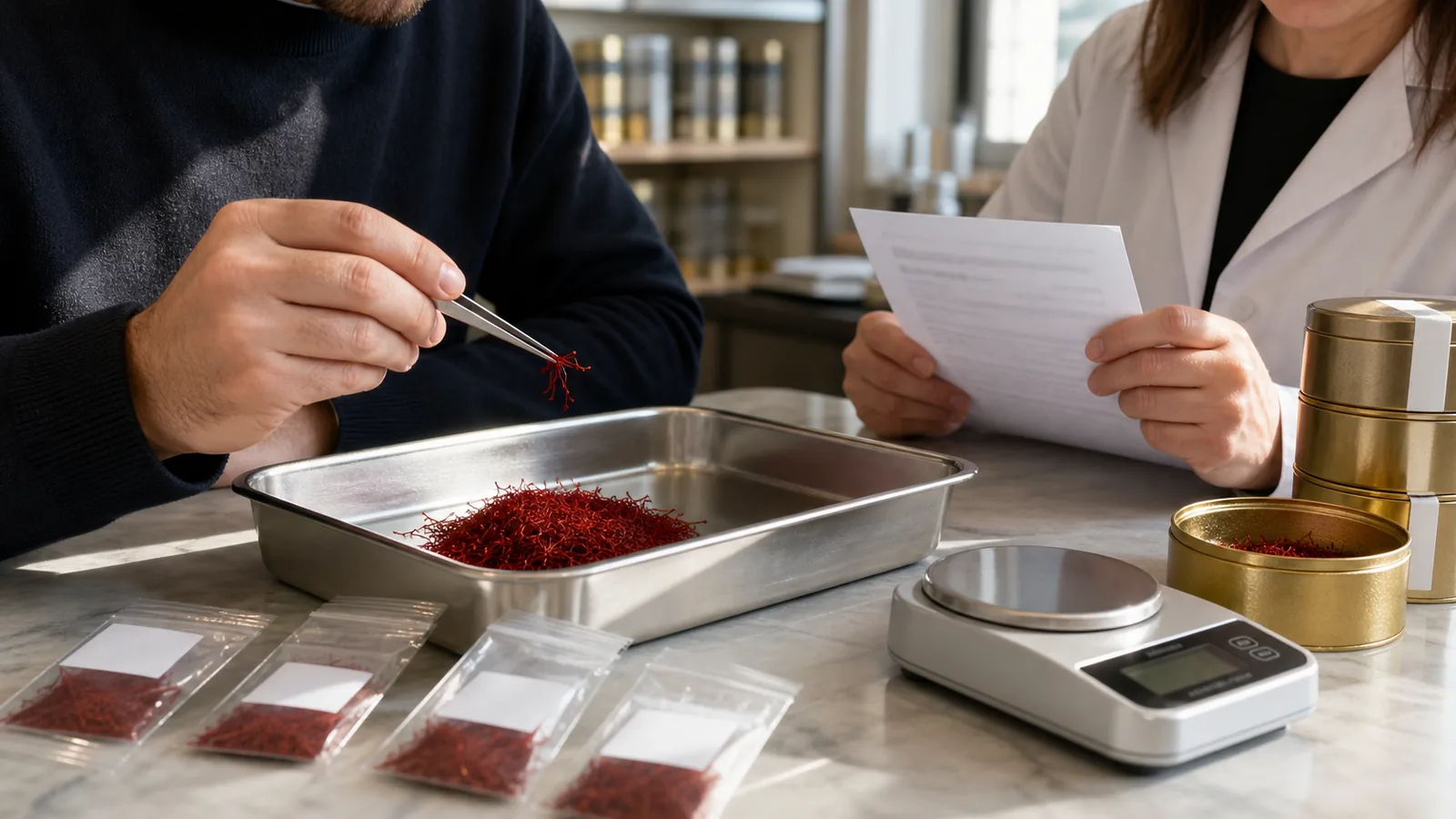
A European brand or California buyer should purchase against a written specification rather than a broad label such as “premium.” At minimum, the agreement should cover:
- the botanical identity Crocus sativus L.;
- declared country and region of origin, supported by traceability records;
- cut or presentation, such as all-red stigmas or stigma-and-style material;
- moisture and volatile matter limits;
- ISO 3632 test results for colouring strength, aroma and bitterness;
- microbiological, contaminant and adulteration tests appropriate to the market;
- lot code, harvest period, packing date and net weight;
- food-contact packaging and storage requirements; and
- an agreed sampling and rejection procedure.
The laboratory named on a certificate, the date of testing and the identity of the sampled lot matter. A report for one batch does not prove the quality of another. Retained reference samples also give both parties something concrete to examine if a dispute arises.
Branding without obscuring origin
A private-label pack can be made for a European or US business while still giving customers accurate information. The brand owner should keep the supplier and lot records behind the label, use origin wording that complies with the destination market and avoid suggesting that repacking changes where the crop was grown.
Origin is only one quality signal. Good saffron also depends on careful picking, hygienic separation, controlled drying and protection from humidity, light and foreign odours. Buyers comparing commercial lots can review our guide to wholesale saffron and ask for the same evidence from every supplier.
Buying saffron in California
The legacy address of this article refers to a saffron shop in California. The 2017 trade report does not provide a current California price or identify a local retail outlet. For a California business, the relevant questions are whether the seller can document the importer, lot, food-safety controls and delivered cost, and whether the pack meets current US labelling and import requirements.
A low per-kilogram quote can become expensive after freight, duties, testing, brokerage, repacking and rejected material are included. Compare offers at the same quality grade and on the same delivered basis. If a sample passes, the purchase contract should still tie the production lot to the approved specification.
A better route from field to finished pack
The old report’s concern was not that Iranian saffron appeared in European packaging. It was that value and identity could be lost between the grower and the final customer. The remedy is a shorter, documented supply chain: fair purchasing at harvest, controlled processing, independent testing, truthful origin information and a brand that can trace every pack back to its lot.
That approach gives growers a clearer market and gives buyers something stronger than a claim. It turns bulk saffron from an anonymous commodity into an ingredient whose origin, quality and handling can be checked.
Sources and context
- The production, trade-route and harvest-market statements above preserve the substance of the original 2017 interview attributed to Iran’s National Saffron Council and ISNA; they are identified as historical claims where they may have changed.
- ISO 3632-1:2011 and ISO 3632-2:2010 define saffron specifications and test methods.
- US Food and Drug Administration: Importing food products into the United States.