


Saffron production in East Azerbaijan has grown beyond a small experimental crop, but the difficult part begins after the flowers are picked. Farmers still face high harvest costs, low prices at the farm gate, weak bargaining power, bulk sales, uneven access to export markets and the risk of smuggling and other illegal trade during the short harvest season.
Why East Azerbaijan grows saffron
East Azerbaijan covers about 45,491 square kilometres in north-west Iran, roughly 2.8% of the country. Its dry conditions, cold winters and farming communities make parts of the province suitable for saffron, particularly around Marand, Mianeh and Azarshahr. The crop also uses its water at a different point in the agricultural calendar from many summer crops, which can make it a useful option in carefully selected fields. That does not mean it is water-free: soil, irrigation timing, healthy corms and local climate still determine whether a planting succeeds.
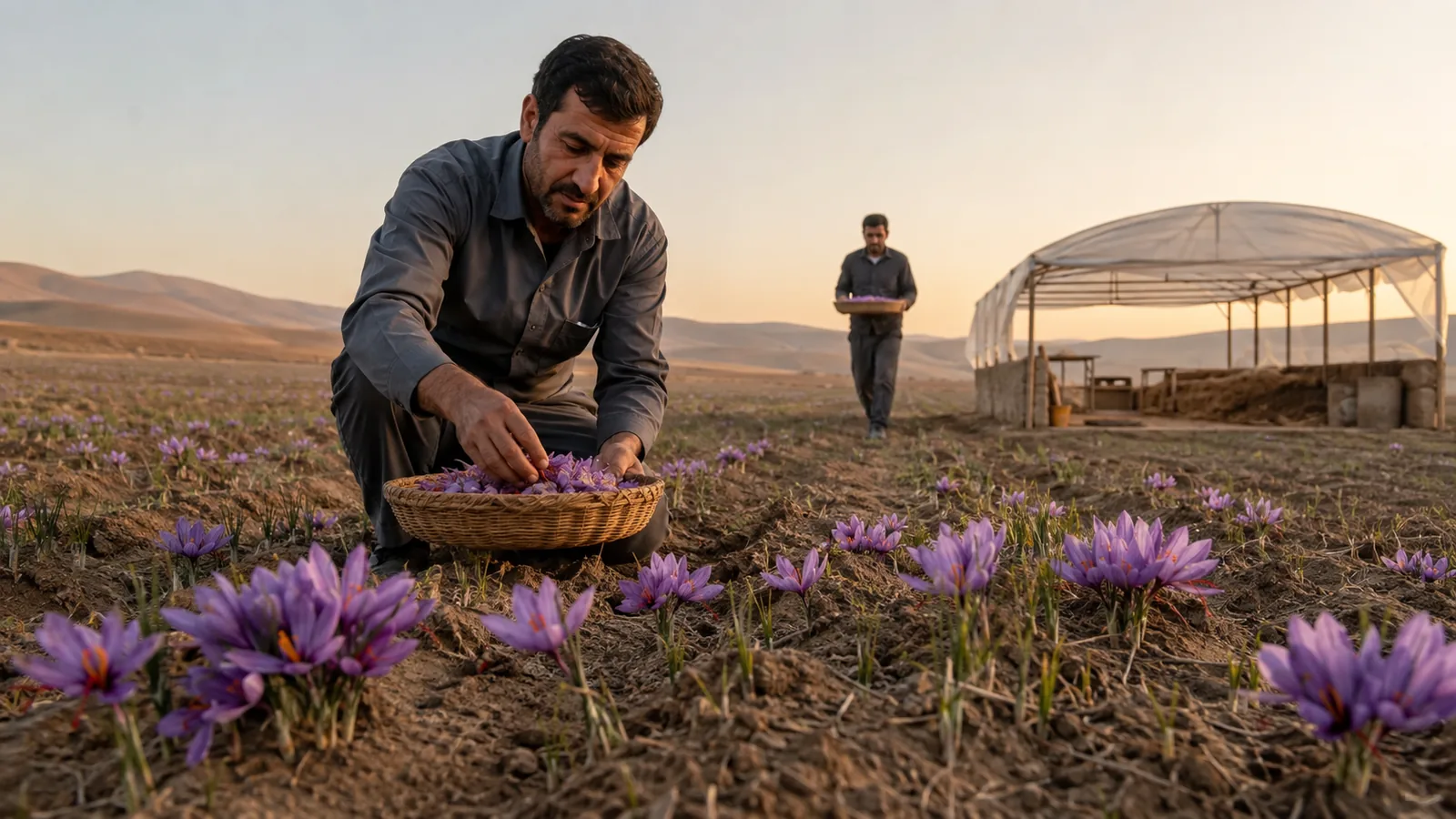
For rural households, saffron has an obvious attraction. A small quantity of dried stigmas can carry substantial value, and a well-managed field can remain productive for several seasons. Yet the crop is labour-intensive. Flowers arrive in a concentrated window, must be collected promptly and need careful separation and drying. Expansion without enough trained labour or reliable post-harvest facilities can therefore increase losses rather than income.
What the provincial production figures show
The figures commonly associated with this post come from an October 2021 report by the Iran Agriculture News Agency, quoting the horticulture director of East Azerbaijan Agricultural Jihad. They are a dated snapshot, not current production estimates.
- In 2020 (Iranian year 1399), the province had 337 hectares under saffron and reported 1.4 tonnes of production.
- For 1400, the cultivated area was reported at 367 hectares, with a forecast harvest of 1.7 tonnes.
- The provincial yield was given as 4.6 kilograms per hectare, compared with a national average of 3.2 kilograms per hectare in that report. The previous English version of this article said 2.3 kilograms, but that conflicts with the primary report and has been corrected here.
- Marand accounted for 202 hectares and about 1.1 tonnes, making it the leading county in the province at the time.
Those numbers show both expansion and a relatively strong reported yield. They should not be read as a promise for an individual farm, nor should the 2021 forecast be presented as today’s result. Weather, field age, corm density, irrigation, disease pressure and the speed of harvesting and drying all affect the final weight and grade. Earlier reports of saffron harvest growth in East Azerbaijan also belong to their own reporting periods, so comparing years requires matching the dates and areas covered.
Why cultivation growth does not guarantee farmer income
The original concern behind this article remains valid: growing more saffron is only one part of a functioning industry. A farmer may produce good stigmas and still receive a poor return when labour costs rise, buyers are scarce or the crop must be sold immediately. Fresh flowers are especially time-sensitive, leaving little room to negotiate if separation and drying facilities are unavailable. The report also described an awkward market moment in which international prices were rising while demand for Iranian saffron had weakened; that observation belongs to the reporting period, not today’s market.
The 2021 provincial report quoted fresh saffron flowers at 200,000–220,000 toman and dried saffron at 16–17 million toman per kilogram. The published report did not state a unit for the flower price, so it should not be used as a per-kilogram comparison. Both figures are historical and are included here only to preserve the market context of that report; they are not current buying or selling prices.
Labour and the short harvest window
Saffron flowers do not wait for a convenient work schedule. Picking usually starts early, and the stigmas need to be separated and dried without unnecessary delay. Labour shortages can leave flowers in the field or lead to rushed handling. Selective mechanisation may help with soil preparation, lifting corms, transport and controlled drying, but delicate flower collection and stigma separation still demand close handling. Mechanisation is useful when it protects quality and reduces bottlenecks, not simply because a machine is available.
Intermediaries, cash flow and bulk sales
Middlemen are not automatically harmful; they can aggregate small lots, provide cash and connect isolated farms with processors. The problem is a market in which farmers have no practical alternative and little information about grade or demand. Producer cooperatives, transparent grading, shared drying rooms and access to several verified buyers can improve bargaining power. Permanent markets and seasonal exhibitions may help buyers find producers, but they cannot by themselves remove every intermediary or guarantee a fair price.
Quality is decided after harvest as well as in the field
A good crop can lose value quickly through rough separation, slow drying, excess moisture or unsuitable storage. The useful goal is consistent, traceable saffron rather than the broad claim that one region is always superior to another.
- Pick clean flowers promptly. Keep soil, damaged plant material and other foreign matter out of the collection containers.
- Separate the stigmas carefully. Decide the intended grade before cutting so lots remain consistent.
- Dry under controlled conditions. The method should remove moisture efficiently without scorching the threads or exposing them to contamination.
- Protect the finished lot. Use food-safe, light-resistant packaging and record the farm, harvest date, grade and batch.
- Test claims before marketing them. Laboratory results and recognised specifications are stronger than unverified labels such as “premium” or “the best.”
Regional production stories, including the report on more than 400 kilograms from East Azerbaijan farms, are useful historical records. For a buyer, however, the condition and traceability of the actual lot matter more than a province-wide slogan.
The export challenge is a value-chain challenge
Iran remains a major origin for saffron traded internationally, while Spain is both a producing country and an important importer, packer and distributor. World Bank WITS data based on UN Comtrade show that Spain reported importing 39,649 kilograms of saffron from Iran in 2024. That evidence supports a real trade relationship; it does not support the sweeping claim that all saffron sold under Spanish brands is merely relabelled Iranian product.
For East Azerbaijan producers, the practical lesson is that origin alone does not secure the final retail value. Export customers need repeatable grades, residue and authenticity documentation where required, dependable delivery, suitable pack sizes and labels that comply with the destination market. Better packaging is part of the answer, but quality control, records, logistics and a trusted commercial relationship come first. Our overview of Iranian saffron in global trade explains how origin and distribution roles can overlap.
East Azerbaijan’s location near Iran’s north-western borders may support regional logistics, but proximity is not the same as market access. Customs requirements, payment channels, transport conditions and buyer demand still decide whether a shipment is viable. Government support is most useful when it improves testing, market information, lawful export routes and producer access to training rather than encouraging volume without a buyer.
A stronger path for East Azerbaijan saffron
The province has demonstrated that it can cultivate saffron at a meaningful scale. The next gains are likely to come from keeping more value close to the farm: reliable separation and drying, objective grading, traceable batches, professional packaging and several routes to market. Cooperatives can help small growers share those costs, provided their grading and payment systems are transparent.
Expansion should remain evidence-led. Before planting more land, growers need to know whether the field suits saffron, who will handle the harvest, where the flowers will be processed and which buyer the finished grade is intended for. That turns saffron production in East Azerbaijan from a hopeful acreage figure into a planned agricultural business—one that respects the skill of the farmer and the expectations of the customer.
Sources and date note
The province figures and historical prices above come from the Iran Agriculture News Agency report dated 27 October 2021. The international trade comparison uses World Bank WITS data for 2024 saffron imports from Iran. Production and price figures change; readers making farm or purchasing decisions should obtain current local figures rather than treating this historical article as a quotation.

![Exporting Saffron to Turkey + Price Guide [Complete 0 to 100]](https://img.rowhanisaffron.com/20260827003933/saffron-export-turkey-quality-inspection.webp)



