Saffron has produced a hypotensive effect in laboratory animals, but the original experiment did not show that saffron is a treatment for low or high blood pressure in people. The extract and isolated compounds were injected into anesthetized rats. Later human trials found much smaller average changes, and people who already have low blood pressure should be especially careful with concentrated saffron products.
What does hypotension mean?
Hypotension means blood pressure that is lower than expected. A low reading is not automatically a problem: some healthy people naturally have lower pressure without symptoms. The American Heart Association says a reading below 90/60 mm Hg is commonly described as hypotension, but symptoms and the underlying cause matter.
Dizziness, fainting, confusion, blurred vision, nausea, unusual fatigue or palpitations can make low pressure clinically important. A sudden drop may be related to dehydration, bleeding, medicines, pregnancy, heart or endocrine conditions, or another cause that needs assessment. Saffron should not become a distraction from finding that cause.
The saffron, crocin and safranal experiment
The study described in the original article was conducted by researchers at Mashhad University of Medical Sciences and published in 2010. In the rat experiment, the team tested an aqueous extract of saffron stigmas and two constituents, crocin and safranal.
Some rats had normal blood pressure. Others had experimentally induced hypertension. The preparations were administered intravenously at several weight-based amounts, and the researchers measured mean arterial pressure and heart rate. In that setting, the extract, crocin and safranal lowered mean arterial pressure in a dose-dependent way. The authors concluded that both compounds appeared to contribute, with safranal possibly playing the larger role.
Those details are important because they define what the research can tell us:
- It was an animal study, not a clinical trial in people.
- The animals were anesthetized and the preparations were injected.
- The model used artificially induced hypertension.
- The measured amounts cannot be translated into teaspoons, cups of tea, capsules or a safe human dose.
The large pressure changes reported in the rats are therefore not a realistic estimate of what a person should expect from food or a supplement.
What have human studies found?
Human evidence is more relevant, although it remains limited. A 2021 systematic review and meta-analysis of eight randomized trials found small average reductions in both systolic and diastolic pressure with saffron supplementation. The authors specifically noted that the effect might not be large enough to have clinical importance.
Another clinical review found an average change in diastolic pressure but not systolic pressure, illustrating that results vary with the studies included and their quality. This is a much more modest picture than the animal experiment. Our broader guide to saffron’s effects on blood pressure explains the human evidence and its limitations in more detail.
Neither body of evidence establishes saffron as a replacement for an antihypertensive medicine. It also does not show that saffron can safely correct hypotension. “Lowers blood pressure” and “treats a blood-pressure disorder” are different claims.
Could saffron make low blood pressure worse?
The average effect in clinical trials was small, but averages do not predict every individual’s response. A concentrated extract may also differ from the culinary saffron used in a meal. If you have symptomatic hypotension, take blood-pressure medicine, or use other products that can lower pressure, discuss saffron supplements with a doctor or pharmacist first.
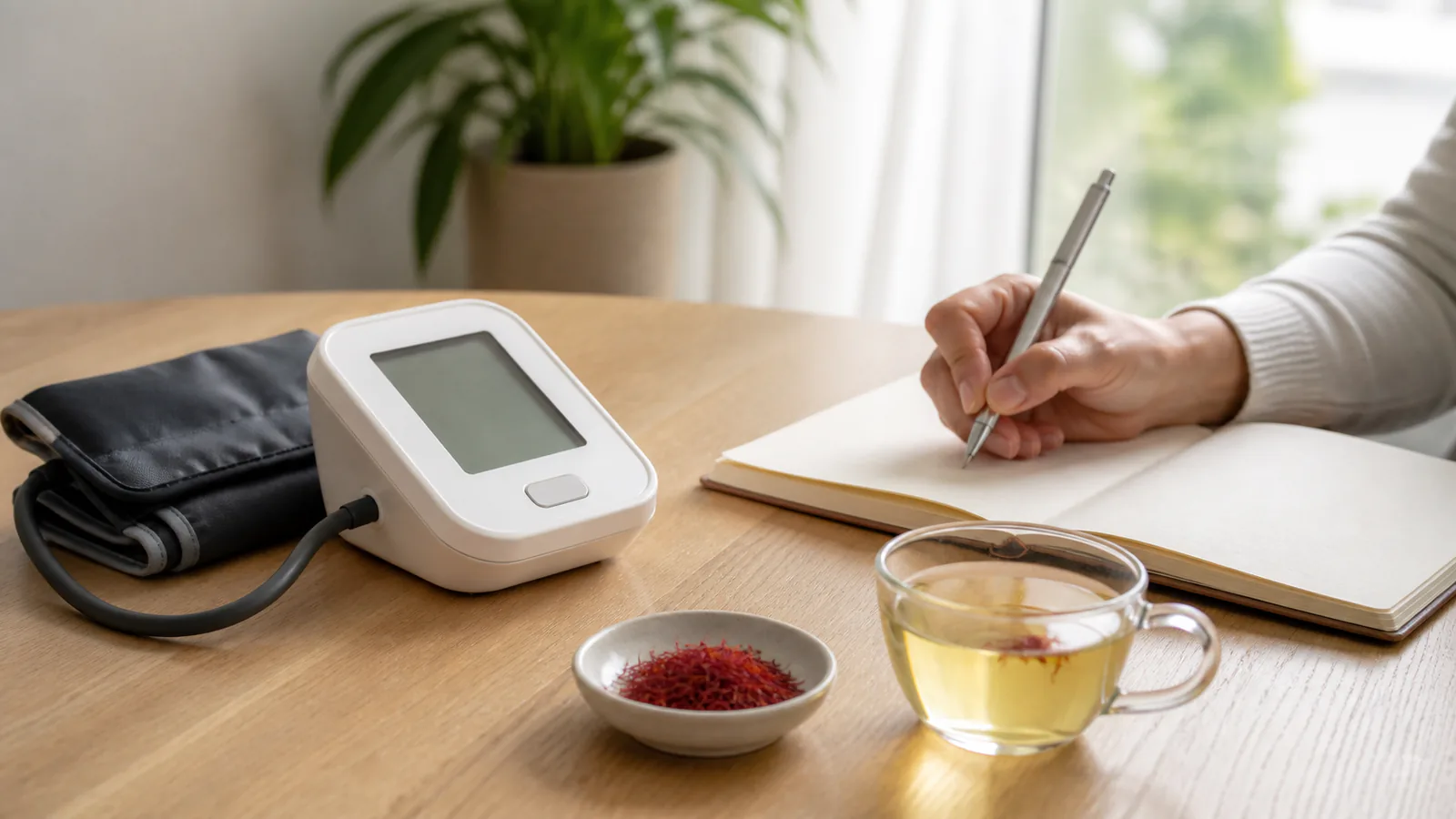
Pay particular attention when starting or changing any supplement. Keep a record of the product, timing, blood-pressure readings and symptoms. Do not stop or adjust prescribed medication on your own. Seek prompt medical advice after fainting, a sudden symptomatic drop in pressure, or repeated dizziness. Emergency symptoms such as chest pain, severe breathing difficulty, signs of shock or loss of consciousness require urgent care.
Natural saffron is not one uniform preparation
The phrase “natural saffron” may refer to whole stigmas, powder, tea, aqueous extract or a capsule. These are not interchangeable. Crocin and safranal content can vary with plant material, storage and processing, while supplements may combine saffron with other ingredients.
That variation is another reason not to turn the rat experiment into a dosing guide. The research question was whether particular preparations affected blood pressure under controlled laboratory conditions. It was not a test of a commercial product, a recipe or self-treatment.
The practical conclusion
Saffron and hypotension are linked by a plausible biological effect and an informative animal study. Human trials suggest that supplements may lower blood pressure slightly on average, but the clinical significance is uncertain. People with low readings or symptoms should treat that as a safety consideration, not as proof that saffron caused the problem or that it can solve it. A healthcare professional can help identify the cause and review possible interactions.