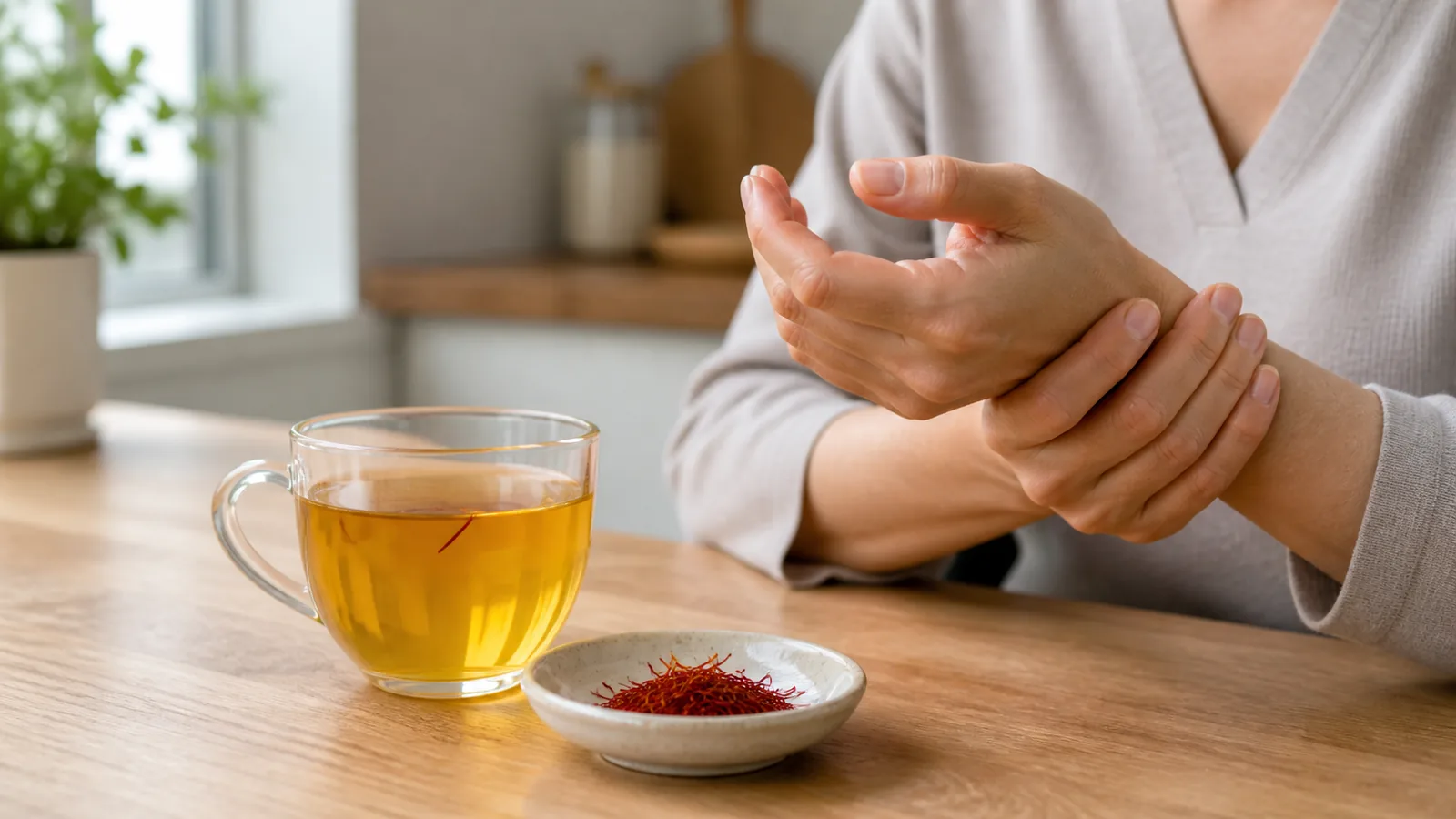
Saffron has shown an ability to absorb ultraviolet radiation in laboratory formulations, but saffron threads, homemade creams and saffron water are not tested sunscreens. The research behind the claimed sun-protective effect used safranal enclosed in specially prepared lipid particles and measured performance in vitro. It did not show that applying saffron to skin can replace a regulated broad-spectrum sunscreen.
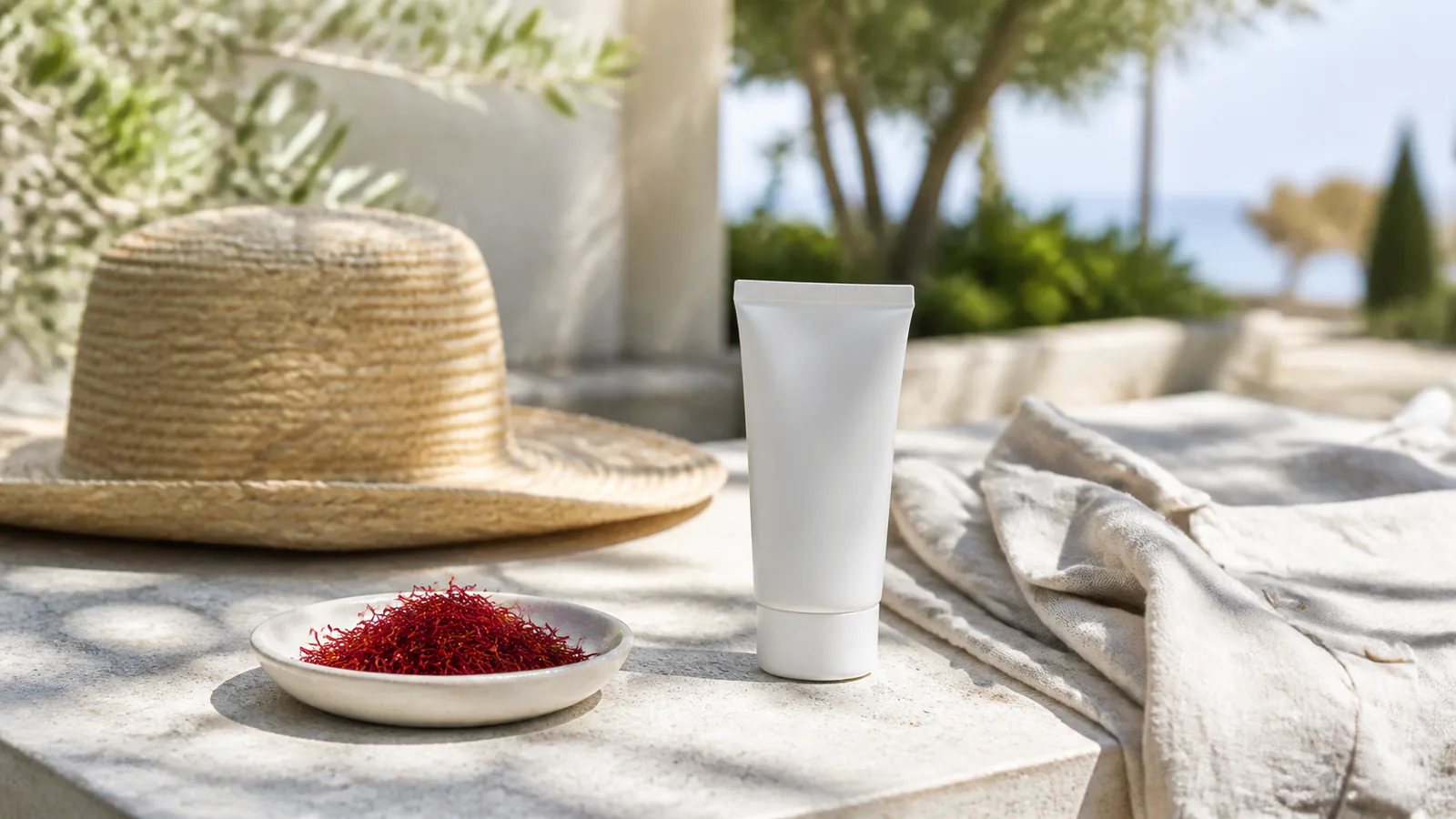
What the saffron sunscreen study tested
Researchers at Mashhad University of Medical Sciences investigated safranal, an aromatic constituent associated with saffron. Their 2011 formulation study placed safranal inside nanoliposomes: microscopic lipid carriers designed to hold and deliver an ingredient.
The team prepared formulas containing different safranal concentrations and compared them with a homosalate reference. They estimated sun protection factor using two laboratory methods. They also studied how much safranal crossed or remained in mouse skin, and used an instrument to measure skin moisture in human volunteers after topical application.
At equal concentration, the formulation containing 8% safranal produced a higher in-vitro SPF result than the 8% homosalate reference. A 1% formulation showed low penetration across mouse skin. The tested 1% and 4% formulas did not produce a moisturizing advantage over empty liposomes during the measurement period.
Why this does not make kitchen saffron a sunscreen
The carrier system was part of the experiment. Nanoliposomes affect how an ingredient disperses, reaches the skin and remains stable. Loose threads in oil, a face mask, saffron water or a homemade cream do not recreate that formulation.
There are other limits:
- Most SPF work was in vitro. Laboratory absorption measurements are useful for screening a formula, but they do not establish how a homemade product performs on people in sunlight.
- SPF is not the whole story. It mainly describes protection from the UVB radiation that causes sunburn. Broad-spectrum performance also requires adequate UVA protection.
- The ingredient was not the finished consumer product. Stability, even coverage, skin reactions and water resistance all need testing.
- More is not automatically better. Increasing an aromatic compound may affect irritation, scent, color and safety as well as UV absorption.
A later laboratory study of safranal-loaded solid lipid nanoparticles also found increasing in-vitro SPF as the amount of safranal rose. It supports continued formulation research, not a recommendation to apply saffron directly.
What SPF and broad spectrum mean
The US Food and Drug Administration explains that SPF primarily indicates UVB protection. A product labeled broad spectrum has also passed testing related to UVA protection. SPF does not tell you how many hours you can remain in the sun, and no sunscreen blocks all ultraviolet radiation.
The American Academy of Dermatology recommends choosing a sunscreen that is:
- broad spectrum, covering UVA and UVB;
- SPF 30 or higher; and
- water resistant.
Follow the label for the amount and timing of application. Reapply as directed, particularly after swimming or sweating. Shade, protective clothing, a wide-brimmed hat and sunglasses remain useful because sunscreen is only one part of sun protection.
Can saffron still be useful in skin research?
Yes. Safranal and other saffron constituents are interesting candidates for researchers studying UV absorption, antioxidants, carrier systems and topical delivery. A useful early formulation result can lead to stability testing, irritation assessment and appropriately designed human studies.
That development path matters. A plant compound does not become a reliable sunscreen simply because it absorbs some UV light. The complete formula has to provide consistent, broad and durable coverage without unacceptable harm, and its labeled protection has to be established by the relevant test methods.
Should you put saffron on sun-exposed skin?
Do not use saffron as your only sun protection. A DIY mixture has no verified SPF, UVA protection or water-resistance claim, and its deep color can stain skin and clothing. Fragrant plant constituents may also irritate sensitive skin. If you choose a cosmetic containing saffron, check the sunscreen label rather than assuming the ingredient supplies protection.
Stop using a product that causes burning, swelling, blistering or a spreading rash. Seek medical advice for a severe reaction or a concerning sunburn. People with a history of skin cancer, photosensitivity or medicines that increase sun sensitivity should ask a clinician for individualized guidance.
The practical conclusion
The sun-protective effect of saffron is best described as a formulation research finding. Safranal in engineered lipid carriers produced measurable in-vitro SPF, which may help scientists design future products. Until a finished product has passed the necessary safety and effectiveness tests, choose a labeled broad-spectrum, water-resistant sunscreen and do not substitute a homemade saffron preparation.