


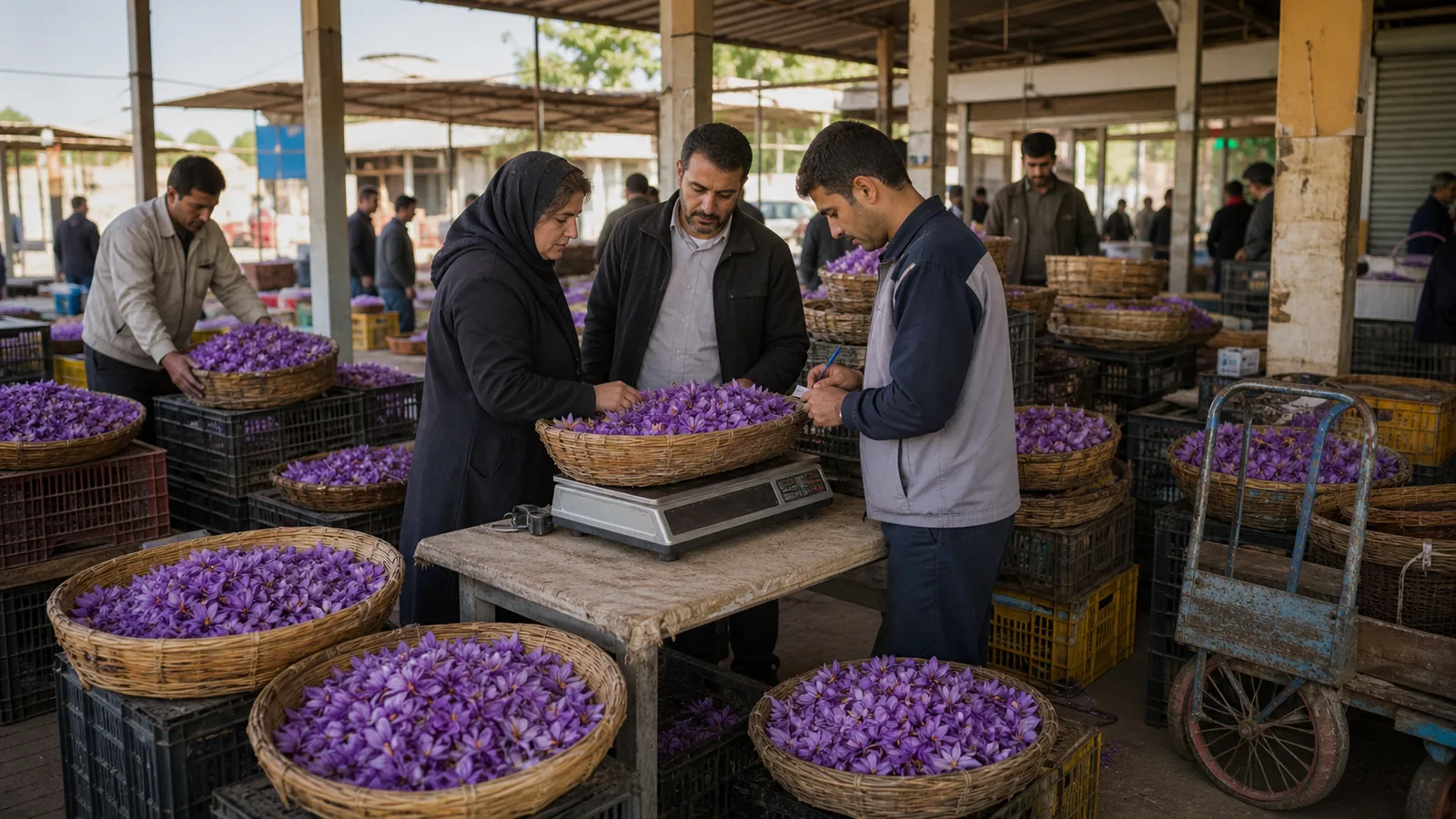
The saffron flower market launch in Rashtkhvar created a small, central place for growers to sell the morning’s harvest during the 2015 season. Supported by the local Islamic council and municipality, the market opened with six stalls and reported funding of 50 million rials.
Rashtkhvar is the spelling preserved in this article’s title and URL; Rashtkhar is another common English rendering of the Persian place name. The historical report described a busy trade point, not a market for jars of dried saffron. Farmers arrived with whole fresh flowers, sold them by weight, and left the delicate work of separating and drying the stigmas to the next part of the chain.
How the Rashtkhar saffron flower market worked
Hossein Choopan, identified as a member of the Rashtkhar farmers’ trade association, told ISNA that growers came to the market after picking their crop. Fresh saffron flowers were being sold for 40,000–50,000 tomans per kilogram. The damaged English version changed the currency to dollars; the original figure was in historical tomans.
The market operated each day after harvest. Choopan said more than seven to nine tonnes of flowers were bought and sold daily across the saffron-producing county. That was a flow of fresh flowers, most of whose weight is petals and moisture. It must not be reported as seven to nine tonnes of dried spice.
A daily venue suited saffron’s unusually short timetable. Flowers are picked in the morning, the three stigmas must be separated without crushing or contamination, and the stigmas then need controlled drying. A buyer of fresh flowers is taking on labour, handling and quality risk that does not exist in the same form when purchasing finished saffron.
What six stalls could change for a grower
Choopan said the centralized market helped stabilize buying and selling prices, narrowed the difference between Rashtkhar and other city markets, and concentrated trade in one place. Each outcome is plausible, but the article supplied no before-and-after price series to demonstrate it.
FAO’s work on agricultural prices explains why the basic mechanism matters: up-to-date information about prices as goods change hands can improve market transparency and help producers and traders make better decisions. A grower who sees several real bids for the same morning’s flowers has more information than one waiting for a single buyer at the farm gate.
The building itself does not create competition. Six stalls could still produce a weak result if one buyer controls most purchases, scales are not checked, price information is hidden or farmers cannot afford transport. FAO’s smallholder analysis likewise notes that information alone may not translate into a better farm price when intermediary power, finance and access remain unequal.
For the market to support price discovery, each lot would need the same basic treatment:
- a visible gross weight, container tare and net flower weight;
- a price stated for the same unit and payment terms;
- more than one buyer able to inspect and bid;
- a time, grower and village record for the lot;
- a simple process for scale, payment or quality disputes;
- daily publication of volume, minimum, maximum and typical prices.
Those records would make Choopan’s price-stability claim testable instead of relying on impressions from a crowded harvest morning.
The 2015 price should stay in 2015
The reported 40,000–50,000 toman price belongs to a particular harvest, currency value and local flower market. It is not a current price for fresh flowers, and it cannot be compared directly with a retail price for dried saffron.
A buyer working backwards from the eventual spice has to allow for flower-to-stigma yield, separation labour, drying loss, quality grade, packaging and rejected material. Those variables change from lot to lot. A fixed fresh-to-dry conversion would create false precision because flower size, stigma development, moisture and how much style remains all vary.
The useful comparison is the grower’s net return after picking and transport. A higher quoted flower price may still leave less income if the market is far away, payment is delayed or a heavy container is not tared correctly. Conversely, a transparent nearby sale can reduce the time a household spends looking for a buyer when the flowers need immediate attention.
Why handling matters at a fresh-flower market
Fresh saffron flowers are not a durable warehouse commodity. They should be shaded, kept in shallow ventilated containers and moved without compression. A deep sack may be convenient to carry but can trap heat, bruise flowers and make clean separation harder.
A peer-reviewed review of saffron drying and post-harvest work describes how labour-intensive the sequence is: picking, transport, stigma separation and drying all shape the finished product. It also notes that collecting 1,000 flowers and then separating their stigmas can take far longer than the initial field cut alone.
That means the market’s capacity cannot be judged only by tonnes crossing its scales. Buyers also need enough clean work space, trained separators and dryer capacity to process the flowers they acquire. If seven to nine tonnes arrive faster than the next stage can handle them, a successful trading day may become a quality problem by evening.
Our article on the Iranian flower-to-drying workflow covers the handling sequence. A separate historical account of the supervised fresh-flower pavilion in Torbat Heydarieh shows how another city approached market rules. The Rashtkhar story is specifically about a six-stall local launch.
Drought changed the volume arriving at market
Choopan connected recent droughts with an estimated 50 percent reduction in saffron flowers across Rashtkhar fields. He described saffron as a strategic crop for the county and said the previous season had produced more than seven tonnes of dried saffron, while the current season was visibly lower.
The two statements use different measures. A 50 percent fall in fresh flowers during an unfinished harvest does not automatically prove a 50 percent fall in final dried saffron. The eventual result also depends on productive area, stigma size, separation and drying.
ISNA placed the county’s saffron area at 5,000 hectares. The report did not say whether every hectare was productive, whether the figure referred to the same season as the seven-tonne harvest, or how drought exposure varied among villages. Those gaps prevent a reliable county yield calculation.
The market could still help document the season. Daily net flower volume, combined with participating growers and village origin, would show when arrivals peaked and how one area compared with another. It would not capture flowers sold elsewhere, but it would be far stronger evidence than a single percentage announced mid-harvest.
Did the market direct more money to farming?
The association’s secretary said the flower market helped direct financial resources towards local agriculture, completed a missing link in the saffron production chain, added grower income and encouraged agricultural activity. The article offered no accounts, participation rate or farm-income comparison to verify those benefits.
A serious evaluation would compare the market with the previous sales route. It would record how many growers used the stalls, what share of county flowers they sold, the number of active buyers, average transport time, rejected lots, payment delays, price spread and net price after fees. It would also follow the flower into processing to see whether faster sale led to faster separation and more consistent dried quality.
The 50 million rials may have been the launch allocation for six stalls, but the report did not say whether it covered land, structures, scales, staffing, cleaning or daily operation. It is therefore a historical funding figure, not a full market-cost estimate.
What the launch established
The 2015 report establishes that Rashtkhar opened a six-stall seasonal market with council and municipal support. It records a fresh-flower price of 40,000–50,000 tomans per kilogram, claimed daily trade of seven to nine tonnes, a 50 percent drought-related flower decline, more than seven tonnes of dry saffron in the preceding year and 5,000 hectares under saffron.
It does not prove that prices stabilized, income rose or the market remained active in later seasons. Those claims need transaction and farm data.
The market’s design was nevertheless pointed at a real bottleneck. Saffron flowers arrive quickly, spoil in quality if handled badly and must find labour and drying capacity almost immediately. A clean venue with honest scales, visible prices, competing buyers and fast onward handling can reduce that friction. Whether Rashtkhar’s six stalls achieved it is the result the original article left unwritten.

![Exporting Saffron to Turkey + Price Guide [Complete 0 to 100]](https://img.rowhanisaffron.com/20260827003933/saffron-export-turkey-quality-inspection.webp)



