


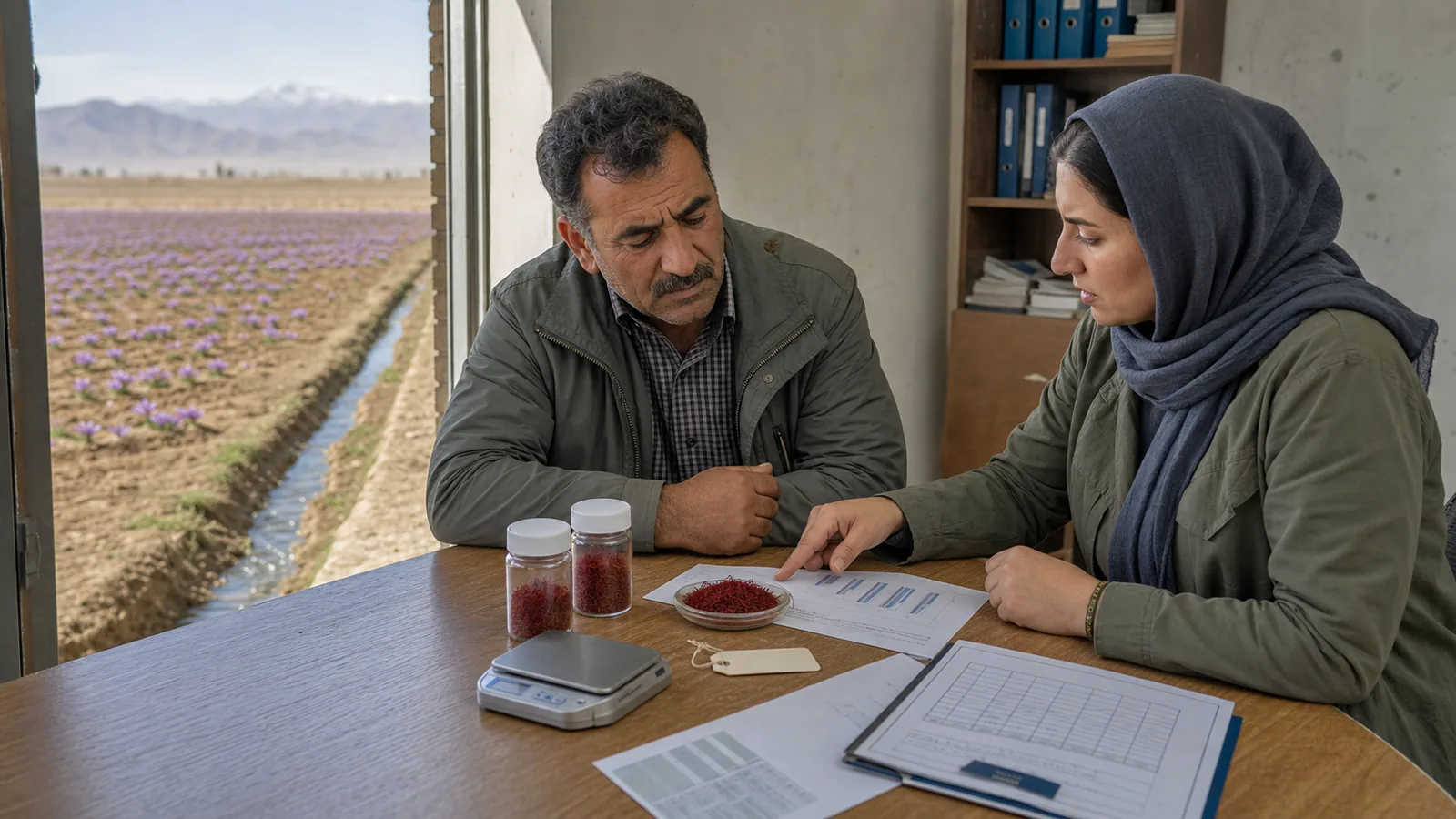
The phrase Chinese Saffron concern sales in this province came from a 2015 warning about Khorasan, not evidence that Chinese-grown saffron had already taken over its shops. Behzad Sadeghi, described in the original report as a senior adviser to Iran’s National Saffron Council, feared that saffron presented as Chinese might one day be sold in Khorasan at one-third of the local price.
His worry joined several real pressures—competition, drought, weak market planning and rural dependence on one crop—but it also included figures that were never sourced. A later official record helps separate the solid parts from the rhetoric. It shows that China was buying Iranian saffron in 2015, while the claimed US$400 million export value did not describe that year’s customs total.
What the 2015 Chinese saffron warning actually said
Sadeghi’s argument began with a vivid hypothetical: cheap Chinese saffron appearing in the streets and alleys of Khorasan. The “one-third” price was his feared outcome. The report did not identify a seller, a completed import, a tested sample, a product grade, a date or a price series.
He blamed delay in a comprehensive saffron plan that he said had taken four years to prepare and present to national officials. In his telling, continued inaction could leave time for foreign producers to develop their own supply while Iranian growers lost ground. He called for special government attention and referred more than once to intervention by the Ministry of Interior.
The concern was as much regional as international. Sadeghi questioned the spread of saffron into wetter western and northern provinces, where farmers could choose other crops. Khorasan growers with dry qanats and few alternatives, he argued, would bear a harder loss if drought continued and overseas demand moved elsewhere.
He also said the world wanted Iranian saffron. That point sits awkwardly beside the warning but is important: his case was not that buyers had stopped valuing Iranian origin. It was that Iran might fail to turn its production advantage into durable farm income.
The one-third price was not a recorded sale
Nothing in the surviving report establishes that saffron from China was being sold in Khorasan for one-third of the prevailing price. It is a forecast framed for political effect.
Even a genuine low quotation would need context. Dried stigma grade, colour strength, style content, moisture, foreign matter, testing, net weight, package size and payment terms all affect the comparison. Customs value, a bulk contract and a retail jar are not interchangeable prices. Nor does the exporting country automatically reveal where a crop was grown.
Chinese saffron cultivation is real rather than imaginary. Recent peer-reviewed field research used corms from Jiande in Zhejiang and conducted saffron trials in Sichuan. That establishes agricultural capability in China; it does not prove that Chinese-grown material entered Khorasan in 2015 or undercut an Iranian lot.
The site’s fuller account of the fear of Chinese saffron sales explains the separate questions of cultivation origin, customs origin, re-export and product authenticity. This page has a narrower job: checking Sadeghi’s policy claims against the figures available for the period.
What official 2014–15 data confirm
An official working document submitted through the FAO/WHO Codex process compiled Iranian Ministry of Agriculture-Jahad and Iran Customs data for the years around the speech. Its production table records 69,407 hectares in Razavi Khorasan and 14,727 in South Khorasan for crop year 2014–15. Together that is 84,134 hectares, so Sadeghi’s rounded statement of more than 80,000 hectares across the two provinces is consistent with the later official table.
The trade figures make the China relationship less simple than the warning suggested. Iran’s 2015 saffron exports were recorded at 121.573 tonnes worth US$165.303 million. China was the third destination by net weight: 11.557 tonnes, valued at US$17.583 million, or 9.5 percent of the listed weight.
In other words, China was already a customer for Iranian saffron in the same historical period. That does not rule out future competition or re-export. It does mean “China” cannot be treated only as a hostile producer in an honest account of the market.
The separate article on saffron exports to China examines the old tariff and indirect-routing problem. Those border costs are different from the unverified claim that Chinese-grown saffron was sold inside Khorasan.
The US$400 million claim needs a year
Sadeghi said saffron foreign-exchange earnings had passed US$400 million and compared the figure with the province’s non-oil exports. The report never supplied a year or customs table.
The later official series offers a plausible clue, but not proof. It records Iranian saffron exports worth US$361.618 million in 2011 and US$418.862 million in 2012, followed by US$200.300 million in 2013, US$227.629 million in 2014 and US$165.303 million in 2015. His figure may have referred to the 2012 high, an estimate, or another scope. It should not be presented as the value for 2015.
His description of saffron as the best alternative to oil went further. The report says its earning capacity was two to three times that of oil, but gives no common unit, period or denominator. A kilogram price, rural income, export value and return on water are different measures. Without knowing which one he meant, the multiple cannot be verified.
Saffron plainly has value beyond its shipment total. Picking, stigma separation, drying, grading, testing, packing and sales distribute work through rural and commercial businesses. That is a reason to measure the chain carefully, not to claim that a crop and a national energy industry are equivalent.
Water efficiency cannot be reduced to one flow rate
The report credits saffron with unusual water efficiency and gives a minimum flow of 0.03 litres per second. Sadeghi said that amount could support the income of a family of five and help prevent migration to a city.
A flow rate alone cannot establish either result. It needs a delivery duration, irrigated area, soil and climate, conveyance loss, irrigation schedule, corm density, flower yield, labour cost and sale price. The same flow can serve very different areas depending on how long and how reliably it is available.
Peer-reviewed research on Iran’s saffron water footprint also found substantial provincial variation. Green, blue, grey and irrigation-loss components differed by location, as did economic water productivity. Saffron’s summer dormancy can suit dry regions, but the crop still depends on timely water and is not automatically the best use of every field.
That makes Sadeghi’s geographic question worth retaining, even though his answer was too broad. Expansion into a wetter province should be assessed through local yield, rainfall, irrigation demand, alternative crops and market access. Protecting Khorasan does not require pretending saffron can grow only there; it requires understanding why families there may have fewer substitutes when qanats fail.
The employment figures remain attributed estimates
Sadeghi linked the two Khorasan provinces’ saffron area to 160,000 operators. He added that roughly 100,000–200,000 people worked in distribution and said the crop supported a population of about one million when dependent households were considered.
The area figure can be checked. The labour figures cannot be reconstructed from this article because it cites no survey and does not define “operator,” seasonal worker, distributor or dependant. A picker employed for several harvest mornings is not the same statistical unit as a farm owner or a full-time packer. Household members may rely partly, rather than wholly, on saffron income.
These numbers should remain part of the historical record because they show the scale of livelihood concern behind the speech. They should not be carried into a current market report until a dated labour source defines who was counted.
What a saffron plan would need to measure
The government programme discussed at the time covered production, processing, distribution and export. Its stated ambitions included higher yields, improved quality, formal records for farms and growers, better processing and packaging, stronger standards and a national identity for Iranian saffron. An announced programme, however, is not evidence that each part was funded or completed.
A useful review would follow outcomes rather than repeat targets. It would track productive hectares and yield separately, test water productivity by region, distinguish farm-gate income from export value, publish the number of active growers, and show how much saffron leaves under an identifiable Iranian brand. It would also record destination, net weight and unit value so a change in price is not mistaken for a change in volume.
For competition with saffron in China or any other country, four records matter most:
- farm and batch origin that follows the product through packing;
- quality results tied to the lot actually offered for sale;
- comparable customs data with year, code, partner, weight and value;
- grower returns after water, labour, processing, transport and finance costs.
Those measures would test whether market share and rural income were protected. A headline about foreign competition cannot do that work.
Reading the warning without repeating the alarm
The 2015 Chinese Saffron concern captured a legitimate fear: a drought-exposed producing region could lose bargaining power while policy stalled. It also turned an unobserved one-third-price scenario into the article’s most memorable line and mixed defensible acreage with unsupported comparisons to oil and household income.
Official figures support the scale of Khorasan’s planted area and confirm that China mattered to the trade. They show China as a buyer of Iranian saffron in 2015, not evidence of a completed takeover of Khorasan’s market. Later agronomic research confirms that saffron is cultivated in China, but cultivation capacity is not proof of what was sold in a particular province ten years earlier.
The lasting issue is whether growers can prove origin and quality, use scarce water productively and keep enough value from the finished sale. Those are measurable questions. They offer Khorasan a stronger defence than fear of a cheap, undefined product.
Historical statements are preserved from this site’s October 2015 report. Official production and customs tables, the archived programme account and peer-reviewed water and cultivation studies were reviewed on 29 August 2026.

![Exporting Saffron to Turkey + Price Guide [Complete 0 to 100]](https://img.rowhanisaffron.com/20260827003933/saffron-export-turkey-quality-inspection.webp)



