


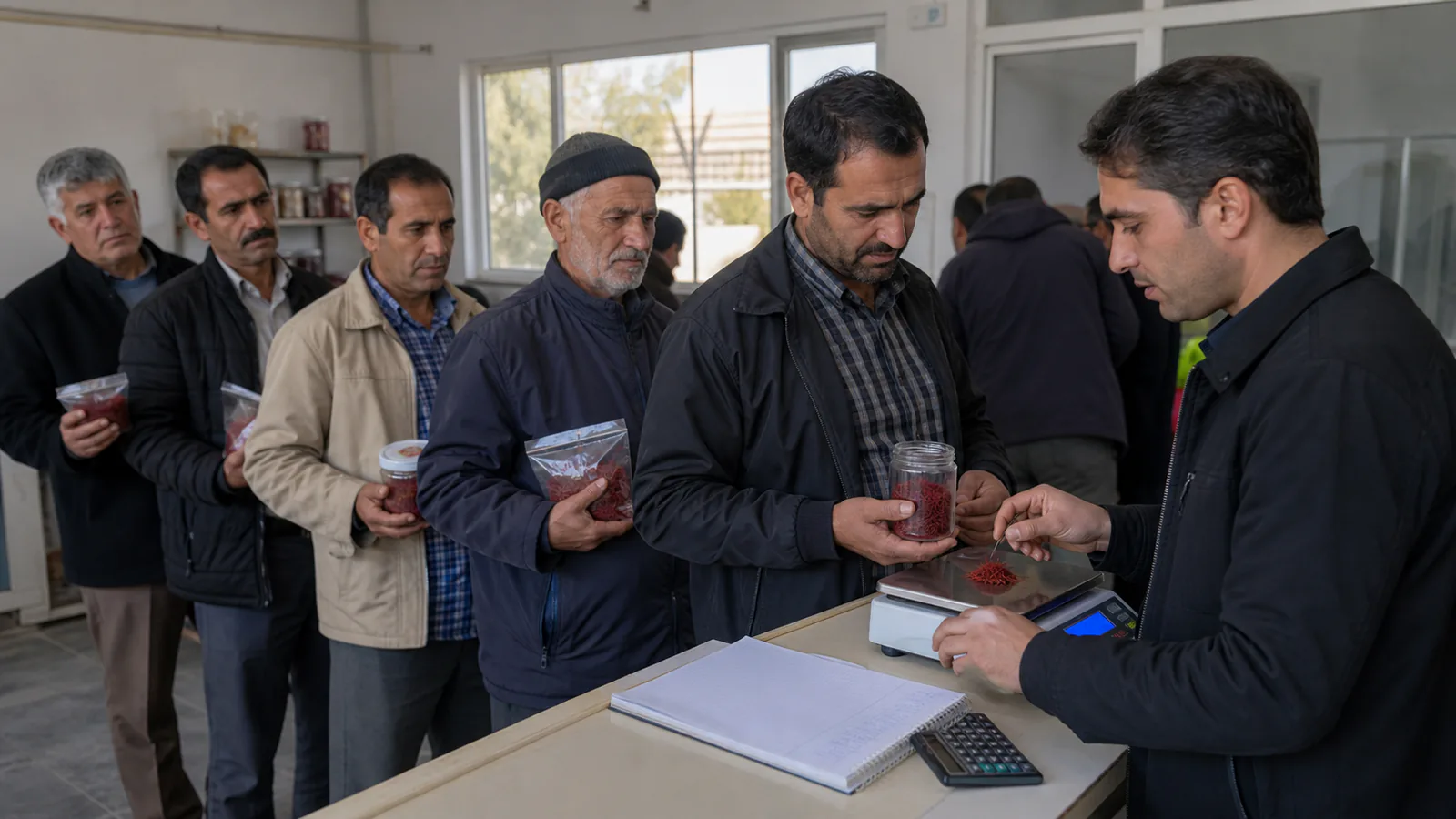
The influx of farmers into the market described a difficult few days in Rashtkhvar’s 2015 saffron harvest. Growers who needed cash to repay debts were bringing newly harvested saffron to market at the same time. Bahman Farrokhi, a member of the local farmers’ trade association, said the sudden supply gave intermediaries room to buy at low prices.
The surviving report contains two separate price movements. Dried saffron was said to have fallen from 4.5 million to 4.3 million tomans per kilogram in one day. Fresh flowers, quoted in three-kilogram lots, fell from 160,000 to 135,000 tomans. Those are historical local figures, not current prices, and one cannot be converted into the other without processing and yield data.
What happened in the Rashtkhvar market
Farrokhi spoke to ISNA after harvesting had begun across a reported 5,000 hectares in Rashtkhvar. He said growers were facing lower production and that recent rain and cold had caused considerable damage. The report did not provide a field survey, sample count or final harvest figure, so the scale of that loss remains an attributed assessment.
His immediate concern was cash flow. Indebted farmers were taking saffron from their farms to market so they could meet repayments. When many sellers arrived together, he said, brokers used the congestion to purchase their product at the minimum price.
Farrokhi advised growers not to sell the entire crop at once. They should bring only the quantity needed to cover immediate obligations, he said. The advice sounds straightforward until the two products in the article are separated. Dried saffron can sometimes be held under suitable conditions. Fresh flowers cannot wait in the same way.
The two price drops measured different products
The first quote concerned a kilogram of dried saffron. A fall from 4.5 million to 4.3 million tomans is a difference of 200,000 tomans, about 4.4 percent of the earlier figure.
The second concerned three kilograms of fresh saffron flowers. Their reported price moved from 160,000 to 135,000 tomans, a decline of 25,000 tomans or 15.625 percent. The original machine translation changed both currencies to dollars and obscured the three-kilogram unit. Both errors materially changed the story.
A basket of whole flowers is mostly petals and moisture. Its buyer must pay for transport, stigma separation, drying, rejected material and the risk that handling delays reduce quality. A kilogram of finished dried spice has already passed through those steps. Comparing the two headline prices directly would therefore be meaningless.
Neither quote is a complete market index. The report gives no grade, lot size beyond the flower unit, buyer count, payment terms, sample method or range of completed trades. It records what one association member said was happening on a particular day.
Why debt can turn harvest into a forced sale
Farm debt has a calendar. Repayments, wages and household expenses do not wait for the seller’s preferred market day. A grower who needs cash now may accept a bid that a better-financed farm can refuse.
FAO’s study of the economic lives of smallholder farmers describes the broader mechanism: limited access to credit can oblige households to sell immediately after harvest, when prices may be at their lowest. That research was not conducted in Rashtkhvar and does not prove Farrokhi’s allegation about local brokers. It does explain why a simultaneous rush to sell can weaken a small producer’s choices.
More buyers do not automatically solve the problem. Growers also need comparable bids, honest weights, prompt payment and a way to reject a disputed grade. A market can look busy while sellers still have little bargaining power.
An FAO Investment Centre review of prices and smallholder investment found that intermediary power, transport, finance and lack of market information can limit how much a favourable price reaches farmers. It also cautions that information alone may not produce a higher farm return. A visible quote is useful; the ability to wait, travel and negotiate matters too.
Fresh flowers impose a much shorter deadline
A dried lot can be retained only if it is properly dried, clean, protected from moisture, traceable and stored without compromising quality. Holding it still carries price, security and finance risks.
Fresh saffron flowers present a different problem. They continue to respire, lose water and deteriorate after picking. A peer-reviewed review of saffron quality and post-harvest practice recommends cool, humid, moderately ventilated conditions and careful transport without crushing the flowers. Even with good handling, growers need fast access to separation labour and drying capacity.
That is why “sell only what you need” cannot be applied to flowers as though they were a dry warehouse commodity. A farmer without processing capacity may have to sell the morning’s flowers quickly. The practical protection is a market that weighs lots consistently and gives several buyers a fair chance to bid before the flowers decline.
Rashtkhvar’s six-stall saffron flower market opened in the same 2015 season. Its central venue could reduce search time, but stalls alone would not guarantee competition, accurate scales or timely payment. This article records the pressure that market design needed to address.
What a fair harvest market should record
Farrokhi’s claim about minimum-price buying cannot be tested from the report because no transaction log was published. A useful market record would capture:
- whether the lot is fresh flowers or dried saffron;
- gross weight, container tare and verified net weight;
- quality or grade and the sampling method used;
- each comparable bid and the accepted price;
- cash, credit or delayed-payment terms;
- sale time, grower area and anonymous lot identifier;
- daily low, high and volume-weighted typical prices.
Those fields would show whether a crowded day produced a wider price spread, fewer bids or lower net returns. They would also separate a real market move from a single distressed transaction.
Finance belongs in the same picture. Short seasonal credit, transparent fees, prompt settlement and producer-group sales may give a grower more choice over timing. Each carries costs and rules of its own; none guarantees that a later price will be higher.
Rain, cold and the reported production decline
The old article connected rain and cold during the preceding days with damage and lower production. Weather can affect open flowers, field access, picking and post-harvest handling, but a county-level loss needs more than an observation at market.
A reliable estimate would compare representative plots with earlier seasons, count flowers over the harvest window, record productive area and measure dried output after consistent processing. The reported 5,000 hectares describes area, not yield. Some fields may have been young, old, damaged or not yet in full production.
The article listed Torbat Heydarieh, Zaveh, Kashmar, Rashtkhvar and Mahvelat among the country’s main saffron-producing areas. That statement should be read as historical regional context. It is not a current ranking and does not show how much each locality contributed that season.
Weather risk also strengthens the cash-flow problem. A farmer expecting a smaller crop may need to sell more of the first available lot to meet the same debt. Our guide to how drought affects saffron production explains why flower counts, daughter corms and final dried yield need separate observation.
A better reading of “the influx”
The title can make the growers sound like the problem. They were not. According to Farrokhi, the rush was a symptom of debt, a concentrated harvest and weak selling options. A farmer taking product to market to meet an obligation is responding rationally to a hard deadline.
The report establishes that two local prices were said to have fallen, a 5,000-hectare harvest was under way, fresh-flower markets were active, and the association feared that intermediaries held the advantage when farmers arrived together. It does not establish the county’s final production loss, the number of indebted growers, the share of the crop sold that day or a causal estimate of broker power.
The strongest response is practical: publish comparable transactions, keep fresh lots moving quickly, let growers see more than one bid, verify weights and grades, and reduce the need to sell dried saffron solely because a debt falls due. That turns a crowded market from a warning sign into evidence growers can use.
Historical names, prices and acreage are preserved from this site’s October 2015 report. FAO finance and market evidence and the peer-reviewed post-harvest review were checked on 29 August 2026.

![Exporting Saffron to Turkey + Price Guide [Complete 0 to 100]](https://img.rowhanisaffron.com/20260827003933/saffron-export-turkey-quality-inspection.webp)



