


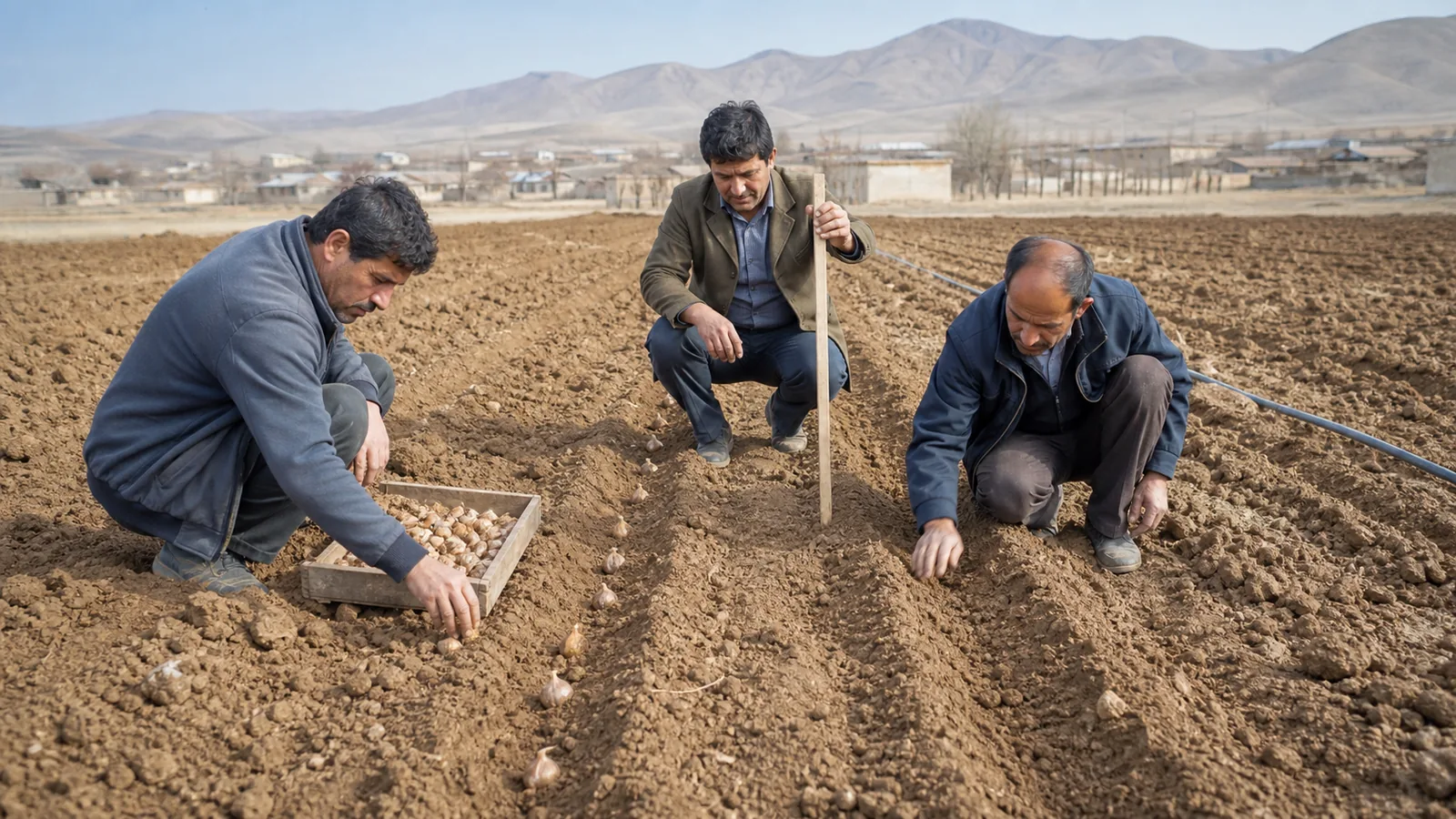
Arak is saffron dehydration is the surviving English title of a 2015 report about water scarcity, not dehydration. The original phrase meant that saffron was being tested as a crop that could fit water-limited areas around Arak. At the centre of the story was a demonstration field in Abdulabad village, along with farmer training, corms sourced from Qaenat and a wider employment-finance programme.
The farm was opened symbolically during Basij Week. Officials presented it as one possible response to a difficult agricultural economy: use a high-value crop suited to a cooler, relatively dry setting, then connect production with processing and packaging. The report announced the start. It did not publish the field’s area, water allocation, harvest or financial result.
What opened in Abdulabad in 2015
ISNA’s Central Region report placed the event in Abdulabad, a village in Arak County. The head of Arak’s Construction or Agricultural Jihad organization attended the opening and described saffron as an alternative crop for places with limited water.
The official tied the project to the period’s “resistance economy” programme and said there had been broad cooperation with the local Sepah district. In the report’s language, agriculture could support a more resilient economy if structural obstacles in the sector were addressed. The demonstration plot was expected to create work and perhaps support a household income.
Those were programme goals, not measured outcomes. The article did not say how many people worked on the plot, what a participating family invested, when revenue might begin or how farm income compared with another crop.
Why Farahan and Arak were considered suitable
The same official called Iran a historic home of saffron and described the crop as native to the Farahan area. The article did not provide a historical or botanical source for the local-origin claim, so it is best read as a statement of regional familiarity rather than proof of where Crocus sativus originated.
There is a firmer agronomic reason to test saffron in a water-constrained district. The plant is active mainly through the cooler part of the year and can return high value from a small area. Its seasonal irrigation demand can be lower than that of many conventional crops.
That does not mean saffron grows by dehydration. A field study of rain-fed and irrigated saffron found that pre-flowering irrigation was important for emergence under its semi-arid conditions; withholding it sharply reduced yield. Soil, rainfall, salinity, field age and irrigation timing determine whether a local field can make the low-water advantage real.
Before presenting saffron as a replacement crop, an Arak trial would therefore need to record cubic metres applied per hectare and per kilogram of dried stigma. Research on the water footprint of Iranian saffron shows substantial variation between provinces. A crop can be drought-tolerant and still be inefficient where irrigation losses or low yield are severe.
Why the corms came from Qaenat
Mir-Davoodi, another person quoted in the report, said suitable planting material had to be secured before the Abdulabad field could begin. The programme obtained what he described as quality saffron corms from farms in Qaenat, South Khorasan.
A saffron corm is not an onion or true seed. It is the underground storage organ used to propagate this sterile crop. Its size, health, storage history and planting density influence establishment and early yield. Moving corms from a successful production region does not guarantee that they will perform identically in a new soil and climate.
A receiving farm should inspect for damage and disease, keep the source lot traceable, and trial a manageable area before expanding. Our guide to selecting and handling saffron corms covers those checks in detail.
What the historical finance figures actually said
A representative of Negar Nasr company in Arak, identified as Sharifi, described the larger employment and economic-resilience finance programme. He said more than 17 billion tomans had been paid in facilities that year across the county.
Sharifi placed Islamic-contract loans at up to 30 million tomans and interest-free loans at up to 10 million tomans. Across 14 activity areas, he said 1,350 people had received facilities. The damaged English version converted those sums to dollars and blurred the recipient figure; the source wording was in tomans and referred to 1,350 recipients, not 14,350.
Mir-Davoodi said the loans connected with saffron were administered through Mehr Eghtesad Bank and were provided to farmers who had received correct-cultivation training. The report did not give the loan term, rate, security, repayment schedule, share devoted to saffron or number of Abdulabad participants.
Nothing in those 2015 figures should be read as a current offer. Their importance is the programme design: finance followed training and planting-material selection instead of being presented as cash alone.
Why a demonstration farm needs more than an opening
Saffron can suit small farms, but the first years carry particular risks. Corm purchases concentrate cost at establishment. Labour demand then arrives in a short harvest window, when flowers must be picked and stigmas separated promptly.
An open-access six-year study of small saffron farms in Gonabad found that corms, labour and water were the three largest cost categories in its sample. Those percentages cannot be transferred directly to Arak, but they show why a one-season gross-income claim would be incomplete. Farm age changes yield, corm value is spread across multiple years, and family labour still has an economic cost even when no wage is paid.
A credible Abdulabad result would have reported at least:
- field area, planting density and corm-lot weight;
- soil analysis, irrigation volume and water quality;
- establishment loss and productive plants per measured area;
- flowers, fresh stigmas and dried saffron by season;
- paid and family labour hours during planting and harvest;
- all corm, water, fertilizer, drying and packaging costs;
- grade, sale channel, actual price and loan repayments;
- net household return compared with the previous use of the land.
Without those figures, the statement that saffron could provide high income remains a proposal. It may be achievable, but the article gives no basis for calculating it.
From raw saffron to a viable local business
The Arak official also argued that Iranian producers had been weakened by lower production and price volatility. He wanted production costs reduced with both short- and long-term support, and said services, packaging and processing would become economically useful if broader barriers were removed.
His call to “return” Iran to first place in world saffron was rhetorical; the report supplied no ranking or baseline showing that the country had lost that position. The practical point was about value after harvest. A grower selling a small bulk lot receives a different return from a business that can dry consistently, verify grade, package efficiently and reach a stable buyer.
Processing is not automatically profitable, either. Equipment use, quality control, packaging weight, compliance, working capital and unsold inventory all carry costs. A village project needs enough dependable production to keep shared facilities useful without encouraging growers to plant beyond water or market capacity.
Our guide to saffron in water-scarce regions explains the agronomic side. The Abdulabad record adds the programme lesson: corms, training, finance, field measurement and a realistic sale plan have to work together.
What can be concluded from the Arak report
The 2015 event established that a saffron demonstration field had begun in Abdulabad with corms sourced from Qaenat. It recorded historical loan ceilings, a countywide finance total, 1,350 recipients across 14 activity areas and an intention to create work for young people.
It did not establish that the field saved a measured volume of water, produced a profitable harvest or supported a family. Those answers would require the farm records the report omitted.
That leaves a useful, honest interpretation of the awkward title. “Arak is saffron dehydration” should be understood as a trial of saffron under water scarcity. The trial made sense as a question. Its success could only be judged after several seasons of water, yield, cost and income data.

![Exporting Saffron to Turkey + Price Guide [Complete 0 to 100]](https://img.rowhanisaffron.com/20260827003933/saffron-export-turkey-quality-inspection.webp)



