


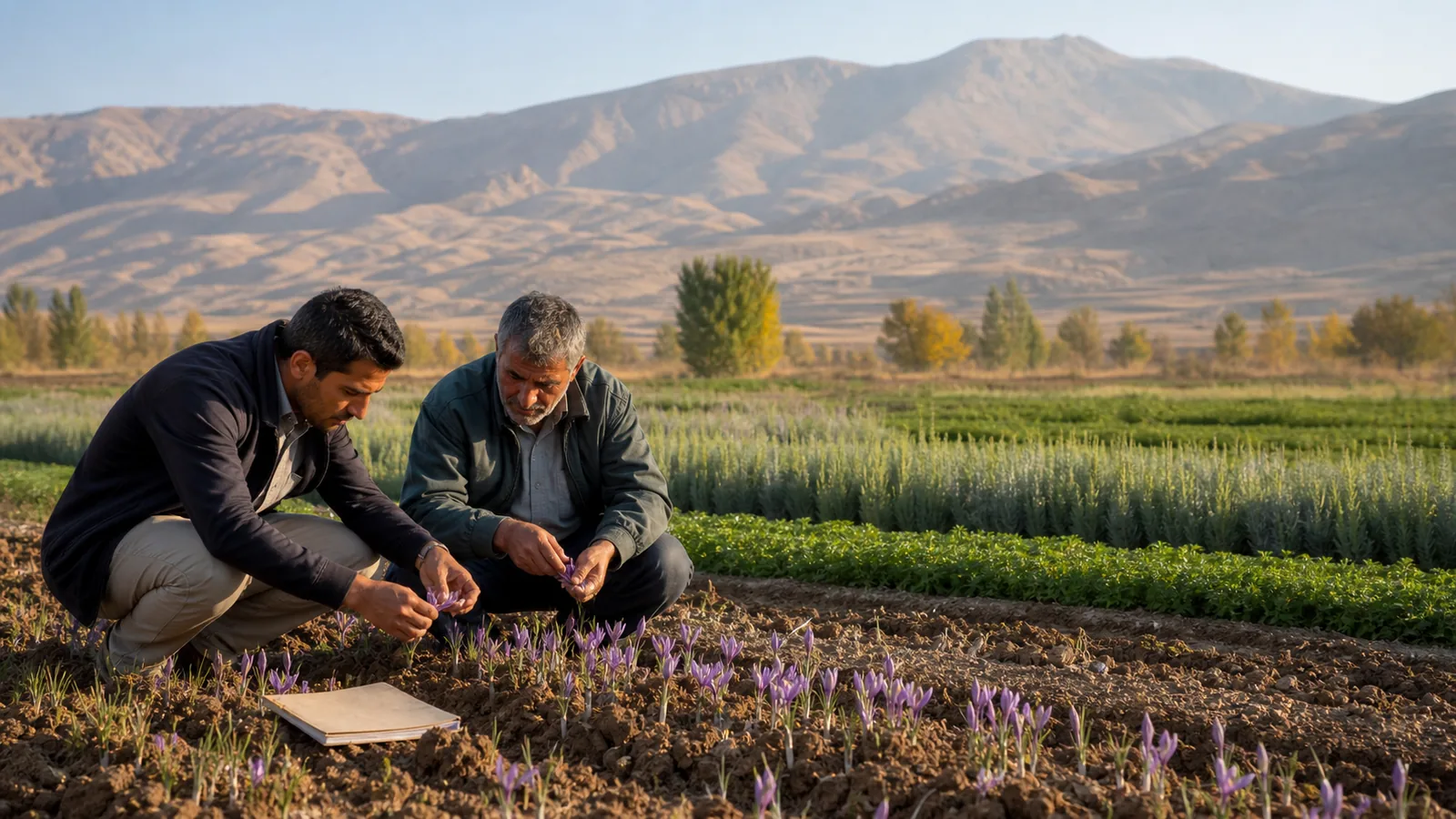
Saffron cultivation in Lorestan expanded alongside medicinal-plant farming during the reporting year covered by this March 2017 article. The provincial horticulture office said about 61 hectares of saffron had been added, taking the reported saffron area to roughly 151 hectares. A separate 100 hectares of medicinal plants brought that category to about 570 hectares.
Those figures are historical, and the distinction between the two crops matters. The surviving English headline says “more than 620 hectares of saffron,” but the underlying report did not describe 620 hectares of saffron alone. It described two programmes whose stated totals add up to about 721 hectares: 570 hectares of medicinal plants and 151 hectares of saffron.
What Lorestan’s agriculture report actually counted
B. Baharvand, identified in the original report as the horticulture director of Lorestan’s Agricultural Jihad Organization, gave the figures in an interview attributed to the Iranian Students News Agency (ISNA). The translated copy said 161 hectares of land had entered medicinal-plant and saffron cultivation during the year.
It then divided that new area into two parts:
- about 100 new hectares of medicinal plants, added to an earlier 470 hectares, for a reported total near 570 hectares; and
- about 61 new hectares of saffron, bringing Lorestan’s reported saffron area to approximately 151 hectares.
The 100-hectare and 61-hectare additions account for the stated 161 hectares. The two resulting totals account for roughly 721 hectares. The “more than 620 hectares” wording may have come from an earlier subtotal or a translation error, but the surviving source does not explain it. This article therefore preserves the original title while making the arithmetic visible rather than repeating 620 as a saffron-only acreage.
Saffron and medicinal plants are related, not interchangeable
Saffron is itself used as a spice, colourant and plant-derived ingredient, so administrative reports sometimes place it beside medicinal and aromatic plants. That does not mean every hectare in the broader category was planted with Crocus sativus. The 151-hectare figure is the relevant saffron estimate in this report.
The distinction also prevents a misleading comparison. A hectare of saffron has its own planting material, labour calendar, irrigation pattern, drying requirements and market. Other medicinal crops grown in Lorestan may have entirely different production cycles and buyers. Combining their acreage can describe a provincial diversification programme, but it cannot describe saffron output.
Why Lorestan was encouraging these crops
Baharvand argued that medicinal-plant cultivation could generate income and employment and said growers needed practical encouragement and support. That was a policy position reported in 2017, not proof that every farm would be profitable.
For a farmer, the economic result depends on much more than the selling reputation of a crop. Suitable soil and drainage, healthy planting material, reliable irrigation, skilled harvest labour, drying capacity and a buyer all matter. Saffron requires particularly concentrated labour when flowers open, because the stigmas must be separated and dried promptly.
Extension work can help growers test those conditions before committing a large area. A sensible programme would begin with site assessment and a manageable plot, then compare flower yield, dry-saffron yield, labour, water, quality and sale price over several seasons. Expansion based only on a provincial acreage target could expose farmers to avoidable cost.
What the 151-hectare figure tells us
Moving from about 90 hectares to 151 hectares would represent substantial growth in one reporting period. It also suggests that Lorestan’s saffron sector was still modest beside Iran’s largest producing regions in Khorasan. The value of the number is therefore local: it records a stage in the crop’s development within Lorestan rather than establishing the province as a national production leader.
Acreage alone does not reveal production. New saffron fields often have a different flower yield from established fields, and results vary with corm size, planting density, field age, weather, irrigation and disease pressure. No harvest weight or dry-saffron yield was supplied in the surviving report. It would be unsafe to derive tonnes of output from the 151 hectares.
Readers comparing regional statistics can consult our overview of saffron production statistics. Any comparison should use figures from the same harvest year and distinguish planted area from harvested area.
How to read this historical report today
The acreage belongs to the period reported in 2017; it is not a current estimate of Lorestan saffron farming. Provincial crop areas can change as growers establish fields, remove old corm beds or switch to another crop. A present-day figure needs a dated release from the provincial agriculture authority or another official statistical source.
The report remains useful because it captures the programme’s intended direction. Officials were promoting saffron and medicinal plants as higher-value alternatives, while recognising that farmers would need extension work and support before adopting them. Its figures also demonstrate why translated agricultural news must be checked line by line: the detailed breakdown is more reliable than the compressed headline.
The durable lesson for growers
Lorestan’s expansion was not one 620-hectare saffron project. It was a combined increase in two categories, with approximately 61 new hectares specifically attributed to saffron. Preserving that distinction gives farmers, buyers and researchers a clearer historical record.
For anyone considering saffron cultivation in Lorestan now, the old acreage is context rather than a planting recommendation. The decision should start with the field, water, corm health, labour and route to market. Our practical guide to saffron cultivation and growing conditions explains the questions to resolve before planting.
Source note: this article reconstructs the figures in the March 2017 report preserved on this URL and attributed there to an ISNA interview with B. Baharvand. Searches of current indexed records did not locate a complete surviving copy of that interview, so the speaker’s abbreviated name and the unexplained 620-hectare headline have not been silently “corrected.” All acreages above are presented as dated, attributed figures rather than current provincial statistics.

![Exporting Saffron to Turkey + Price Guide [Complete 0 to 100]](https://img.rowhanisaffron.com/20260827003933/saffron-export-turkey-quality-inspection.webp)



