


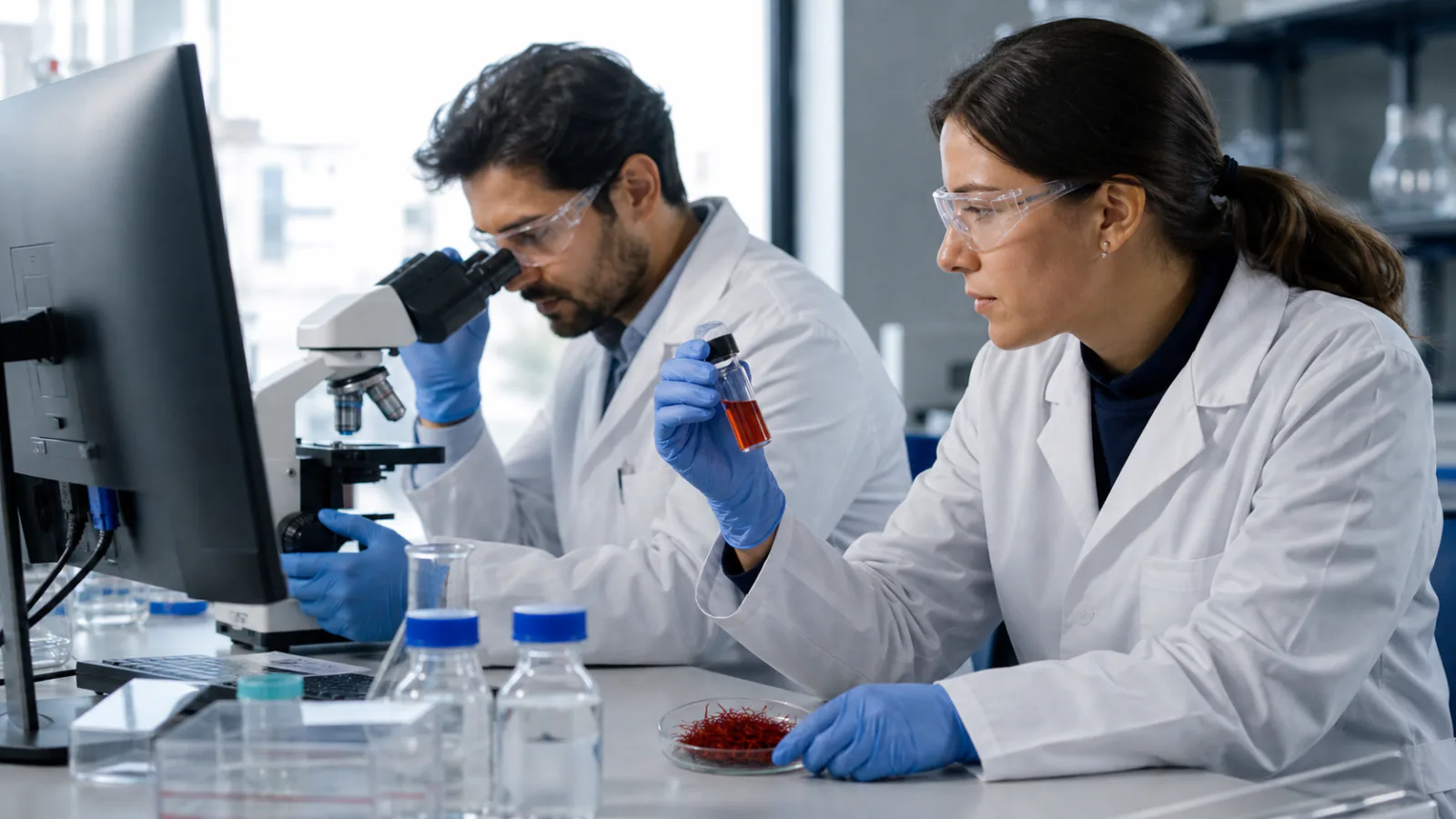
Cancer control with saffron is a research question, not an established therapy. Saffron and compounds such as crocin and crocetin have produced interesting results in cells and animals. Human evidence has not shown that saffron prevents, controls or cures cancer, and it must never replace oncology care.
This distinction matters. A result in a cultured cancer cell can identify a possible biological mechanism; it cannot tell us whether eating saffron will shrink a tumour in a person. Dose, absorption, metabolism, interactions and harm all have to be studied in well-designed human trials.
Cancer Control With Saffron: What the Evidence Really Shows
What “cancer” means
Cancer is not one disease. It is a large group of diseases in which abnormal cells grow without normal control and may invade nearby tissue or spread to other parts of the body. The cancer’s tissue of origin, molecular features and stage help determine its behaviour and treatment.
The older article grouped cancers into three broad families. The idea remains useful, although modern classification is more detailed:
- Carcinomas begin in epithelial cells that cover surfaces or line organs; many breast, lung, colorectal and skin cancers are carcinomas.
- Sarcomas begin in bone or soft connective tissues such as muscle, fat or blood vessels.
- Leukaemias, lymphomas and myelomas affect blood-forming or immune-system cells in different ways.
Because the diseases differ, a laboratory effect in one cell line cannot be generalised to “cancer” as a whole.
How cancer is treated
Standard treatment may include surgery, radiotherapy, chemotherapy, hormone therapy, targeted drugs, immunotherapy, stem-cell transplantation or a combination. The right plan depends on the diagnosis and the individual. Treatment can cause difficult side effects, but “natural” does not mean safer, and avoiding effective care can reduce the chance of remission or cure.
The US National Cancer Institute explains that no special diet, food, vitamin, mineral, supplement or herb has been proved to slow, cure or prevent the return of cancer. Complementary care means an approach used alongside standard treatment after its safety and evidence are considered; an alternative is used instead. They are not interchangeable.
Why researchers study saffron compounds
Saffron is the dried stigma of Crocus sativus. Its best-known constituents include crocin, crocetin, safranal and picrocrocin. Crocin contributes much of the colour released into water, while safranal is associated with aroma. Researchers can isolate or standardise these compounds and expose cells or animals to controlled concentrations.
Studies have investigated whether saffron constituents influence processes involved in tumour biology, including cell-cycle signalling, nucleic-acid synthesis, oxidative balance and apoptosis—the regulated process by which damaged cells can be removed. These were the four mechanisms listed in the original article. They describe hypotheses and preclinical observations, not instructions for self-treatment.
What laboratory and animal studies have found
Cell studies have reported reduced growth or changes in signalling in models of breast, lung, colorectal, pancreatic, prostate, skin and other cancers. Animal experiments have also examined tumour onset, growth, body weight and survival. The older version of this page referred to a mouse skin-cancer experiment that delayed tumour appearance and reduced weight loss; that is an animal outcome, not a demonstrated human benefit.
A 2025 systematic review of saffron constituents in breast-cancer models included 44 preclinical studies. It found potential mechanisms involving apoptosis and the cell cycle, with crocin having the strongest preclinical signal. Crucially, the authors focused on preclinical work because human studies were lacking.
Preclinical research is valuable for selecting compounds, studying mechanisms and planning trials. Many substances affect cancer cells in a dish but fail as medicines because a safe concentration cannot reach a human tumour, the body changes the compound, or the apparent effect does not hold up in controlled trials.
What the evidence does not establish
- Saffron has not been proved to prevent cancer in humans.
- It has not been shown to make a tumour shrink or stop spreading.
- It has not been shown to protect patients from radiotherapy-related DNA damage.
- Food use does not reproduce the concentration or formulation used in a laboratory experiment.
- A supplement labelled “crocin” is not automatically equivalent to a research preparation.
The old article said scientific findings “strongly suggest” effectiveness against aggressive cancers. That language outran the evidence. The defensible conclusion is that several saffron compounds remain candidates for further research.
Traditional use is context, not clinical proof
Saffron has a long history in Persian, Arabic, Indian and Chinese traditions; the name fan hong hua is associated with it in Chinese materia medica. Historical systems used saffron for many purposes, including mood, sleep, respiratory and heart complaints. Those traditions help explain why scientists investigate the plant, but age and popularity do not demonstrate effectiveness for cancer.
The same standard applies to modern marketing. A mechanistic phrase such as “supports apoptosis” can mislead when it implies that a commercial spice or supplement treats a patient’s tumour.
Could saffron interact with cancer treatment?
Possibly. Concentrated botanicals can have pharmacological effects, and anticancer medicines often have narrow safety margins. The National Center for Complementary and Integrative Health warns that some herbs can interfere with cancer treatment and advises patients to discuss complementary products with their healthcare team.
Anyone receiving chemotherapy, radiotherapy, immunotherapy, targeted treatment or hormone therapy should tell the oncology team about saffron extracts, crocin products and all other supplements. A clinician or oncology pharmacist can consider the exact product, dose, treatment regimen and medical history. Do not infer safety from culinary use, and do not stop prescribed care to try saffron.
The original page mentioned low blood pressure, dry mouth, anxiety, drowsiness, nausea and yellowing at high intake. Such lists are not a reliable safety assessment without preparation and dose. Product contamination, adulteration and inaccurate labels can introduce additional risks.
What useful human research would need to show
A credible clinical programme would first define and analyse the intervention: saffron species, extract method, constituent concentration, contaminants, stability and dose. Early trials would study pharmacokinetics, tolerability and interactions before asking whether a treatment affects symptoms, tumour response, recurrence or survival.
Later trials would need suitable controls, preregistered outcomes, enough participants and follow-up, and results separated by cancer type and standard treatment. A change in an antioxidant blood marker is not the same as cancer control. Nor is improved quality of life proof that a tumour has responded.
A safe reading of the current evidence
Saffron research has moved beyond folklore: crocin, crocetin and related compounds have measurable effects in experimental systems. The next step is not to promote them as cures. It is to test defined preparations rigorously and report both benefits and harms.
For a person with cancer, the practical conclusion is simple. Use evidence-based oncology care, tell the clinical team about every supplement, and treat claims of cancer prevention or control with saffron as unproven. Promising laboratory biology is a reason for research, not a reason to replace treatment.

![Exporting Saffron to Turkey + Price Guide [Complete 0 to 100]](https://img.rowhanisaffron.com/20260827003933/saffron-export-turkey-quality-inspection.webp)



