


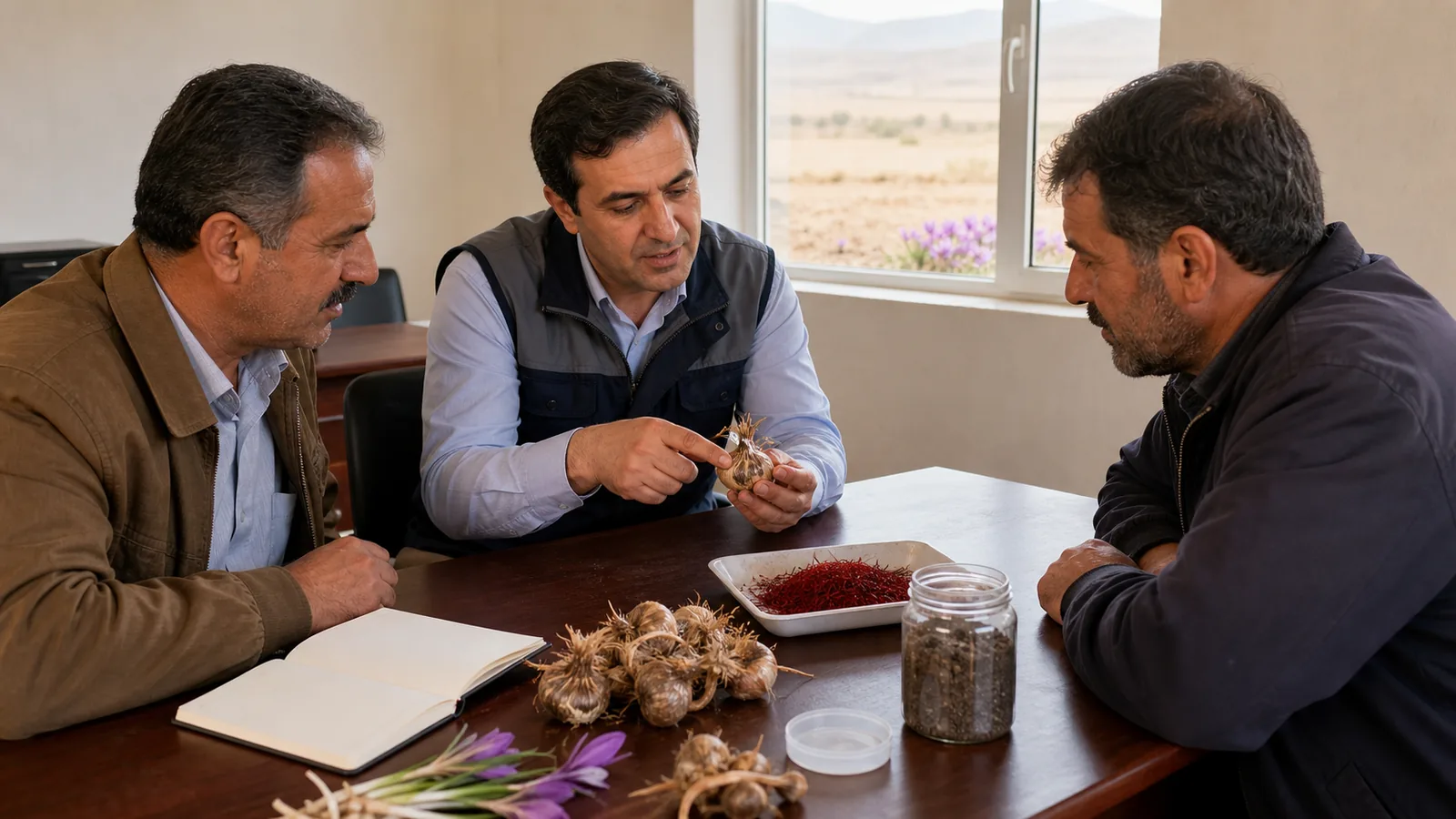
A local saffron office opened in Piran with a practical purpose: to give farmers a place to learn about the crop before replacing part of their existing planting. The short report, published on this site in 2017, says the agriculture authority worked with the private sector and described the office as the first initiative of its kind in the province.
The announcement followed a successful local field trial. Officials promoted saffron as a high-value crop with a comparatively modest irrigation requirement and a field life of roughly seven years. Their hope was that access to advice and a visible demonstration would give farmers enough confidence to consider it.
What the Piran saffron office was meant to do
The surviving account gives only a brief description, but its logic is clear. A new crop is difficult to introduce through a speech alone. Growers need local evidence, planting material, technical guidance and somewhere to take problems after the corms go into the ground. A local office can connect those pieces.
The report says the agricultural office and private sector collaborated on the launch. That combination can be useful when responsibilities are clear: public extension staff can assess local agronomy, while experienced suppliers and buyers can explain planting materials, post-harvest handling and the market. Neither side should promise a return that the field data cannot support.
Why a local trial mattered
Saffron is not automatically suitable wherever water is scarce. Its water demand is modest compared with many irrigated crops, yet drainage, soil structure, winter conditions, summer dormancy and irrigation timing still matter. A trial in local soil is more informative than copying a programme from a distant saffron region.
A useful demonstration plot should record more than whether flowers appeared. It should document:
- the source, size and health of the planted corms;
- soil and irrigation-water test results;
- planting date, depth, spacing and field preparation;
- irrigation, weed, pest and disease management;
- flowers and dry saffron produced per unit of land;
- harvest and stigma-separation labour; and
- drying quality, saleable grade, buyer and realised price.
Without those records, a “high-yielding” trial is difficult for another farmer to evaluate or repeat. The original report uses that positive description but does not provide a plot size, yield figure, test method or sale record, so the result should be treated as encouraging local experience rather than a guaranteed benchmark.
Understanding the seven-year field
The article describes saffron as a seven-year crop. That does not mean a grower waits seven years for the first flower. Saffron is a perennial grown from corms, and the same planting can remain in the field for several seasons while daughter corms multiply. Yields and management needs change as the stand ages.
A multi-year field reduces the need to sow a new annual crop each season, but it also locks the grower into the original choice of land and planting material. Poor drainage, contaminated corms, excessive density or a weak market plan can become expensive problems. Before planting, farmers need a realistic rotation and lifting plan rather than a simple assumption that every field should remain untouched for exactly seven years.
Lower water demand is only part of the decision
The Piran announcement highlighted water saving. That was a reasonable reason to test saffron, not a complete business case. Irrigation still has to be available at the stages the crop needs it, and poorly timed water can damage flowering or corm health. Labour is another constraint because flowers must be picked promptly and the stigmas separated and dried with care.
Revenue depends on saleable dry weight and quality, not the number of purple flowers seen in a field. A farmer should calculate corms, land preparation, water, labour, drying, storage, testing and route-to-market costs. The likely buyer and specification should be identified before a large area is planted.
Our guide to saffron cultivation methods provides the broader agronomic sequence. Local advice remains essential because planting and irrigation dates cannot be transferred unchanged between climates.
What farmers should expect from an advisory office
An effective saffron office should not merely distribute corms. It should help a grower decide whether to plant at all. That starts with soil and water assessment, a small pilot area and a written cost estimate. Training should cover corm inspection, field preparation, irrigation timing, harvesting, rapid stigma separation, controlled drying and safe storage.
The office should also collect results from participating farms. When growers can compare input costs, dry yield, labour hours, rejected material and actual sale prices, they can make better decisions than they can from promotional language. Private-sector involvement is most valuable when it brings a transparent specification or purchase route, not an informal promise of high revenue.
A note on the place name
The archived English title calls the location “Piran,” and the page has appeared for the query “piran irani.” The body text is an incomplete machine translation and does not preserve the office’s formal name, the official’s name or a source link clearly enough to identify the location more precisely. It may refer to Piranshahr, but changing the historical record to that spelling without the original report would be guesswork.
For that reason, this article retains Piran in the title and account while being explicit about the limitation. The substantive lesson remains intact: a public–private local office was opened after field trials to encourage a lower-water, multi-year saffron crop, and its value depended on turning that early interest into careful, measurable farm support.

![Exporting Saffron to Turkey + Price Guide [Complete 0 to 100]](https://img.rowhanisaffron.com/20260827003933/saffron-export-turkey-quality-inspection.webp)



