


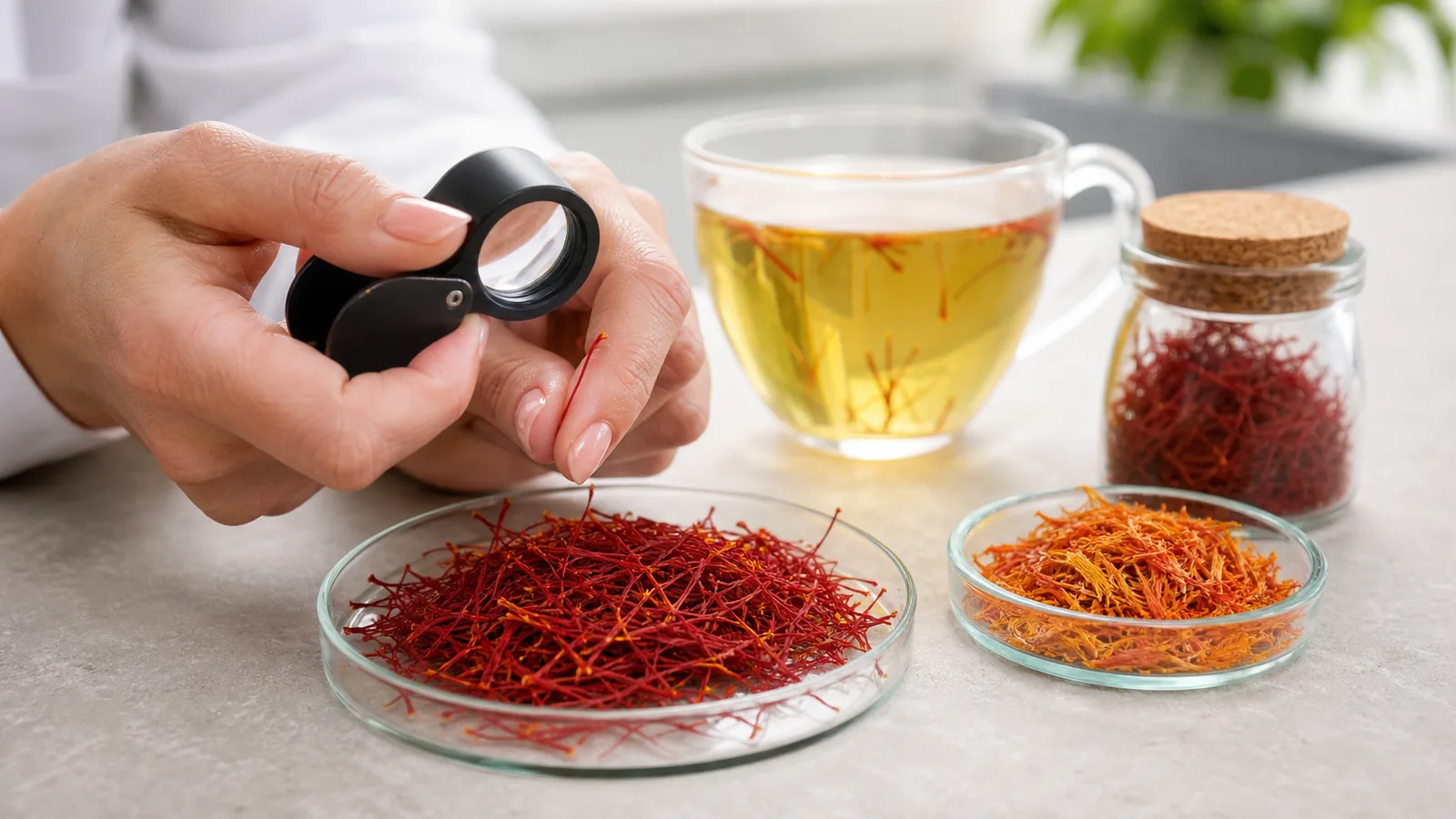
How do you know saffron is genuine? To learn how to identify real saffron, start with what the seller can document, then examine the threads. Real saffron consists of dried stigmas from Crocus sativus. The threads are usually deep red, irregular rather than machine-identical, and broaden at one end. They should release colour gradually in warm water while retaining some of their red colour.
Those observations can reveal an obviously poor product, but no kitchen trick proves purity. Safflower petals, dyed plant fibres, added stems, sugar, salt and artificial colour can all alter a sample. Ground saffron is harder to assess by eye. When authenticity matters, traceable purchasing and appropriate laboratory tests carry more weight than a viral “real saffron test.”
What saffron fraud can look like
The US Food and Drug Administration describes economically motivated adulteration as the deliberate substitution or addition of a lower-value material for financial gain. Its saffron example is straightforward: expensive saffron may be bulked with other plant material, including stems.
Other documented possibilities include safflower, marigold, turmeric and coloured fibres. The material may be mixed into real saffron or sold in its place. Extra moisture or soluble substances can also increase sale weight. A low price is not proof of fraud, and a high price is not proof of authenticity; both need evidence about the batch.
Safflower is a real, useful crop in its own right, but it is not saffron. Its petals can resemble red or orange fragments after drying. Selling it openly as safflower is legitimate. Selling it as Crocus sativus is substitution.
Look closely at whole saffron threads
Whole threads give a buyer more visual information than powder. A saffron stigma is not a perfectly straight, uniform strand. It commonly has a narrow lower portion and a broader, trumpet-like end. Natural threads vary slightly in length, curve and shade because they came from flowers and were separated by hand.
Warning signs include a packet dominated by flat petals, identical cut fibres, conspicuous yellow plant material, dust, or a large quantity of unrelated fragments. None of these observations identifies every sophisticated adulterant. Microscopy can distinguish structures that the unaided eye cannot, while chemical or DNA methods can investigate substances and species.
Buying intact threads also reduces—but does not eliminate—the opportunity to conceal cheaper powders. ISO notes that fraud is more common in powdered saffron because added material is less visible. Powder can still be a legitimate product when it comes from a controlled, traceable batch.
Use aroma, taste and colour as clues
Good saffron has a distinctive aroma that people may describe as warm, hay-like, floral or slightly metallic. Its taste is characteristically bitter. Sweetness or obvious saltiness can be a warning that soluble material was added, but tasting alone cannot measure how much is present or rule out other adulteration.
In warm water, genuine threads begin releasing a yellow-to-golden colour. The process is not an instant burst of opaque red dye. The threads should not immediately turn white simply because colour entered the water. Water temperature, thread size, age and quantity all affect what a buyer sees, so this remains a screening observation rather than a certification.
Likewise, pressing a thread on paper may reveal an oily coating or added colour, but a clean paper test does not prove identity. Saffron naturally contains volatile aroma compounds, and paper, pressure and moisture vary. Treat simple home checks as reasons to investigate, not as a pass/fail laboratory.
Skip the flame test
The old version of this article advised putting a saffron thread in a gas flame and judging the flame colour. That is neither a dependable authenticity method nor a sensible household test. Flame colour can be influenced by salts, contamination, the burner and surrounding material. It cannot establish the botanical identity or purity of the sample.
Burning a valuable food also creates an unnecessary fire and fume risk. Do not use the method. If a product remains suspicious after checking its source, label and physical appearance, ask the supplier for batch evidence or have it tested by a competent laboratory.
What laboratory testing can establish
ISO 3632 covers dried saffron in filaments, cut filaments and powder. Its test methods assess characteristics associated with colour, aroma, flavour, moisture and foreign matter. ISO describes saffron as pure when it meets the standard’s requirements and no external matter has been added.
One test cannot answer every fraud question. A peer-reviewed study found that the spectrometric ISO approach did not reliably identify the nature of certain added botanicals at lower concentrations. More specific methods—including microscopy, chromatography, mass spectrometry and DNA testing—may be needed when a laboratory is looking for a particular adulterant.
For example, researchers have developed species-specific PCR methods to detect safflower DNA in saffron. Other work has identified chemical markers for safflower, marigold, turmeric and additional botanical materials. The method should fit the question: determining colour strength is different from proving that no foreign plant species is present.
Check the seller and the batch, not just the box
Professional packaging helps protect saffron from contamination, moisture and light, but attractive packaging is not evidence by itself. Look for a responsible business name and address, net weight, lot or batch identifier, origin statement, packing or best-before information, storage advice and contact details appropriate to the market.
For a larger purchase, ask what the supplier means by “tested.” A useful answer names the sample, date, laboratory, test method and result. A generic certificate copied between products or a report without a matching lot number does not establish the contents of your packet.
Buyers seeking a saffron importer in Ohio should apply the same standard they would use elsewhere in the United States: confirm the business identity, food label, batch traceability and handling route. A city name repeated in a web listing is not a quality credential. For commercial quantities, our guide to buying saffron in bulk covers documentation and sampling in more detail.
A practical buying checklist
- Prefer whole, recognisable threads when you want to inspect the product yourself.
- Check that the seller, lot, net weight, origin and contact information are clear.
- Compare the price with the stated grade, origin, test evidence and quantity rather than price alone.
- Look for foreign petals, fibres, excessive yellow material, dust or obvious surface dye.
- Use aroma, bitter taste and gradual golden infusion only as supporting clues.
- Do not rely on flame, paper or water tests as proof of purity.
- For a high-value or commercial lot, use representative sampling and an accredited laboratory.
Store saffron after you have checked it
Keep saffron tightly closed in a clean, food-safe container away from light, moisture and heat. A small container is useful because it reduces the air exchanged each time it is opened. Avoid storing it above a stove or beside a sunny window.
Grinding increases the surface area exposed to air, so keep threads whole until needed when practical. Use a clean, dry utensil and close the container promptly. Our guide to storing saffron explains the handling details.
The most reliable answer
You can reject some bad saffron with careful observation, but genuine-looking threads can still contain an undeclared addition. The strongest answer combines a traceable supplier, a defined batch, credible documentation, intact sensory characteristics and testing proportionate to the value and risk of the purchase.
That approach is less dramatic than setting a thread on fire, but it is much more useful. It protects the buyer without promising certainty that a home test cannot provide.
Sources reviewed
- US Food and Drug Administration: Economically Motivated Adulteration (Food Fraud).
- International Organization for Standardization: How to recognize quality saffron?
- ISO 3632-2:2010: test methods for saffron filaments and powder, confirmed current in 2022.
- Villa et al.: PCR detection and quantification of safflower in saffron, Food Chemistry, 2017.
- Sabatino et al.: analytical evaluation of saffron adulteration, Journal of Food Science, 2011.
Sources and current standard status were reviewed on 30 August 2026. This guide is for purchasing and food-quality decisions; only a competent analysis of a representative sample can support a formal authenticity conclusion.

![Exporting Saffron to Turkey + Price Guide [Complete 0 to 100]](https://img.rowhanisaffron.com/20260827003933/saffron-export-turkey-quality-inspection.webp)



