


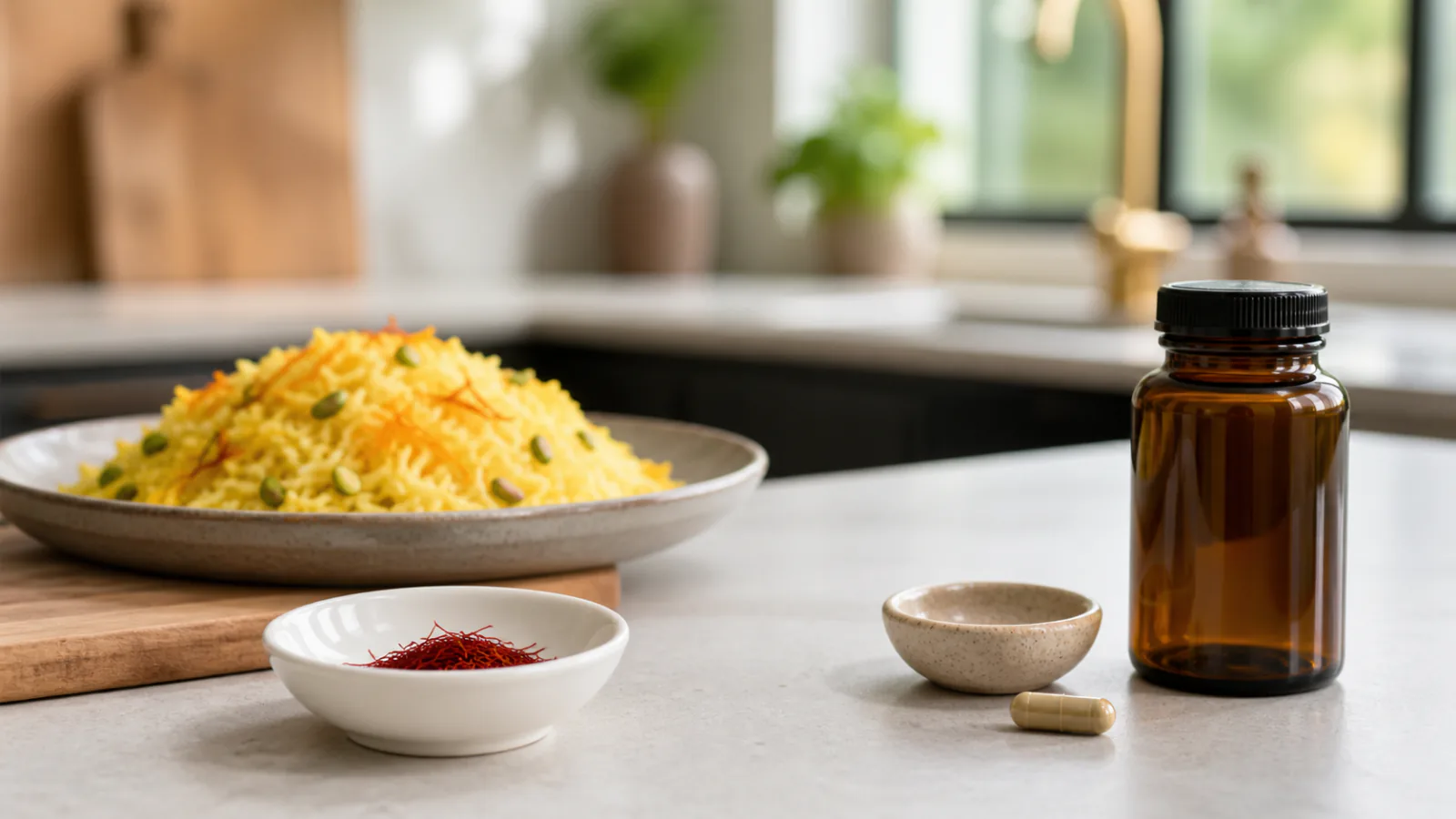
The advantages and disadvantages of saffron depend on how it is used. A few threads added to food are not the same as a concentrated extract taken every day. Saffron offers distinctive colour, aroma and flavour, and several standardised preparations have shown promising effects in human trials. It is not a proven treatment for the long list of diseases often attached to it online.
Safety also changes with dose, product quality, pregnancy, medicines and health conditions. This guide separates ordinary culinary use from supplement and research doses so the possible benefits and risks are easier to judge.
Advantages and Disadvantages of Saffron: Evidence and Safety
Advantages of saffron in food
Saffron is the dried stigma of Crocus sativus. A small amount can flavour and colour an entire dish, so it is normally used sparingly. Blooming gently crushed threads in warm water or milk distributes the colour more evenly than adding dry threads at the end.
- Complex sensory character: genuine saffron contributes floral, honeyed and hay-like aroma, mild bitterness and a golden colour.
- Small serving quantity: a recipe generally needs a modest pinch rather than a large volume of spice.
- Flexible use: it can work in rice, soups, sauces, breads, desserts and drinks when its flavour suits the dish.
- Plant compounds of research interest: crocin, crocetin, picrocrocin and safranal contribute to saffron’s colour, taste and aroma and are studied separately from culinary use.
Saffron is not a meaningful source of everyday calories, protein or essential nutrients at normal recipe quantities. Calling it “nutritionally rich” based on values per 100 grams is misleading because nobody eats that serving as a spice.
Which health benefits have human evidence?
A systematic evidence map of saffron clinical research found that studies have examined mood, eye conditions, metabolic measures, cognition and other outcomes. Evidence strength varied, and many trials were small or used different preparations and doses.
The most consistent human research has been in depressive symptoms, where some standardised saffron extracts have outperformed placebo in short trials. That does not mean culinary saffron is an antidepressant, nor should anyone change prescribed treatment without a clinician.
Small trials have also investigated age-related macular degeneration and retinal function. The older article went much further, saying saffron restores damaged eye cells and prevents vision loss. Current evidence does not justify those promises. Eye disease can progress without obvious symptoms, so saffron must not replace examination or treatment by an eye-care professional.
Claims that are not established
The earlier version listed asthma, skin disease, urinary infection, jaundice, anaemia, stomach pain, high cholesterol, heart disease and cancer as conditions saffron treats or prevents. A long traditional-use list is not proof. Reliable treatment claims require replicated human trials using a defined preparation and a clinically meaningful outcome.
Crocin and crocetin have antioxidant properties in experimental systems, and saffron constituents affect cancer cells in laboratory studies. Those findings do not show that saffron prevents or treats cancer in people. The National Cancer Institute states that no herb or special food has been proved to slow, cure or prevent the return of cancer.
Disadvantages and side effects
Reported side effects in saffron trials and safety reports include nausea, headache, dizziness, dry mouth, drowsiness, appetite changes and allergic reactions. The likelihood depends on the extract, dose, duration and person. A recent systematic review of saffron adverse events is more useful than repeating a fixed symptom list without context.
Very large amounts can be toxic. The old article claimed that exactly 5 grams in one meal can be fatal and listed vomiting, slow heart rate, bleeding and yellow skin as certain results of “indiscriminate use.” That is not a reliable universal threshold. Toxicity cannot be reduced to one number independent of product, body size and clinical circumstances. Never experiment with gram-level doses.
A culinary pinch in a shared dish is a different exposure from capsules or concentrated extracts. More is not better. Follow the labelled serving of a reputable product and discuss medicinal use with a qualified healthcare professional.
Pregnancy and breastfeeding require special caution
The old page simultaneously warned of miscarriage and promoted saffron to make childbirth easier. Neither is appropriate self-care advice. Saffron has a cultural history of use around labour, and its possible effects on uterine activity are exactly why timing, dose and medical supervision matter.
A 2026 integrative review of saffron in pregnancy found limited and inconclusive safety evidence. It reported that some low-dose studies at term examined cervical ripening and labour outcomes, while higher exposure was associated with concern about uterine stimulation and miscarriage. The authors called for standardised preparations and longer-term safety data before clinical recommendations.
Pregnant people should not take saffron extracts or medicinal quantities unless their obstetric clinician specifically recommends and supervises them. Normal food questions should also be discussed if the pregnancy is high risk. Evidence for supplement use while breastfeeding is insufficient.
Medicines, blood pressure and bleeding
Saffron supplements may affect physiological measures or interact with medicines, but interaction data are incomplete. People using blood-pressure medicine, anticoagulants, antiplatelet drugs, psychiatric medicines or multiple prescriptions should ask a pharmacist or clinician before taking a concentrated saffron product.
The same applies before surgery and during cancer treatment. A natural source does not guarantee compatibility with anaesthesia, chemotherapy or other drugs. Bring the product label and ingredient list to the conversation; “saffron supplement” is not specific enough.
Product quality is part of the risk
Saffron is expensive and vulnerable to adulteration. Added plant material, artificial colour, moisture or substitution can change both quality and safety. Powder is harder for a buyer to inspect than intact threads. Purchase from a supplier that can identify the lot and provide relevant testing rather than relying on colour alone.
ISO 3632-1:2025 specifies dried saffron in filament, cut-filament and powder forms. A standard can support a specification, but a logo or vague “ISO grade” claim is not a batch result.
How to store saffron without losing quality
Keep saffron in a clean, dry, tightly closed food-safe container away from light, heat, moisture and strong odours. Open it briefly and use a dry utensil. Aroma compounds can dissipate and moisture can damage the product when a container is repeatedly left open.
A small opaque tin or dark glass jar in a cool cupboard is usually more practical than a large half-empty clear jar beside a cooker. Do not use saffron that smells musty, shows moisture or has been contaminated.
How to weigh the benefits and risks
- For cooking, use a small amount for flavour and colour rather than for a medical effect.
- For a supplement, look for a defined extract, dose, batch testing and realistic claim.
- Do not use saffron to delay diagnosis or replace prescribed treatment.
- Seek professional advice during pregnancy, breastfeeding, cancer care, before surgery or when medicines may interact.
- Stop and seek medical help for a serious reaction or suspected large ingestion.
Saffron’s strongest everyday advantage is culinary: a small quantity gives food a character few ingredients can reproduce. Its disadvantage is that price, folklore and early research invite exaggerated claims. Treat food as food, research extracts as specific products, and medical decisions as decisions that deserve real clinical evidence.

![Exporting Saffron to Turkey + Price Guide [Complete 0 to 100]](https://img.rowhanisaffron.com/20260827003933/saffron-export-turkey-quality-inspection.webp)



