


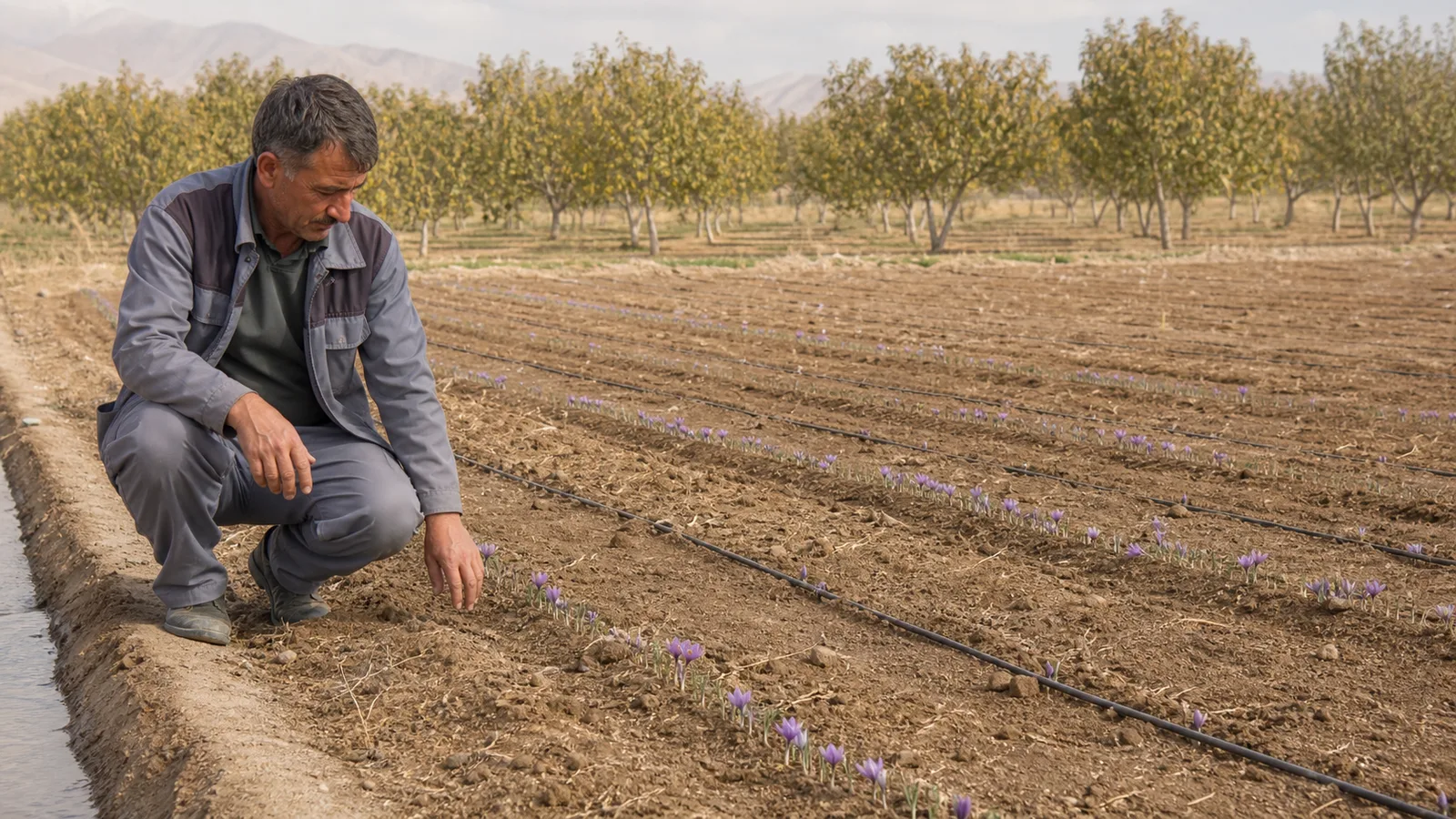
Saffron farming beyond Khorasan has been tested in several very different parts of Iran. Archived reports from Chaharmahal and Bakhtiari, Qom and Anar County in Kerman describe the same basic pressure: farmers and agricultural officials were looking for a valuable crop that could fit tighter water supplies. Their results were promising enough to justify trials, but they do not amount to a universal instruction to replace an existing orchard or field.
Read together, the three cases show what expansion really requires. Chaharmahal and Bakhtiari focused on distributing planting corms. Qom was still measuring a small pilot. Anar combined training, young fields and interested buyers, then ran into a water-quality constraint. Each solved one part of the puzzle and exposed another.
Why these three regional cases belong together
The original destination article covered only Chaharmahal and Bakhtiari. Its assigned source articles concern Qom and Anar, hundreds of kilometers away. Their figures must not be blended into a fictional national programme or attributed to the wrong province.
What connects them is the crop-replacement question: can saffron offer a practical use for selected land where water-intensive farming is becoming harder? The answer depends on climate, soil, salinity, irrigation timing, corm health, harvest labor and a reliable market. Hectares or corm tonnage alone cannot settle it.
Chaharmahal and Bakhtiari: 120 tonnes of planting corms
The Chaharmahal and Bakhtiari report records an agricultural official saying saffron cultivation was expanding and that more than 120 tonnes of planting material had been distributed during that programme year. The old English version called them “bulbs”; the more accurate term for saffron’s underground planting material is corms.
The 120-tonne figure is not a saffron harvest and should not be read as the weight of dried spice. It also cannot be converted safely into hectares without the corm-size distribution, planting density, losses and actual planted area. What it does show is a material effort to establish or enlarge fields.
The official presented saffron as a relatively low-water alternative that might create work for farming families. Those were programme expectations, not a documented employment count. The archive gives no named districts, harvest result, yield, budget or later evaluation, so it would be misleading to report the scheme as current or complete.
Qom: a ten-hectare desert pilot with conflicting totals
A second report, attributed to ISNA, records comments by Mohammad Reza Talaee, then identified as head of Qom’s Agricultural Jihad organization. He said the province had close to 10 hectares of saffron and described the crop as part of a shift toward farming with lower water demand.
The reported average yield was 2 kilograms of dried saffron per hectare. The same account says the provincial harvest rose by more than 2.5 times, from under 3 kilograms in the previous year to 8 kilograms in the reporting year.
Those figures do not reconcile if all 10 hectares were mature and harvested: 10 hectares at 2 kilograms per hectare would imply about 20 kilograms. Some plots may have been young, not yet bearing, or excluded from the average, but the source does not explain. The safest reading is that Qom had roughly 10 hectares in a pilot programme, while its reported yield and total-harvest figures came from different bases.
Talaee also estimated that 30% of Qom’s land had potential for saffron. That is an attributed planning estimate, not a published land-suitability survey. He expected development particularly in mountainous areas and described family participation in planting, field care and harvest as a way to manage seasonal labor and farm income. Neither the area estimate nor the income expectation should be treated as a guarantee.
The Qom case is valuable precisely because it was still experimental. It shows why a province should establish a consistent baseline—bearing hectares, field age, irrigation, harvested weight and grade—before turning a pilot into a large expansion claim.
Anar in Kerman: saffron beside the pistachio economy
The third case comes from Anar County in Kerman. “Anar” was mistranslated as “Pomegranate City” in the old English article; here it refers to the county known for pistachio farming. A local horticulture official, identified as Alavi, discussed saffron as one possible response to water scarcity and declining water quality.
The archived figures describe 12 hectares of saffron, with 8 hectares said to have reached an economically productive stage. The local Agricultural Jihad office had held six or seven workshops on saffron and medicinal plants as the replacement programme entered its second year.
Market access was part of the plan. The official said companies and processors had contacted the growers and wanted to buy the crop at farm-gate prices. Farmers in the preceding season reportedly sold dried saffron in bulk before they had time to package it themselves. That demonstrates buyer interest at the time; the source gives no contract, price, grade, payment term or commitment that can be relied on today.
Why saffron was not a complete pistachio replacement
The Anar source is more cautious than its old headline. The official did not recommend closing productive pistachio orchards and planting saffron everywhere. He described using empty land and encouraging selective replacement where the economics and field conditions made sense.
He estimated that saffron used about one-tenth as much water as pistachio in the local comparison. That ratio remains an attributed Anar estimate, not a universal crop coefficient. Water demand changes with climate, soil, field age, irrigation method, rainfall and management. The Food and Agriculture Organization’s account of Gonabad’s qanat-based saffron system supports the broader point that saffron can work with relatively limited water, while still requiring a dependable water source.
Water salinity was the immediate barrier to full replacement in Anar. Research confirms that this is not a trivial detail. A field study of saffron with semi-saline water tested specific water and soil salinity levels together with planting dates; it does not show that every saline well is safe. Local water and soil testing must come before investment.
“Low water” still requires an irrigation plan
Saffron can have high value per unit of water, but drought tolerance is not the same as zero-water farming. Irrigation timing influences flowering, corm growth and the following season’s potential. Too much water or poor drainage can also damage corms.
That is why crop replacement should compare complete systems rather than slogans. A farmer needs the expected water volume and quality for the local field, the opportunity cost of removing an existing crop, the years needed for saffron fields to mature, seasonal labor availability and realistic dried-saffron grades and prices.
What a responsible expansion programme should record
The three archives suggest a practical sequence for future projects:
- test soil drainage, salinity and irrigation water before corm purchase;
- start with measured plots and record bearing area separately from newly planted area;
- document corm size, planting density, irrigation and field age alongside yield;
- train growers in disease prevention, flower handling, drying and storage;
- confirm buyer grades, prices, quantities and payment terms in writing; and
- compare several seasons before recommending replacement at scale.
This approach also applies to other emerging regions. The evidence from Kurdistan’s saffron trials and Golpayegan’s expansion shows the same need to separate plans, planted area and verified harvest results.
The lesson from Chaharmahal, Qom and Anar
These programmes support saffron’s role as a candidate crop for water-constrained Iranian agriculture. Chaharmahal and Bakhtiari supplied a substantial amount of corms, Qom tested the crop on about 10 hectares, and Anar paired 12 hectares with training and buyer interest.
They also show why replacement decisions must remain local. Qom’s archived totals conflict, Chaharmahal’s report lacks harvest results, and Anar’s saline water blocked a simple switch from pistachio. Saffron farming beyond Khorasan can be credible when trials, water tests, agronomy and market commitments agree. Without that evidence, a low-water label is not enough.

![Exporting Saffron to Turkey + Price Guide [Complete 0 to 100]](https://img.rowhanisaffron.com/20260827003933/saffron-export-turkey-quality-inspection.webp)



