


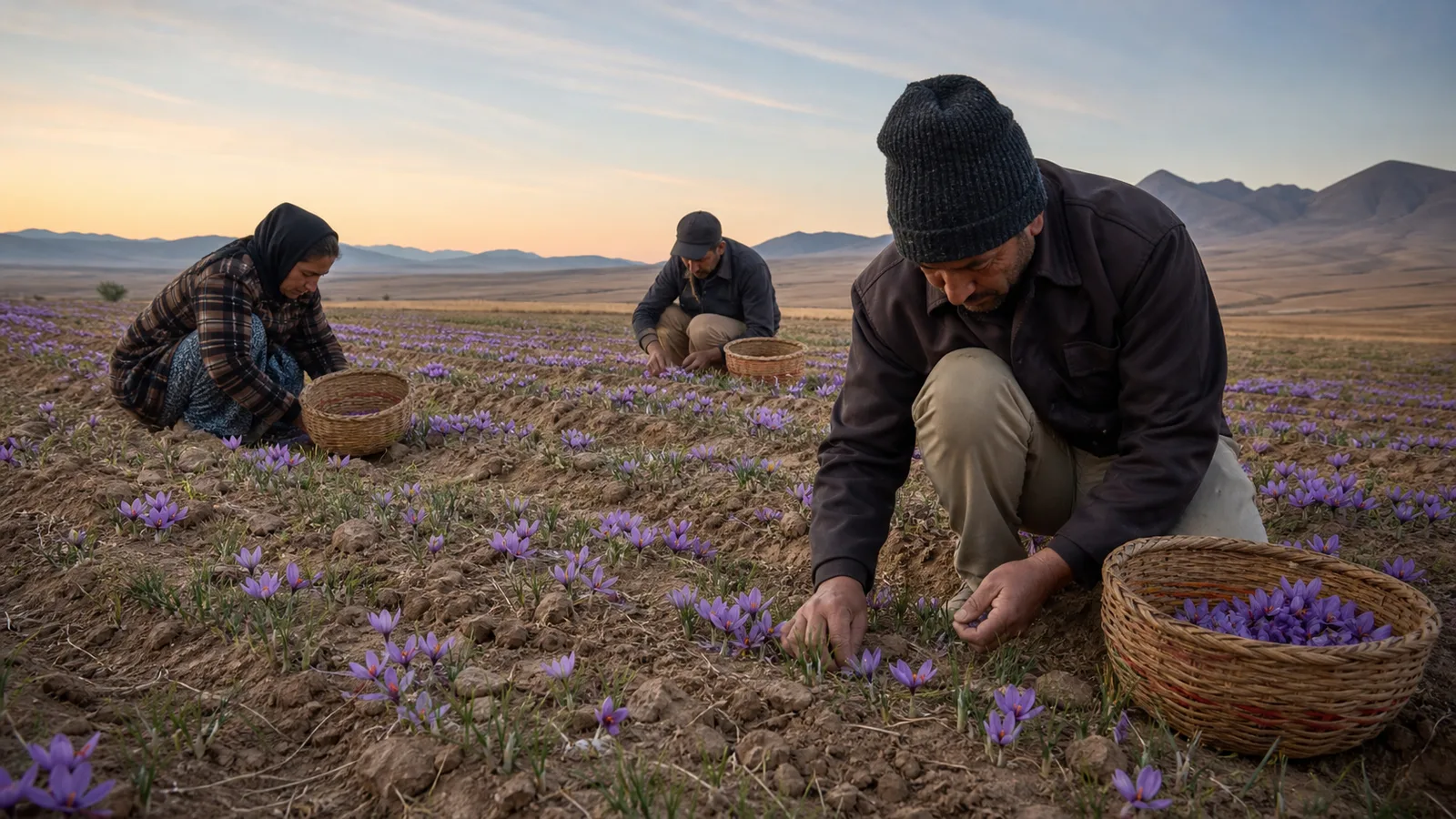
The Golpayegan saffron harvest report described 50 hectares of bearing fields and a forecast of about 500 kilograms of dried saffron. Another 10 hectares had been planted but were not yet part of that harvest. The figures made Golpayegan a useful starting point for comparing very different saffron-growing areas across Iran, from large production centres in Khorasan Razavi to small, rain-fed plots in Kurdistan.
This is a consolidated account of several archived regional reports. Their acreage, forecasts and working practices belong to the seasons in which local agricultural officials announced them; they are not current production estimates or present-day prices. Keeping that distinction clear matters because weather, field age, water availability and the share of land actually flowering can change a harvest substantially from one year to the next.
Golpayegan’s 50-hectare saffron harvest
Heidar Ali Golmohammadi, then head of the local agricultural department, reported 60 hectares under saffron in Golpayegan. Fifty hectares were described as fertile, while 10 hectares were newly planted. Production from the bearing area was forecast at roughly 500 kilograms, with a reported yield of more than 10 kilograms per hectare.
The original timing sentence said the harvest began at the end of October and continued until the middle of October, which cannot be chronologically correct. It is therefore safer to retain the reported late-October start without inventing an end date. The accompanying employment sentence was also too garbled to support a reliable worker count, so it should not be used as a labour statistic.
Those limitations do not erase the main point. The report recorded a meaningful Golpayegan saffron harvest, separated established fields from new planting, and showed that growers were expanding a crop suited to the area’s autumn production calendar. A reader comparing nearby Isfahan Province reports can also see a different scale in the Natanz saffron harvest.
Why regional harvest figures need context
Harvest announcements often place hectares, yield and total output side by side, but the numbers do not always use the same denominator. Total planted land may include young fields that are not yet bearing. A yield may refer only to productive hectares, while the total forecast may cover the whole locality. Some reports count saffron flowers; others count dried stigmas. Forecasts can also change once flowering begins.
For that reason, the regional sections below preserve each report’s meaning while marking contradictions rather than smoothing them away. The comparisons are useful as historical snapshots, not as a league table of permanent regional performance.
Sistan and Baluchestan: expansion delayed by heat
In Sistan and Baluchestan, horticulture director Ardeshir Shahraki said unusually hot weather delayed planting by about two weeks. Planting began in the first ten days of October and was expected to continue into the month’s second ten-day period. The required saffron corms—not onions in the culinary sense—were supplied with farmer participation from South Khorasan and Khorasan Razavi.
The archived account contained two different acreage statements. It projected a 12-hectare increase that would take the provincial area to 44 hectares, but it also described 22 hectares as currently planted, nine of them fertile. These may refer to a target and an existing planted base, but the source does not explain the reconciliation. Both figures should therefore remain labelled rather than combined into a single total.
The previous season’s output was given as 45 kilograms of saffron flowers, not 45 kilograms of dried spice. Shahraki also described production becoming more substantial from a field’s third year and remaining economic through the sixth. Cultivation was reported in Khash, Mirjavah, Zahedan and five other cities.
Gonabad: drought, tanker irrigation and a weaker forecast
Gonabad’s report shows how water stress can change a harvest even in an established growing area. Alireza Hosseinzadeh, then director of the local agricultural department, put saffron acreage at about 3,500 hectares. The previous harvest was reported at roughly nine tonnes, equivalent to about 2.6 kilograms per hectare if all 3,500 hectares were bearing.
The same account carried two forecasts that do not fully agree: its headline described a 30% fall, while another sentence expressed hope that output could remain close to the previous nine tonnes. In villages where water sources had lost much of their discharge, the expected decline was 30% to 50%. Some farms were being irrigated by tanker, and water constraints had prevented further expansion of the planted area.
Harvesting was scheduled from the second half of November until 10 Azar in the Iranian calendar. This was a drought-affected seasonal report, not evidence that every Gonabad field will experience the same loss.
Qazvin: 87 hectares, with bearing land clearly separated
Qazvin Province reported 87 hectares under saffron: 73.5 hectares of fertile fields and 13.5 hectares of young, non-bearing planting. At an estimated three kilograms per hectare across the fertile area, the forecast of more than 220 kilograms is arithmetically consistent.
Horticulture director Ali Akbari said farm activity began in October, with flowering from November to mid-December. He identified Qazvin, Takestan, Abik and Buin Zahra as areas where cultivation could develop further. The source also listed uses in foods, confectionery, ice cream, beverages, colouring and fragrance products. Its unsupported disease-treatment claims have not been carried forward; a regional harvest article is not a sound basis for medical advice.
Mahvalat: 3,200 hectares centred on Shadmehr
Mahvalat was one of the largest harvests in this group. Ramazan Ali Ghasemi, then director of the local agricultural department, reported 3,200 hectares and forecast about 11 tonnes of dried saffron if weather and other natural conditions remained favourable. That total corresponds to roughly 3.4 kilograms per hectare across the stated area. Mahvalat was described as fifth in Khorasan Razavi for saffron area and output, with production concentrated around Shadmehr.
Two organised flower markets, in Shadmehr and Dogh Abad village, were intended to give freshly picked flowers a more orderly route to buyers. The report also referred to workshops and updated cultivation and nutrition practices for growers.
Because the announcement came from the COVID-19 period, it urged workers to trim nails, clean and disinfect hands, use gloves and masks, keep their distance and avoid the customary group gatherings for overnight flower cleaning. Its unsourced claim about a particular drying temperature and virus destruction is not repeated here. For ongoing handling, the durable principles are clean hands and equipment, protection from contamination, safe raw materials and locally validated drying controls; the World Health Organization’s food-handling guidance provides a current general framework.
Taybad: 4,560 hectares and an organised flower market
Taybad’s archived forecast covered about 4,560 hectares. Ali Asghar Khoshkhoo reported an average of 390 kilograms of flowers per hectare and an expected 3.9 kilograms of dried saffron per hectare. Multiplied across the stated area, the dry-yield estimate is about 17.8 tonnes, which supports the rounded forecast of roughly 18 tonnes. Harvesting was expected to continue through the end of November.
The local flower market was a central part of the story. It was established to concentrate sales, reduce unsanitary roadside or informal trading, limit dependence on brokers and develop recognition for the Taybad name. The source also contained a separate report about fodder corn; that material has been left out because it does not help someone seeking saffron-harvest information.
Ardestan: revived cultivation, but conflicting yield figures
Ardestan, another Isfahan Province producer, reported saffron harvesting across 84 hectares, with a forecast of more than 580 kilograms. The account said work began in colder areas around mid-November and finished in warmer areas around mid-December. It also described a revival: cultivation had previously faded from the city, then expanded again during the preceding decade.
There is an important numerical caution. Dividing 580 kilograms by 84 hectares gives about 6.9 kilograms per hectare, not the “more than eight kilograms” also quoted in the report. The higher yield may have applied only to a smaller bearing area, but no such denominator was supplied. Both claims cannot be treated as one verified calculation.
The report’s figure of more than 7,000 direct jobs referred to Ardestan’s agricultural sector as a whole, not saffron alone. It also mentioned mechanisation credit, but the translated currency and amount were unreliable. Neither figure should be recast as saffron revenue or employment.
Firoozeh: an output forecast centred on Taghankooh
In Firoozeh, Gholam Hassan Klidari reported 850 hectares, mainly in the Taghankooh section, and an expected dry yield of 4.5 kilograms per hectare. That works out to about 3,825 kilograms, making the rounded forecast of four tonnes reasonable. The city was described as 22nd in Khorasan Razavi by saffron production and cultivated area.
The local programme included model farms, healthy corm selection, grower workshops and updated cultivation and nutrition methods. During the pandemic-era harvest, the advice to flower handlers echoed Mahvalat’s emphasis on clean hands, short nails, disposable gloves, masks and spacing during communal night cleaning. Farmers were also directed through the local agricultural office to a support-purchase programme operating in neighbouring Neishabour. These were measures tied to that particular season, not a claim that the same programme is operating now.
Sarvabad: five hectares grown with seasonal rainfall
Sarvabad in Kurdistan provides the smallest-scale example. A local horticulture expert reported five hectares, an average yield of about 2.5 kilograms per hectare and an expected total near 12 kilograms. Harvesting was due to run from mid-November into early December, with most fields around Sarvabad and Qala Jay village.
Rainfall had been sufficient that season, so growers did not need the usual first irrigation expected in late October. That does not make saffron universally rain-fed; it records what happened under one season’s local conditions around the Zagros Mountains. The report also associated the crop with work for about 12 people.
What these harvest reports show together
The regional contrast is the useful part of this combined record. Golpayegan’s forecast was built around a relatively high reported yield on 50 bearing hectares. Taybad and Mahvalat operated at a much larger scale but reported lower output per hectare. Qazvin carefully separated fertile and non-bearing land. Gonabad showed the cost of severe water pressure, while Sarvabad benefited from rainfall in one particular season.
Markets and handling matter alongside field performance. Taybad and Mahvalat organised flower markets because saffron flowers are delicate and must move quickly into cleaning and drying. Firoozeh linked growers to a support-purchase route. Hygiene advice became especially visible during the pandemic, but clean handling remains relevant whenever the stigmas are separated and dried.
Quality should not be inferred from a province name or a promotional comparison alone. The current ISO 3632-1 specification for saffron concerns the dried product and provides a more appropriate basis for quality assessment than an unsupported regional superlative.
A concise reading of the numbers
- Golpayegan: 50 bearing hectares, 10 newly planted hectares and about 500 kilograms forecast.
- Sistan and Baluchestan: expansion was reported, but the 44-hectare projection and 22-hectare current-area statement were not reconciled.
- Gonabad: about 3,500 hectares, with drought-related losses forecast and some farms dependent on tanker irrigation.
- Qazvin: 73.5 bearing hectares plus 13.5 non-bearing hectares, with more than 220 kilograms forecast.
- Mahvalat: 3,200 hectares and roughly 11 tonnes forecast.
- Taybad: about 4,560 hectares and roughly 18 tonnes forecast.
- Ardestan: 84 hectares and more than 580 kilograms forecast, with a separate yield claim that does not match the total-area calculation.
- Firoozeh: 850 hectares and a rounded forecast of four tonnes.
- Sarvabad: five hectares and about 12 kilograms forecast.
These figures preserve what each archived source promised while making the inconsistencies visible. For another large regional comparison, see the account of the Kashmar saffron harvest, where field scale, labour and market arrangements create a different production picture.

![Exporting Saffron to Turkey + Price Guide [Complete 0 to 100]](https://img.rowhanisaffron.com/20260827003933/saffron-export-turkey-quality-inspection.webp)



