


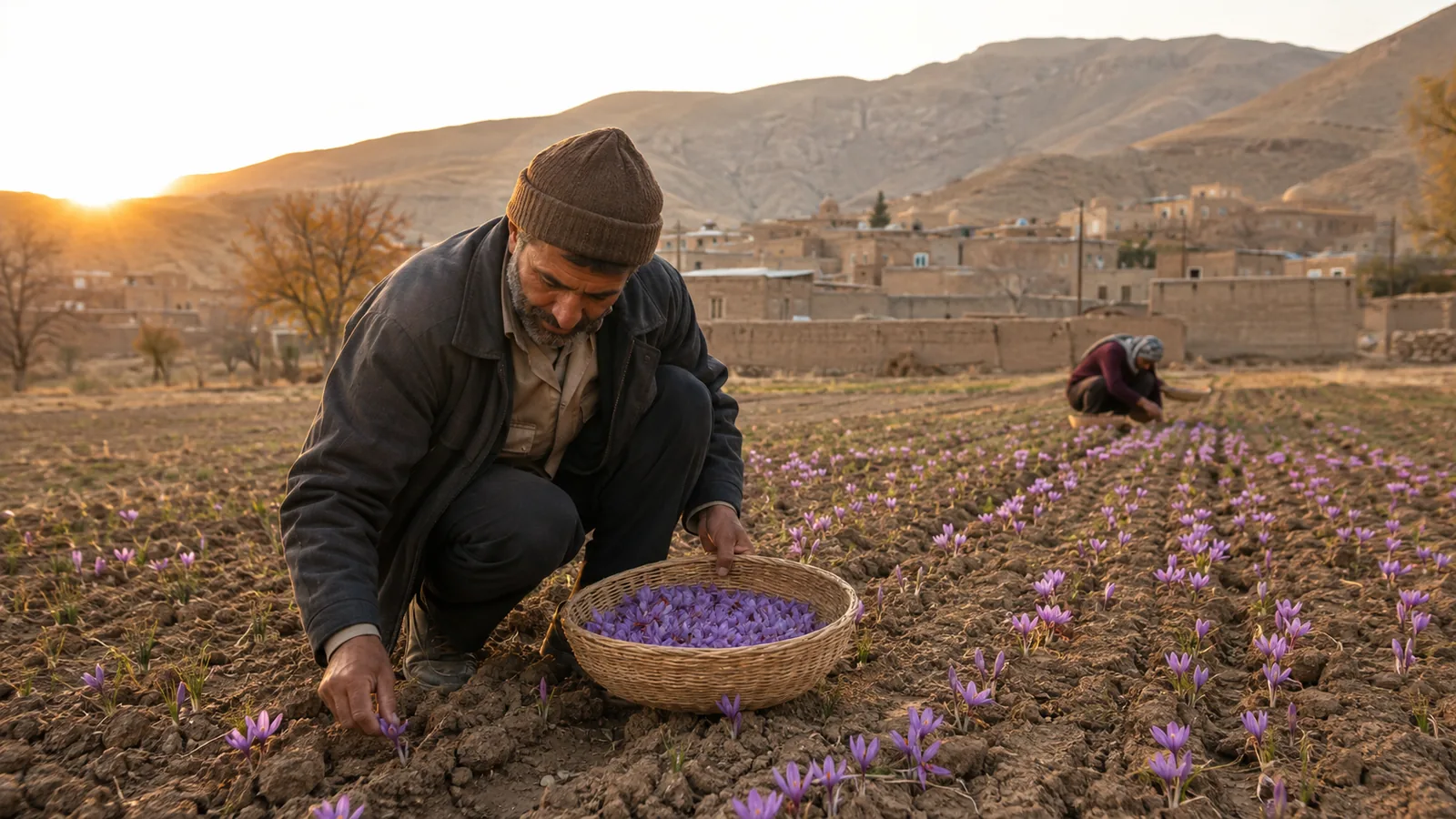
Harvesting saffron from the farms of Darolsiadeh Alavi village of Kashan begins in the cool weeks of autumn. The original report placed the start in late October, when purple Crocus sativus flowers appear in fields around Alavi and the Niasar district.
Where Darolsiadeh Alavi is located
The name appears in the stored English article as “Darolsiadeh Alavi.” Local agricultural reports more commonly refer to Alavi village, near Mashhad Ardehal in Kashan County. It is associated with the Niasar area on the higher, cooler side of a county better known internationally for its historic city and desert-edge landscape.
That location helps explain why saffron can grow here. Kashan is not one uniform climate. The northern and eastern approaches meet the desert plain, while settlements on and near the slopes of the Karkas range experience cooler conditions and different patterns of elevation, rainfall and soil.
Kashan saffron is not a contradiction
Khorasan is Iran’s dominant saffron-growing region, but Crocus sativus is not restricted to one province. The plant is also cultivated in suitable parts of Isfahan province, including Kashan County.
Agricultural reporting from Kashan has identified Alavi, Hasanarud and villages in Niasar as important local production areas. One Iranian Agricultural News Agency account of Kashan saffron reported that most of the county’s planted area was in Niasar and gave a local average of five kilograms of dried saffron per hectare.
Why the harvest begins in late October
Saffron flowers after summer dormancy as autumn temperatures fall and soil moisture returns. The exact start varies by altitude, weather, irrigation and field condition, so one village may begin picking while another field is still waiting for buds.
The original Darolsiadeh Alavi account refers to the last weeks of October. Broader Kashan reports place the local window from late October into November. This is a short, concentrated season rather than a single harvest day.
What happens during a village saffron harvest
Flowers are normally picked early, before they open fully in stronger sunlight. Pickers place them in shallow, clean containers so the lower blossoms are not crushed by excessive weight.
The crop then moves quickly to separation. Each flower contains three red stigmas, which are removed from the petals and yellow style according to the grade being prepared. Drying reduces the fresh stigmas to the light, concentrated spice sold as saffron threads.
Speed matters, but careless speed can damage the product. Clean hands and surfaces, protection from dust, an even layer during drying and dry storage all help preserve the aroma, colour and condition established in the field.
How large is saffron cultivation in Kashan?
The short original article did not give a hectare or production total for Darolsiadeh Alavi. Dated county figures provide context without pretending they all describe the same season.
In 2020, another Kashan harvest report from the agricultural news agency recorded more than 650 kilograms from 110 hectares, with an average around six kilograms per hectare. Those are county-level figures and should not be assigned to Alavi village alone.
What “high-quality saffron” should mean
The source called Alavi’s crop high quality and said it met international standards, but it did not provide a certificate or laboratory result. Quality cannot be established by location or appearance alone.
For a buyer, a useful assessment includes thread composition, aroma, moisture, cleanliness, colouring strength, packaging and traceability. Laboratory testing can add evidence for characteristics that a photograph cannot confirm. The article therefore preserves the village’s quality reputation without turning it into an unsupported certification claim.
Water use and field suitability
Saffron is often chosen in dry regions because its irrigation pattern differs from many summer crops. Most active growth occurs through the cooler months, and the corm remains dormant during summer.
It still needs suitable soil and well-timed water. A field that holds too much water can expose corms to rot, while poorly timed irrigation or prolonged stress can reduce flowering. The cooler slopes around parts of Kashan create opportunities, but growers must assess drainage, frost exposure and available water field by field.
Kashan’s varied landscape and access
The original article connected saffron cultivation with Kashan’s broader geography. The county sits on important routes through central Iran and combines desert scenery with cooler mountain settlements. That variety supports different agricultural and travel seasons within a relatively small area.
Visitors should remember that a saffron field is a working farm, not an unrestricted attraction. Harvest is brief and labour-intensive. Access should be arranged with local growers, paths should be respected, and flowers should not be picked without permission.
Why the Alavi harvest matters
Darolsiadeh Alavi demonstrates that Iranian saffron has meaningful local stories beyond the largest Khorasan production centres. The village’s autumn harvest connects a crop adapted to dry conditions with Kashan’s cooler highland settlements and seasonal rural work.
Its value is best understood through specifics: where the fields are, when flowers open, how they are handled and what evidence supports the finished quality. Preserving those details gives buyers and readers a clearer picture than calling saffron “red gold” without explaining the work behind it.

![Exporting Saffron to Turkey + Price Guide [Complete 0 to 100]](https://img.rowhanisaffron.com/20260827003933/saffron-export-turkey-quality-inspection.webp)



