


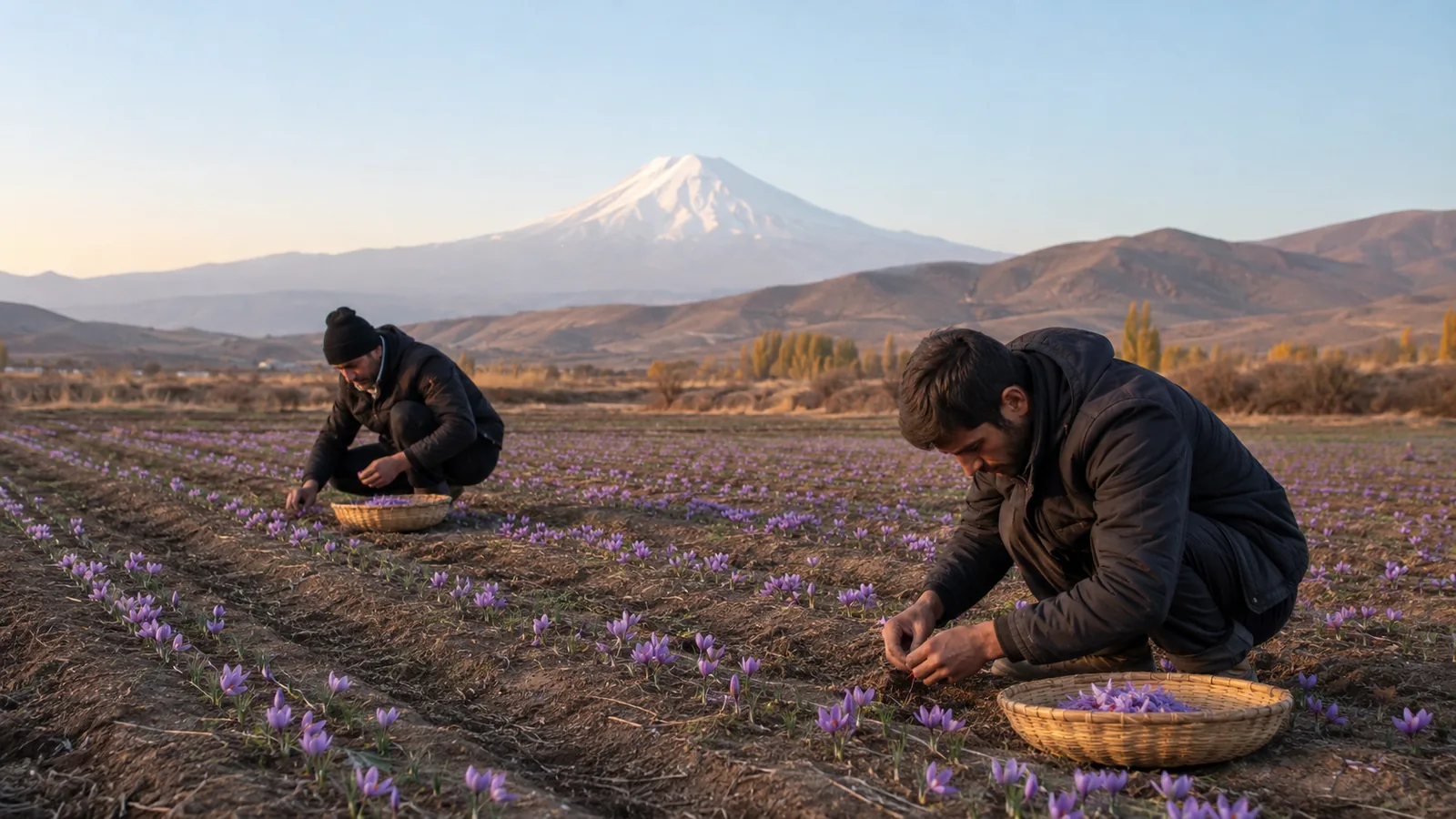
The saffron harvest from five hectares of Damavand farmland began in early November 2020, according to a local agricultural report. The small planted area showed saffron taking root in a cooler county east of Tehran, where growers were testing its fit with local climate and farm economics.
What the five-hectare Damavand report recorded
Hossein Ardalani, then identified as director of Damavand Agricultural Jihad, announced that picking had started across five hectares. He said the local planted area was gradually increasing because saffron’s growing requirements could match parts of Damavand’s climate and the dried crop had high value relative to its weight.
The report did not give a production total, average yield, field locations or the number of growers. Five hectares describes the area from which harvest had begun, not five hectares with identical age, management or output.
Why saffron can be considered in Damavand
Saffron needs a site with a suitable seasonal rhythm: summer dormancy, moisture and cooling before autumn flowering, and enough winter and spring growth to replenish the corm. Damavand’s elevation and colder conditions distinguish it from the best-known production areas in Khorasan.
That does not make every Damavand field suitable. Soil drainage, frost exposure, the timing of irrigation, slope and planting depth all need to be assessed locally. Research indexed by FAO’s AGRIS database on climate, soil and saffron yield shows why regional conditions cannot be reduced to a single temperature or soil rule.
Harvest is the most labour-intensive stage
Ardalani called harvest the hardest part of saffron cultivation. Flowers appear over a short period and are normally picked early, before stronger sunlight opens them fully and before more blossoms emerge the next day.
Picking is only the first stage. The flowers must be moved without being crushed, the red stigmas separated, and the saffron dried promptly. A five-hectare crop can create a sharp temporary demand for hands even when the annual planted area sounds modest.
The 2020 hygiene instructions
The harvest took place during the coronavirus pandemic. The original report instructed workers to receive hygiene guidance before entering the field, disinfect their hands, keep two metres from nearby workers and avoid touching collection-container handles before disinfection.
Those rules document the public-health conditions of November 2020; they are not presented here as current pandemic requirements. The lasting food-handling principle is simpler: workers, hands, tools and containers should be clean, and anyone who is ill should not handle harvested flowers.
Clean containers protect a delicate crop
Fresh saffron flowers are easily compressed. Shallow, clean baskets or food-safe trays allow air movement and reduce the weight placed on the lower layer. Containers previously used for soil, chemicals or unrelated farm materials should not be reused without suitable cleaning.
After separation, the stigmas need controlled drying and protection from dust and moisture. The Food and Agriculture Organization’s work on Iranian saffron quality treats harvest, processing, standardization and post-harvest handling as connected parts of the value chain.
What “high export potential” means
Ardalani described saffron as a non-oil export product with substantial potential and said it was not widely understood by the public. Dried saffron’s low weight and high unit value can make long-distance trade practical, but potential is not the same as an export contract.
A grower or processor still needs consistent grade, traceability, appropriate packaging, accurate documents and a buyer whose import rules can be met. A new producing district also has to establish a reputation based on evidence rather than relying only on the general reputation of Iranian saffron.
Added value depends on what happens after picking
A crop can lose value between the field and the package. Slow separation, uncontrolled heat, damp storage or mixing different lots can reduce consistency. Careful processing allows the finished threads to retain clearer identity and gives a buyer a better basis for comparing lots.
Local value also depends on who performs those steps. If flowers or loose saffron leave Damavand without traceable origin, another processor may capture the recognition associated with grading and packaging.
How a small cultivation area should be expanded
Gradual growth is sensible when a crop is new to a district. Growers can compare field age, corm health, flower timing, yield, labour hours and drying results before committing more land.
Expansion also needs enough workers and processing capacity for the flowering peak. Planting more hectares without a plan for rapid picking and separation can create a bottleneck precisely when the crop is most perishable.
How to read the Damavand harvest today
The five-hectare figure and two-metre distancing instruction belong to a dated 2020 report. They should not be presented as Damavand’s current cultivated area or today’s health rule.
What remains useful is the practical picture of an emerging saffron district. Damavand offered fields with a potentially suitable seasonal climate, but success depended on labour, hygiene, prompt processing and measured expansion. Those details explain more than the phrase “high-value crop” on its own.

![Exporting Saffron to Turkey + Price Guide [Complete 0 to 100]](https://img.rowhanisaffron.com/20260827003933/saffron-export-turkey-quality-inspection.webp)



