


Beginning of saffron cultivation in 6 hectares of lands of Badreh city marked a small but deliberate shift in local farming. Heshmatollah Siahi, then director of Badreh’s Agricultural Jihad office, said tests had identified suitable dryland sites and that six hectares were being planted with saffron corms.
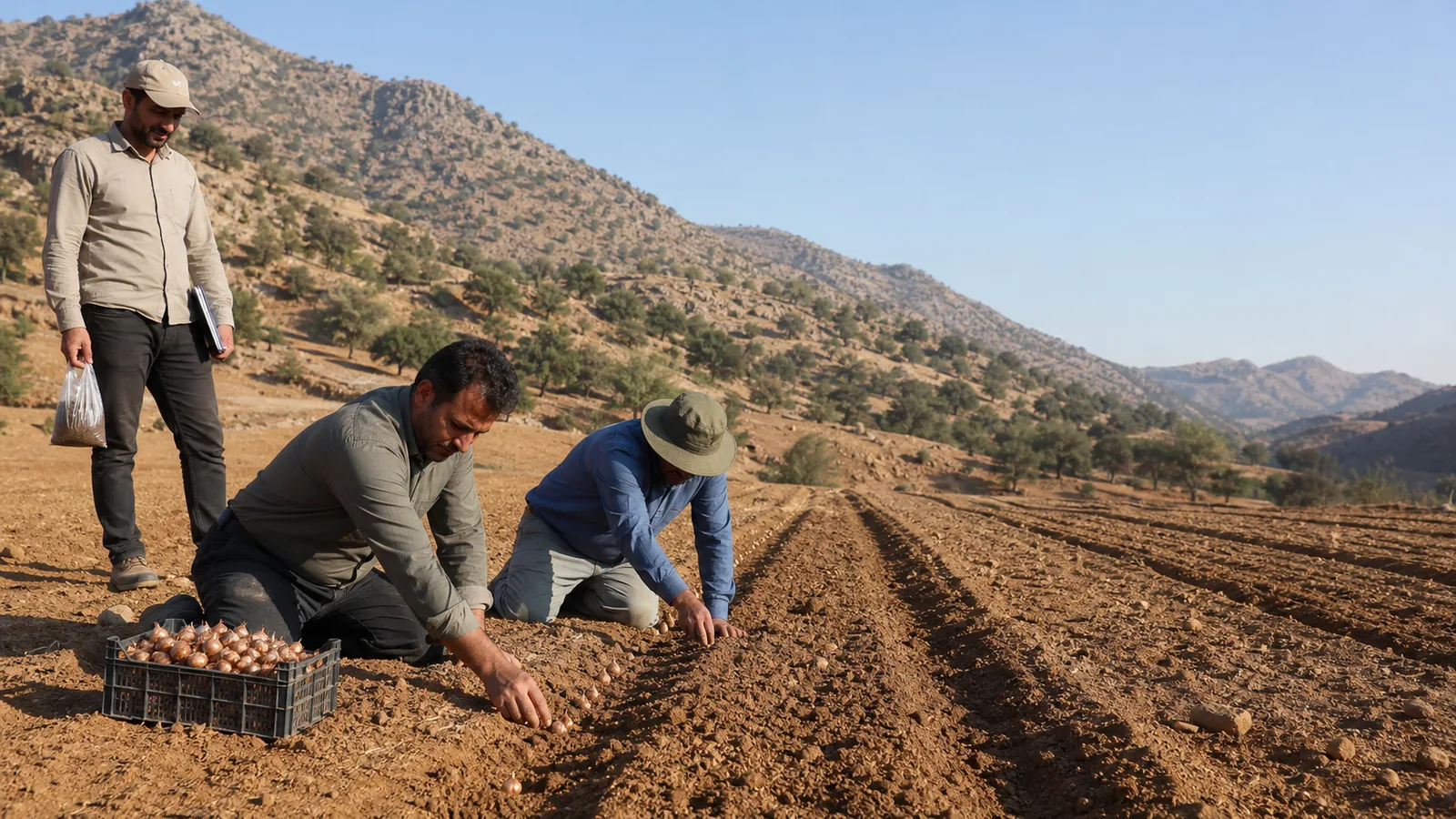
The six-hectare figure belongs to that archived announcement, not to a current survey of Badreh. Its significance was the start of a new crop in a county better known for dryland cereals and livestock. The practical question was whether saffron could turn carefully selected land into a higher-value, multi-year field without creating another fragile market.
What the six-hectare project involved
Siahi said saffron had already begun to develop in several parts of Ilam province and that Badreh was joining that expansion. The local agricultural office had tested dryland sites before identifying land for the first six hectares.
“Dryland” should not be read as “no water needed.” Saffron uses less irrigation than many crops because much of its growth occurs through autumn and winter, but the first irrigation helps trigger flowering and later water supports leaves and daughter-corm development. A field still needs access to water at the right times, even when rainfall supplies part of the requirement.
The original announcement placed planting between August and October. That is consistent with official agricultural guidance from other Iranian growing areas, which commonly describes a late-summer to early-autumn window. The right date in Badreh depends on soil temperature, moisture, altitude and the arrival of autumn weather; it should be set with local agronomic advice rather than copied from a general calendar.
The “saffron onion” is a corm
The archived translation called the planting material a saffron onion. The more accurate botanical term is corm: a compact underground stem that stores energy and produces flowers, leaves and daughter corms.
Healthy planting material is one of the most consequential choices in a new field. Corms should be firm, appropriately sized for production and free from visible rot or injury. They also need clean handling and a field with good drainage. A poorly drained site can keep soil wet around the corm and increase the risk of decay.
Siahi said a corm planting could remain productive for up to ten years in suitable conditions. That is possible, but it is an upper range rather than a guarantee. Crowding, declining corm size, disease, weeds and uneven nutrition can make renewal necessary earlier. A grower should monitor field performance by year instead of leaving the planting untouched simply because ten years were mentioned in the announcement.
Why tests matter before planting
A test result saying land is “suitable” should answer more than whether a saffron flower can emerge. For a commercial field, the assessment should consider:
- soil texture, depth, compaction and drainage;
- salinity and the quality of available irrigation water;
- previous crops, weeds and soil-borne disease risk;
- summer heat and autumn temperature patterns;
- access for picking during a short flowering period; and
- a clean place for rapid stigma separation and drying.
These details determine whether the field can produce saleable dried saffron, not merely flowers. Testing also helps avoid planting valuable corms in a site that will be difficult to irrigate, drain or harvest.
A new saffron field develops over several seasons
The first season is mainly an establishment year. Some large corms may flower, but a grower should not assume that six planted hectares will immediately perform like six mature hectares. As daughter corms multiply and the stand develops, the bearing area and yield can change substantially.
A practical record for each plot should include the corm source and size, planting date and density, irrigation dates, flowers collected, dried saffron weight, labour used and any disease losses. Those records show whether yield is actually improving and which fields need a different approach.
Harvest itself remains labour-sensitive. Flowers are normally picked promptly after opening, then the red stigmas are separated and dried under controlled, hygienic conditions. If Badreh grows more saffron but lacks trained labour during the peak or suitable drying capacity, quality can fall at precisely the moment production expands.
High value does not mean guaranteed profit
The Badreh agricultural office linked support for saffron and pistachios to their potential added value. Both can suit water-conscious crop planning, but “high value” describes the product, not the farmer’s guaranteed margin.
A saffron field has significant establishment costs: corms, soil preparation, planting labour and the opportunity cost of land. Later costs include irrigation, weeding, harvest, stigma separation, drying, grading and packaging. Income depends on yield, tested quality, market access and the price when the crop is sold.
In 2023, Ilam’s provincial horticulture manager said repeated drought made better use of water a priority and pointed to lower-water crops such as pistachios, almonds and damask roses. The official crop-pattern update reinforces the strategy behind Badreh’s saffron trial, but it does not supply a newer Badreh saffron total.
Badreh’s setting
Badreh is in eastern Ilam province, about 38 kilometres west of Darreh Shahr. The archived description places it near 33° north latitude and 47° east longitude, with high ground to the south and Chektair hill to the north. This is part of the rugged Zagros landscape, where elevation and slope can create meaningful differences between nearby fields.
That local variation is why the six-hectare plan began with tests. A result from one site cannot be applied to every dry field in the county. Expansion should follow measured performance from the initial plots, access to water and labour, and evidence that growers can dry and sell the crop well.
How to judge whether the project succeeded
The original announcement established the starting point: six hectares, selected dryland sites, an August-to-October planting window and a plan to support saffron alongside pistachios. It did not report a harvest, yield or later planted area.
A proper follow-up would compare the crop year, planted and bearing hectares, dried saffron output, yield by field age, quality-test results, labour needs and the share sold through traceable local packaging. Until that evidence is available, the safest conclusion is simple: Badreh began a carefully targeted saffron trial with long-term potential, but the six-hectare launch alone does not prove commercial success.

![Exporting Saffron to Turkey + Price Guide [Complete 0 to 100]](https://img.rowhanisaffron.com/20260827003933/saffron-export-turkey-quality-inspection.webp)



