


South Khorasan produced a reported 67 tons of saffron from roughly 16,800 hectares during the period covered by this provincial crop account. The number belongs to a dated agricultural record and should not be read as the province’s output today.
What the 67-ton saffron figure represents
Abdolreza Rezaei, then identified as director of horticulture for South Khorasan Agricultural Jihad, discussed year-to-year changes in three strategic crops: saffron, barberry and jujube. For saffron, the comparison began with 16,253 hectares under cultivation in the Iranian year 1397.
A later academic analysis using statistics from the provincial agricultural authority records about 16,807 hectares and 67 tons of saffron. The figures are consistent with the scale in Rezaei’s account, but they describe that reporting period rather than a permanent annual level.
How much is 67 tons across that area?
Dividing 67,000 kilograms by 16,807 hectares gives a broad provincial average of about four kilograms of dried saffron per cultivated hectare. That calculation is useful for understanding scale; it is not a guaranteed field yield.
The total cultivated area can include fields of different ages and conditions. Productive corm density, irrigation timing, soil salinity, weather during flower initiation, picking speed and drying practice all affect the amount and quality recovered from an individual plot.
Why South Khorasan is central to saffron production
The province has a long association with saffron farming, particularly around Qaenat and other eastern districts. Dry summers suit the corm’s dormant period, while autumn cooling and managed irrigation help initiate flowering. Those broad conditions do not remove the need for field-by-field soil and water assessment.
A peer-reviewed study on saffron business clusters in South Khorasan cites the same 16,807-hectare and 67-ton provincial statistics. It also highlights a lasting economic issue: producing a large crop does not automatically mean that the region captures the full value from processing, branding and market access.
South Khorasan is also an eastern border province, adjoining Afghanistan and neighbouring Khorasan Razavi, Yazd, Kerman, and Sistan and Baluchestan. The original account noted that the province began with only four counties. That geography helps explain both the distances within its agricultural network and the importance of dependable routes from farms to processors and markets.
Harvest volume depends on careful handling
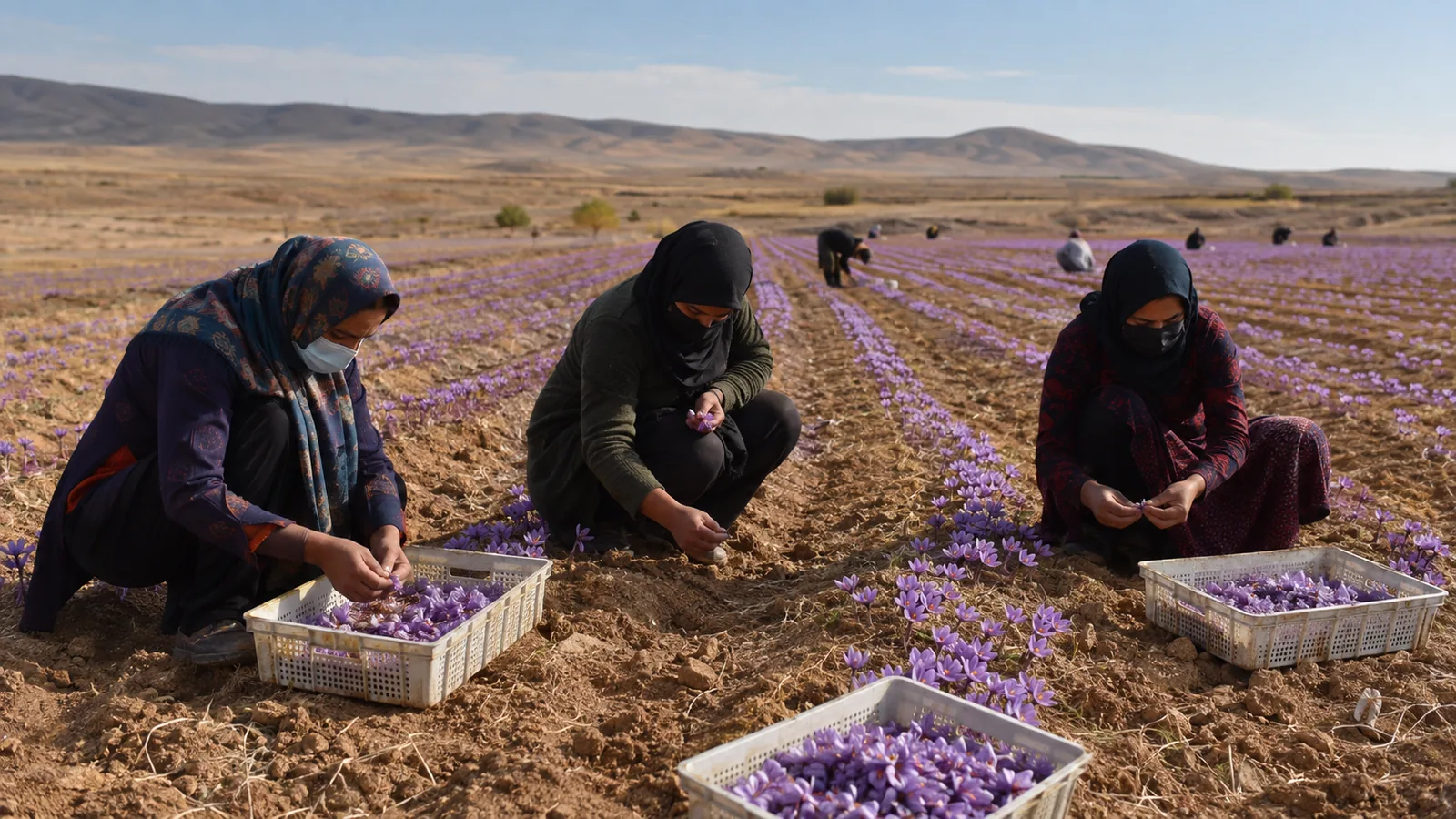
Sixty-seven tons of dry saffron represents a far larger mass of fresh flowers and an intense, short-lived demand for labour. Flowers have to be picked promptly, kept from being crushed or overheated, and moved to a clean separation area. The stigmas then need controlled drying and protection from moisture.
Provincial volume is therefore more than a field statistic. It reflects the capacity of households, seasonal workers, collection points and processors to handle each day’s bloom while its quality is still recoverable.
A dated total should not be turned into a current claim
Annual production changes. An official Iranian Agricultural News Agency report from November 2021 described 70 tons in the preceding year but forecast 56 tons for the current season. It attributed the expected fall to reduced rain, salinity, heat and declining water and soil quality.
That later example explains why the title’s 67 tons must stay attached to its historical context. Cultivated area may rise while output falls, and a provincial estimate may be revised after harvest.
Barberry and jujube were part of the original comparison
Rezaei’s account placed saffron alongside South Khorasan’s other characteristic horticultural crops. It estimated that barberry area had risen from 16,726 hectares in 1397 to 17,600 hectares in 1398, while production increased from about 18,830 to 20,800 tons.
For jujube, it reported an increase from 3,631 to 3,863 hectares and from 6,309 to 7,000 tons over the same comparison. These numbers do not measure saffron performance, but they show that the 67-ton statement came from a broader review of the province’s crop economy rather than a standalone marketing claim.
Production and value creation are different measures
A province can lead in cultivation yet lose much of the possible value if saffron leaves the region in bulk. Careful grading, documented origin, hygienic processing, laboratory testing where required, suitable packaging and direct access to buyers all affect how much benefit remains near the farms.
The business-cluster research argues for stronger coordination among growers, processors and marketers. That does not establish a single best commercial model, but it identifies why the production total alone cannot describe the health of the regional saffron sector.
How to read provincial saffron statistics
Three distinctions keep a figure such as 67 tons meaningful. First, note whether it is a forecast or a final harvest total. Second, pair it with the correct cultivated area and crop year. Third, do not mistake a province-wide average for what every farm produced.
The source account is most useful when read this way: South Khorasan had already developed a very large saffron-growing base, with 16,253 hectares recorded in 1397 and roughly 16,800 hectares associated with the 67-ton figure. The surrounding barberry and jujube data confirm the report’s wider agricultural context.
What remains important beyond the headline
The headline preserves a significant historical result, but the enduring story is the system behind it. South Khorasan’s saffron depends on suitable land, healthy corms, carefully timed water, rapid harvest, controlled drying and a route to market that rewards traceable quality.
Newer official figures should be used for any claim about current production. The 67-ton record remains valuable as a dated benchmark and as evidence of the province’s established role in Iranian saffron, not as an unchanging annual promise.

![Exporting Saffron to Turkey + Price Guide [Complete 0 to 100]](https://img.rowhanisaffron.com/20260827003933/saffron-export-turkey-quality-inspection.webp)



