


The level of saffron cultivation in Chaharmahal and Bakhtiari was increasing when this provincial report recorded 228 hectares and forecast a harvest of about 912 kilograms. The figures described a developing production area outside Khorasan, supported by cooler highland conditions and interest in crops with a different water schedule.
What the 228-hectare report said
Atallah Ebrahimi, then head of the province’s Agricultural Jihad Organization, described Chaharmahal and Bakhtiari as suitable for saffron cultivation. His production estimate works out to an average of four kilograms of dried saffron per hectare across the stated area.
That calculation is a provincial average, not a promise for an individual field. The source does not separate bearing and newly planted hectares, identify the crop year in its English copy or show how the 912-kilogram forecast was assembled. Those limits matter when the old figure is compared with later reports.
Why saffron can grow in this highland province
Chaharmahal and Bakhtiari has varied elevation, winter cold and local differences in soil and rainfall. Saffron can benefit from a dry summer dormancy followed by cooler autumn conditions that encourage flowering.
Climate alone does not guarantee a crop. Corm health, planting depth and density, drainage, irrigation timing, field age and frost exposure all affect yield. Research indexed by FAO’s AGRIS database has examined soil and climate effects on saffron yield and found that results can differ materially between growing regions.
Low water use needs a careful definition
Ebrahimi described saffron as a low-water crop whose growing period allows it to use seasonal rain. That is a useful comparison with some summer crops, but it should not be shortened to “saffron needs no irrigation.”
Flowering and leaf growth still depend on moisture arriving at useful times. Rainfall may provide part of that need, while fields in a dry season require planned irrigation. Soil that stays waterlogged can be as damaging as prolonged shortage because saffron corms need drainage.
From 228 hectares to a later 300-hectare estimate
The 228 hectares and 912 kilograms belong to the historical source. A later Iranian Agricultural News Agency report on the province put saffron cultivation at roughly 300 hectares, average yield at about five kilograms per hectare and expected production at 1.5 tonnes.
The newer snapshot supports the statement that cultivation was increasing. It does not prove a smooth annual trend, since planted area, bearing area, weather and reporting methods can change between crop years.
What the quality claim does and does not establish
The original report credited the province’s climate and topography with saffron of high quality, strong aroma and colouring power. Those are plausible product characteristics, but no sample, grade or laboratory result is included on the page.
Quality should be checked in the finished dried saffron. Buyers may assess thread composition, cleanliness, moisture, aroma, colour strength, packaging and traceability, with laboratory testing where required. Provincial origin alone cannot certify every package.
Seasonal employment during harvest
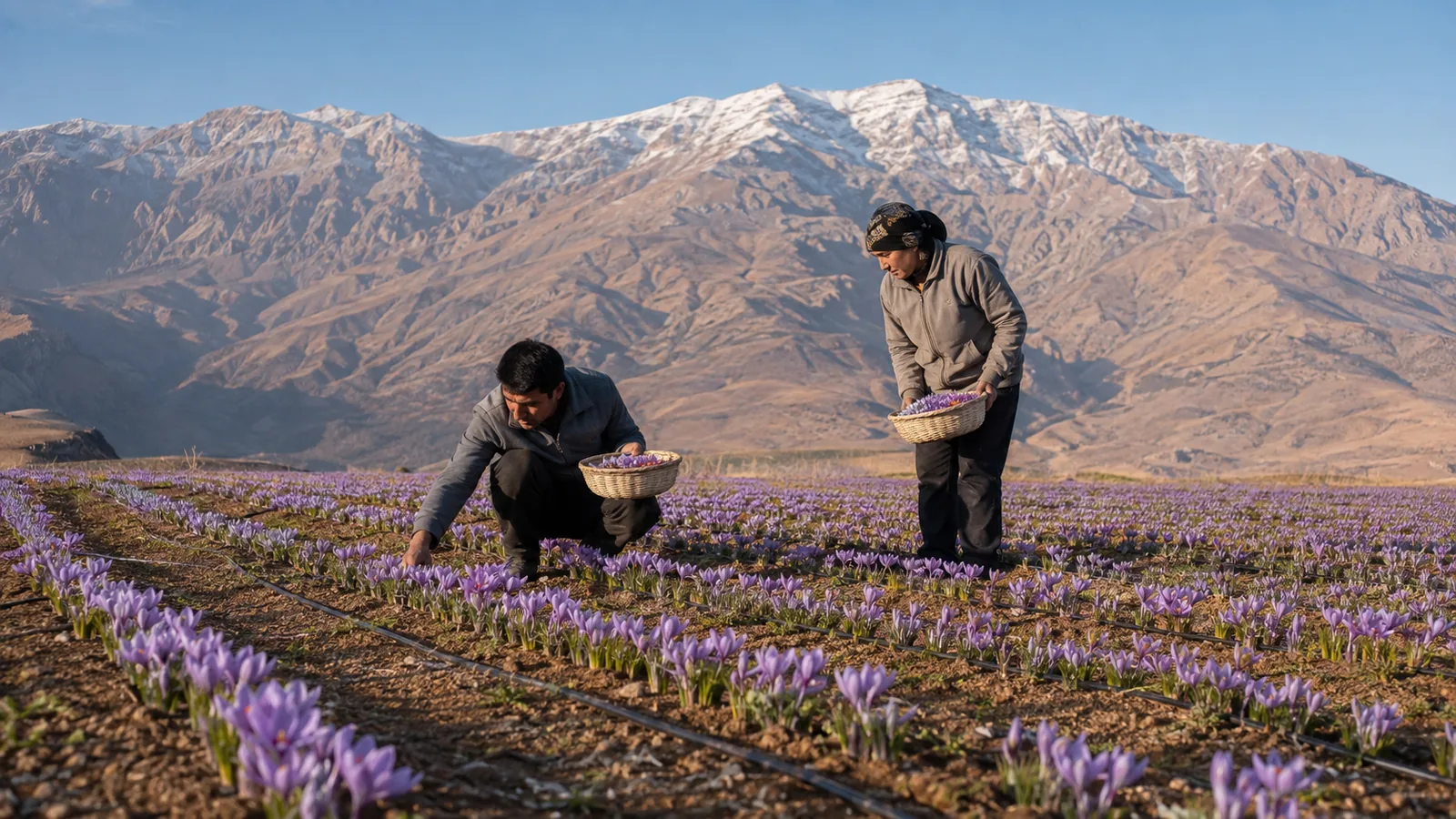
Ebrahimi also emphasized income and employment. Saffron creates a concentrated demand for workers because flowers appear over a short autumn window and need to be picked promptly.
Work continues after the field. Flowers have to be transported without crushing, the red stigmas separated, and the saffron dried, graded and packed. That activity can support rural households, but its duration and income depend on planted area, yield, labour rates and the way the finished saffron is sold.
The post-harvest step determines whether origin stays visible
Later provincial reporting said some saffron left Chaharmahal and Bakhtiari in bulk and was packaged under brands elsewhere. That arrangement can move the crop efficiently, but it reduces the visibility of the producing region and leaves more of the packaging value with another business.
A local processing operation needs more than a box and a label. Clean separation, controlled drying, reliable grading, food-safe packaging, traceability and access to buyers all have to work together. Otherwise, additional packaging can add cost without improving quality or farmer returns.
What expanding cultivation requires
An increase in hectares creates demand for healthy corms, trained labour and enough drying capacity at the same time. A field may remain productive for several years, so poor site selection or planting material can affect more than one harvest.
Expansion also needs a realistic market plan. Growers should know who will buy fresh flowers or dried threads, which grade is required, how the crop will be tested and packed, and whether the available price covers field and harvest costs.
How to read the growth of saffron cultivation
The historical 228-hectare report and the later 300-hectare account show saffron gaining ground in Chaharmahal and Bakhtiari. The change is meaningful, but the numbers should remain attached to their own source periods rather than being presented as today’s live production total.
The long-term opportunity comes from fit, not fashion. Saffron can suit highland fields and a cooler-season water schedule, provide concentrated rural work and produce a high-value dried crop. Its success still depends on field-level conditions, timely labour, careful processing and a market that recognizes the province’s product.

![Exporting Saffron to Turkey + Price Guide [Complete 0 to 100]](https://img.rowhanisaffron.com/20260827003933/saffron-export-turkey-quality-inspection.webp)



