


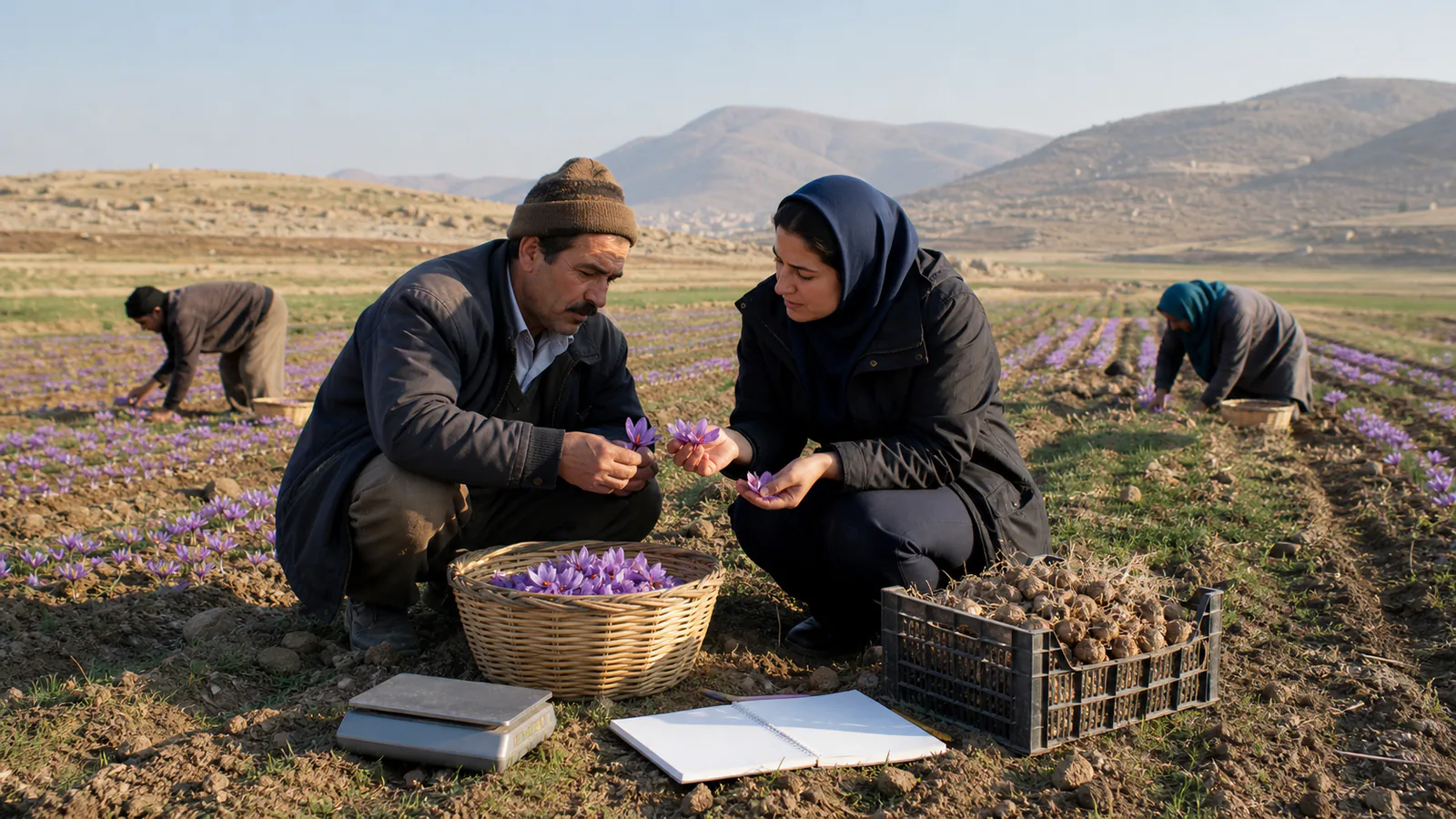
A historical Islamabad-Gharb report expected 50 kilograms of dry saffron from 24 hectares, with harvest running through November. Two Kermanshah Province sources add the wider plan: one forecast 200 kilograms from 80 hectares, while another described expansion from 185 to 335 hectares and a three-year target near 1,000. A Bahar city report offers a separate eight-kilogram comparison from two hectares.
These figures cover different places and periods, and several are forecasts rather than final weights. They should not be added into a regional total. Read together, they show how local production, field age, climate, training, corm subsidies, and development finance shaped saffron expansion in western Iran.
What Islamabad-Gharb’s 50 kg figure meant
Kamran Karimi, identified as the local agricultural director, said harvesting began in early November and was expected to continue until the end of the month. He forecast 50 kilograms of saffron from 24 hectares across Islamabad-Gharb.
That equals about 2.08 kilograms per hectare if the full 24 hectares were productive and the forecast was achieved. The article gives no final dry weight, field-age breakdown, or productive-area adjustment, so 2.08 is an implied forecast yield—not a measured farm average.
The distinction matters because the destination title says “harvesting 50 kg,” while the body repeatedly says “expected.” A later result would be needed before changing the forecast into a completed harvest.
Firoozabad was the local production center
Karimi identified Firoozabad village as Islamabad-Gharb’s saffron center, with six hectares under cultivation. The report does not state how much of the 50-kilogram city forecast came from those six hectares, so a village yield cannot be calculated.
He said all parts of the county could grow saffron but considered northern and southern areas more favorable because of greater rainfall. That is a local official’s historical assessment, not a parcel-level suitability test. Soil drainage, salinity, cold and heat events, corm health, irrigation access, and field history still need to be checked.
The destination’s general road and geography paragraphs do not affect saffron performance. The useful geographic point is that Islamabad-Gharb sits within Kermanshah Province and therefore belongs inside the province-level production context supplied by the assigned sources.
The 200 kg Kermanshah forecast does not match its stated average
Hamidreza Jahangiri, identified as Kermanshah Province’s horticulture director, reported 80 hectares under saffron and an average of four kilograms per hectare. The source title describes a 200-kilogram production forecast.
Those numbers do not reconcile: 80 hectares at four kilograms per hectare would equal 320 kilograms, while 200 kilograms over 80 hectares equals 2.5 kilograms per hectare. The source provides no explanation.
Possible reasons include young or nonproductive hectares, rounding, a damaged translation, or figures drawn from different seasons. None can be selected confidently. The correct editorial response is to preserve the 80-hectare, four-kg/ha, and 200-kilogram statements while making the inconsistency visible.
Harvest timing and climatic limits across the province
Jahangiri said the provincial harvest began on November 4 and would last about 20 days, depending on conditions. That timing is broadly compatible with the early-to-late November window reported for Islamabad-Gharb.
He considered most of Kermanshah Province suitable for saffron, excluding Qasr-e Shirin and the warmer parts of Sarpol-e Zahab and Gilan-e Gharb. The largest areas were reported in Kermanshah city, Kangavar, and Sahneh.
These are regional observations from that period. “Most cities can cultivate” does not mean every field is suitable or profitable. A trial plot and local agronomic assessment are safer than extending a provincial statement to all land.
The 1,000-hectare headline was a target, not an achievement
A third assigned source is titled “Saffron cultivation in Kermanshah reached 1,000 hectares.” Its body says horticulture director Reza Zarei announced a three-year plan to reach approximately 1,000 hectares. At the time, planted area had grown from 185 to 335 hectares after 150 hectares were added.
In other words, the province had not yet reached 1,000 hectares in the article’s own timeline. An 800-hectare expansion from the earlier 185-hectare base would total about 985 hectares, reasonably close to the rounded target. Adding 800 to the already expanded 335, however, would produce 1,135. The plan’s baseline must be specified before auditing progress.
Zarei said new cultivation was concentrated in Kermanshah city and also reached Dalahu, Sahneh, Islamabad-Gharb, Gilan-e Gharb, and Javanroud. That distribution shows the destination’s 24 hectares were one part of a much broader development effort.
Corm subsidies and training supported expansion
Karimi said the local agricultural office held cultivation classes and supplied saffron corms with a subsidy. Zarei added that applicants received half the corm-preparation cost free in the reported year.
These were period-specific support measures, not current entitlements. The sources do not give eligibility, corm quantity or health grade, supplier records, payment method, or follow-up results.
Zarei also said a farmer with sufficient land and the ability to irrigate twice in October could plant saffron. That is too broad to use as present-day planting advice. Irrigation timing matters, but soil, drainage, climate, corm health, density, disease, labor, and market access also determine whether a field is viable.
Yield was reported to change with field age
Zarei described a seven-year cultivation cycle with approximately 1.5 kilograms per hectare in year one, 3.5 in year two, then more than five and sometimes up to nine in later years. He put the provincial average at six kilograms per hectare.
These are historical extension figures, not a guaranteed progression. They also help explain why a district with many young fields could have a lower average even while total planted area grows.
Peer-reviewed evidence supports the importance of field age and corm density. A study of 110 Iranian saffron farms found that dense planting and cultivation age influenced technical efficiency, with excessive density shortening productive life. Each field needs its own annual yield and corm-health record.
Why irrigation cannot be reduced to “twice in October”
Saffron’s autumn–winter cycle can make it attractive in water-stressed areas, and early irrigation helps coordinate flowering. Yet the amount and number of irrigations depend on climate, soil, rainfall, field age, and production goal.
A two-year Iranian experiment found that irrigation rounds and mother-corm size affected flower yield, quality measurements, daughter-corm development, and nutrient uptake. This is why a short news quote cannot replace site-specific planning.
A current grower should document water source, salinity, application depth, timing, rainfall, soil moisture, and drainage. The number of rounds alone does not show water efficiency.
Bahar’s eight-kilogram harvest is a separate comparison
The Bahar city source, from Hamedan Province rather than Kermanshah, reported eight kilograms of saffron from 20,000 square metres. Because 20,000 m² equals two hectares, the implied yield is four kilograms per hectare.
The wording presents eight kilograms as harvested rather than forecast. It does not state field age, final moisture, grade, or whether the entire two hectares were productive, so the comparison remains approximate.
Bahar’s governor said more than 75% of the city’s population worked in agriculture. Its agricultural workgroup had approved 79 of 212 bank-referred projects, with contracts worth 54 billion rials. Those projects were agriculture-wide, not saffron-only; the article also mentions garden, farm, mushroom, cereal, seed, and fertilizer activities. They provide development context but cannot be credited specifically to the eight-kilogram harvest.
How the local figures compare without double counting
The reports support four distinct observations:
- Islamabad-Gharb expected 50 kg from 24 ha, implying about 2.08 kg/ha if achieved;
- Kermanshah Province was reported at 80 ha with a conflicting 200-kg forecast and four-kg/ha average;
- a later expansion account placed provincial area at 335 ha and targeted roughly 1,000 ha over three years; and
- Bahar reported 8 kg from 2 ha, implying four kg/ha in a different province.
The Kermanshah reports may come from different years and cannot be collapsed into one current total. The Bahar number is a comparator, not a contribution to Kermanshah production.
What a current regional assessment would need
Current planning should replace forecasts with final dry weights and map productive hectares by field age. It should also record corm source and health, planting density, water use, harvest labor, drying, quality results, realized price, and subsidy cost.
Expansion targets are meaningful only when markets and post-harvest capacity grow with them. More hectares can create a larger harvest while reducing average yield or farmer returns if fields are young, labor is short, or buyers are weak.
For another provincial example of why area and yield arithmetic must be reconciled before drawing conclusions, see the historical Fars saffron yield report.
The combined lesson from Islamabad-Gharb and its sources
The destination preserves Islamabad-Gharb’s 50-kilogram forecast, 24 hectares, November window, Firoozabad’s six hectares, local training, and corm support. The Kermanshah sources add province-wide area, harvest timing, climatic limits, growth from 185 to 335 hectares, the 1,000-hectare target, subsidy detail, and reported yield progression. Bahar adds a measured eight-kilogram comparison and agriculture-finance context.
None of the sources proves a current 50-, 200-, or 1,000-hectare outcome. Their value is in showing what must be verified: whether a number is a target or result, which geography it covers, how field age affects yield, and whether public support leads to durable saleable production.

![Exporting Saffron to Turkey + Price Guide [Complete 0 to 100]](https://img.rowhanisaffron.com/20260827003933/saffron-export-turkey-quality-inspection.webp)



