


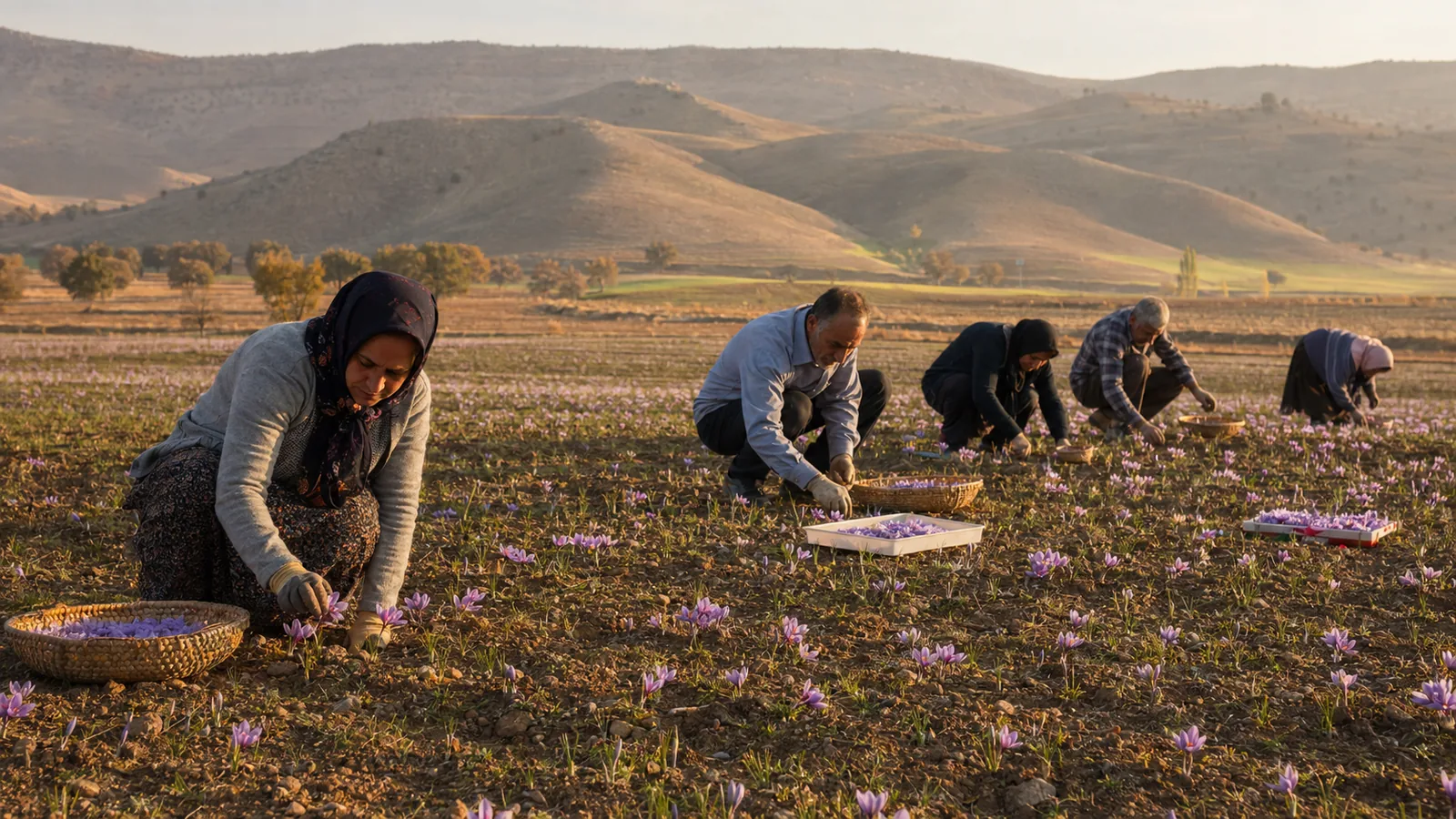
A saffron harvest was reported across 160 hectares of farms in Khorramabad, with the season expected to involve hundreds of rural households in picking, cleaning, drying and packing the crop. The figures describe a particular harvest period, not the city’s present cultivated area or current output.
What the 160-hectare report said
Morad Biranvand, identified in the report as director of Khorramabad Agricultural Jihad, said 160 hectares in the county were under saffron. Of that total, 132 hectares were described as fields at least two years old and therefore further into their productive cycle than newly planted land.
The report forecast roughly 550 kilograms of saffron for Khorramabad and referred to an average yield of about three kilograms per hectare. These figures should be read as the authority’s estimate for that season. They do not provide field-level measurements, a final weighed total or a breakdown between productive and newly planted hectares.
Why field age matters to the estimate
A newly established saffron field does not necessarily perform like an older one. Flowering can change as the corm population develops, while soil, corm health, planting density, rainfall and irrigation still affect the result. That is why the distinction between the total 160 hectares and the 132 hectares aged two years or more is useful.
Local research also cautions against treating one regional average as a promise. A six-year Khorramabad trial catalogued by FAO’s AGRIS database found marked differences between crop years. Its purpose and growing conditions were not identical to every commercial field, but it illustrates how strongly field age and management can influence dry-saffron yield.
Harvesting is only the first urgent job
Saffron flowers arrive in a short autumn window. They are normally picked early and handled gently, before heat and compression reduce their condition. Once the flowers reach the working area, the red stigmas have to be separated and dried without an avoidable delay.
The Khorramabad report connected harvesting with cleaning, processing and packaging rather than presenting picking as the whole operation. That distinction matters: a large planted area creates value only when labour and drying capacity can keep pace with the daily bloom.
Rural households and seasonal work
More than 400 rural households were said to be involved in saffron cultivation in Khorramabad. The report described some harvesting, cleaning and processing as family work and referred to more than 1,000 trained agricultural workers.
It also used a figure of about 100 seasonal workers per hectare over a two-month period. The original wording does not make clear whether that number represents individual workers, shifts or accumulated labour-days, so it should not be converted into a precise employment total. What the passage does establish is that harvest and post-harvest handling were regarded as labour-intensive local activities.
The role described for women’s micro-cooperatives
Women’s micro-cooperatives were reported to have received organization and training support from the local agricultural authority. For a crop that requires careful stigma separation, drying and packing, organized household-scale work can help growers share skills and coordinate a time-sensitive workload.
Training alone does not guarantee a uniform finished product. Clean work surfaces, food-safe containers, controlled drying, protection from moisture and traceable lots are still necessary if several households contribute to processing.
How the 550-kilogram forecast fits other records
A separate April 2020 report from the Iranian Agricultural News Agency also quoted Biranvand on 160 hectares of saffron in Khorramabad. It recorded more than 500 kilograms produced and marketed in the Iranian year 1398, broadly consistent with the scale of the later 550-kilogram forecast.
That corroboration is useful, but the two numbers are not interchangeable. One is a reported result for a named year and the other is a forecast. Neither should be presented as a current production figure without a newer official survey.
Packaging, branding and product quality
The local authority said many growers had received permission for home packaging, while larger producers were working on branding and improved packs. Packaging can protect dried saffron from moisture, light and physical damage, but an attractive box cannot correct poor drying, mixed grades or uncertain origin.
For buyers, the useful information is what can be checked: net weight, producer or packer identity, lot traceability, hygienic handling and a description that matches the material inside. For growers, separating lots and recording harvest and drying details gives branding a foundation beyond appearance.
Turnover and guaranteed purchase were period-specific
The report valued Khorramabad’s annual saffron turnover at more than two billion tomans and linked the crop with employment, household livelihoods and reduced outward migration. That monetary figure belongs to the price level and production assumptions of the reporting period; it is not a current valuation.
It also said the Rural Cooperative Organization could place guaranteed purchasing on its agenda if required and if the necessary instructions were issued. This was a conditional policy statement, not proof that every grower had a standing purchase guarantee or a fixed price.
What this harvest record shows today
The value of the Khorramabad report is its picture of a regional saffron system: 160 hectares in cultivation, 132 hectares beyond the earliest establishment stage, a 550-kilogram seasonal forecast, more than 400 involved households and an effort to organize processing and packaging.
Its figures should remain tied to their historical season. For future expansion, the sound questions are whether each field is suitable, whether trained labour and drying space are ready for the flowering peak, and whether the finished saffron can be handled and documented consistently. Those practical details matter more than planted area alone.

![Exporting Saffron to Turkey + Price Guide [Complete 0 to 100]](https://img.rowhanisaffron.com/20260827003933/saffron-export-turkey-quality-inspection.webp)



