


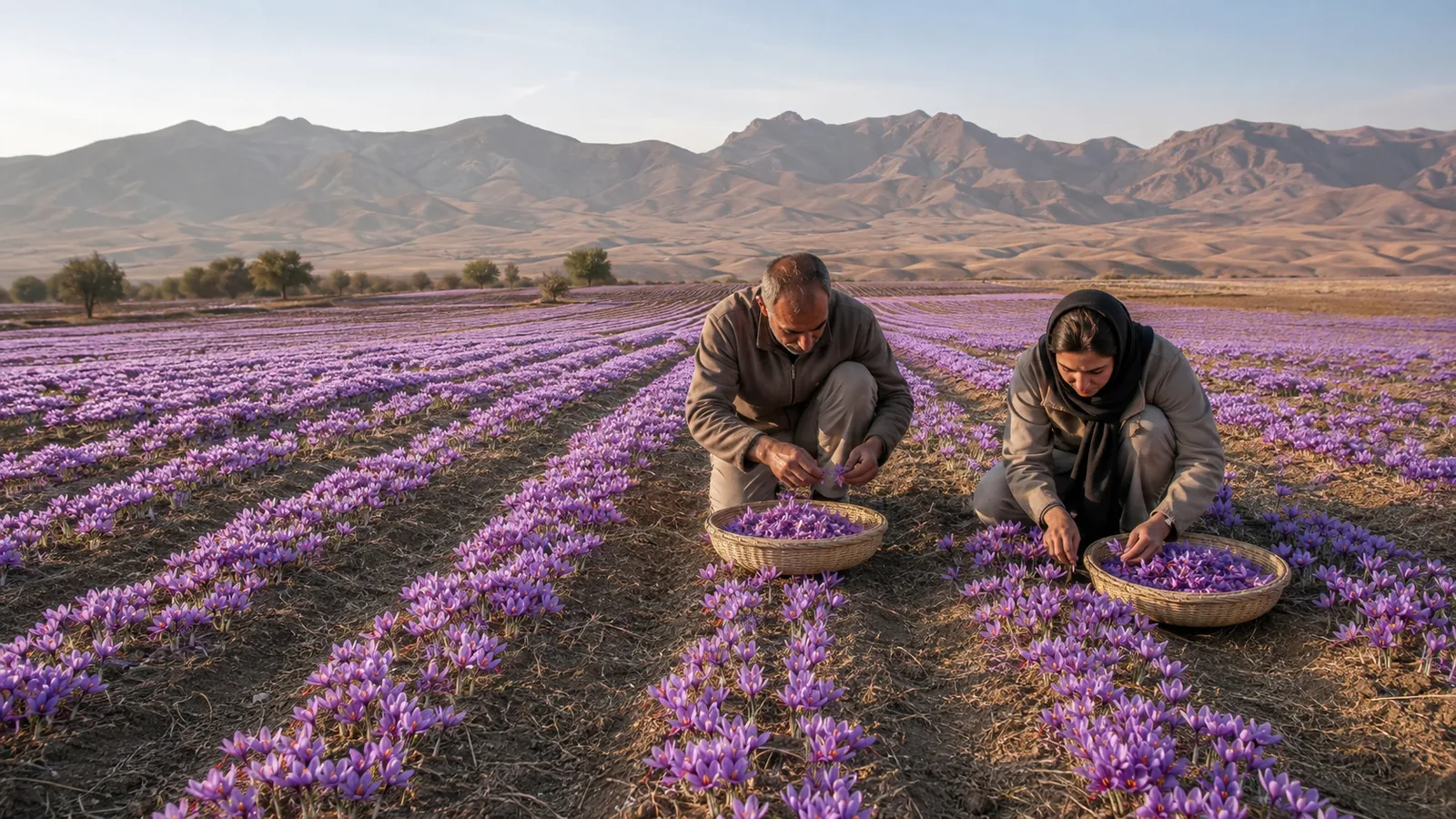
Nearly 200 hectares were under saffron cultivation in Marand when this local report was published. The planted area had risen from 184 to 194 hectares, while officials put the average saffron yield per hectare at seven kilograms and the best-performing farms at up to 12 kilograms.
What the Marand cultivation figures showed
Ali Sayadi, then identified as director of Marand Agricultural Jihad, described a ten-hectare year-on-year increase. His figures placed Marand at the centre of saffron farming in East Azerbaijan and showed that cultivation was expanding rather than remaining a small trial crop.
The report also gave annual production as 1,000 kilograms. That total does not equal seven kilograms across all 194 hectares, so the numbers probably use different bases: total planted area may have included young or non-bearing fields, while average yield may have referred only to productive hectares. The source does not provide the breakdown needed to reconcile them exactly.
Saffron yield per hectare in Marand
A yield figure measures dried stigmas, not the weight of freshly picked flowers. Sayadi’s seven-kilogram average and upper figure of 12 kilograms per hectare describe a wide gap between a typical field and the area’s leading farms.
That difference cannot be credited to one practice alone. Corm size and density, field age, soil, drainage, temperature, irrigation timing, weed pressure and the speed of harvest all influence the final dry weight. A review indexed by FAO’s AGRIS database found that Iranian saffron yield per hectare changed over time and identified agronomic management, drought, economics and post-harvest handling as connected pressures.
Why 1,000 kilograms did not mean 1,000 kilograms for export
Sayadi said Marand produced about one tonne annually but had not yet exported saffron directly from the county. Product grown in one place can still reach customers elsewhere after being sold to a trader or processor, so the absence of a local exporter does not prove that none of the crop crossed a border.
What Marand lacked, according to the report, was a stronger local route from farm to finished, traceable package. Without that route, growers had less influence over the final presentation and destination of their saffron.
Retail and wholesale told different stories
The local retail market was described as reasonably healthy. Wholesale conditions were weaker because costs reduced the price growers could accept, and saffron was often sold for less than they wanted.
A retail sale can capture value from small quantities, direct contact and convenient packaging. A bulk sale moves more product at once, but the buyer takes on grading, packaging, distribution and sales risk. Comparing the two only by price per kilogram misses those different costs and services.
The 40% packaged and 60% bulk split
According to Sayadi, 40% of Marand’s saffron was packaged and 60% was sold in bulk. He also referred to three saffron brands obtained for the county, although the translated report does not identify the businesses or clarify whether “obtained” means registered, licensed or purchased.
The split matters because packaging can preserve origin information and make a small retail quantity easier to sell. It does not automatically produce a premium. The saffron still needs consistent grading, clean processing, suitable food-contact materials, accurate weight and a route to customers who value those things.
Why the report called for a packaging facility
Marand’s early trade was described as sales of whole flowers, with little demand for a local packaging industry. As planted area and output increased, Sayadi argued that a processing and packaging facility had become necessary.
A local facility can shorten the distance between harvest and controlled processing, but only if it matches the scale and needs of growers. Research indexed by AGRIS on packaging and branding in Iran’s saffron value chain treats processing, export capability and production as related parts of value creation. Equipment without quality control, buyers and traceability would not solve the market problem by itself.
Water use and the labour constraint
Sayadi recommended saffron as a lower-water crop suited to further cultivation in the county. Its active cycle falls mainly through the cooler part of the year, but fields still need reliable water at the right stages. “Low water” should not be mistaken for “no irrigation.”
He also warned that harvest requires substantial labour. Flowers appear over a short period and are normally picked early, before heat and handling reduce their condition. The red stigmas then have to be separated and dried promptly. Expanding hectares without enough trained workers can shift the constraint from water to harvest capacity.
How Marand’s cultivation later changed
The nearly 200-hectare title belongs to the earlier report. A later Iranian Agricultural News Agency report on Marand put the newer crop-year area at 263 hectares: 247 bearing and 16 not yet bearing. It forecast 1,900 kilograms, or a little over seven kilograms per bearing hectare.
Those later figures support the earlier direction of travel, but they should not be merged into one continuous statistical series without confirming the years and measurement rules. They are separate snapshots from different officials and crop seasons.
What the Marand story means for growers and buyers
Marand’s expansion shows the appeal of saffron outside Iran’s traditional Khorasan heartland. The crop offered a way to use land and seasonal water differently, yet it brought its own demands: healthy planting stock, patient field establishment, concentrated manual harvest and careful post-harvest work.
For buyers, origin alone does not establish grade or quality. A useful package should identify the seller and product, protect the threads and allow traceability. For growers, higher saffron yield per hectare is only part of the result. The crop must also be harvested on time and sold through a channel that rewards clean processing and reliable quality.

![Exporting Saffron to Turkey + Price Guide [Complete 0 to 100]](https://img.rowhanisaffron.com/20260827003933/saffron-export-turkey-quality-inspection.webp)



