


The current price of Iranian saffron flowers was not economical for growers in Farooj during the 2020 harvest described in this report. A farmer with 35 hectares said the local price had fallen from at least 150,000 tomans to 80,000–90,000 tomans per kilogram while picking and flower-cleaning costs still had to be paid.
This was a dated Farooj price report
Mohammad Hossein Tayebi of Se Gonbad village spoke after the North Khorasan saffron harvest had been under way for about ten days. His complaint concerned a particular market and crop season, not the price of fresh saffron flowers today.
That distinction matters because a saffron-flower price can change within hours as flowering peaks, labour demand shifts and the amount brought to market rises. The old numbers should be read in their 2020 context; they are not a current quotation or an offer to buy or sell.
How the flower price fell during the harvest
Tayebi said buying began at 150,000 tomans per kilogram or more, then dropped to roughly 80,000–90,000 tomans. Another local account from the same period described an even higher opening level before the market settled near 90,000.
A sharp fall during peak flowering creates an immediate problem for a farmer. Fresh flowers contain far more weight than the dried red stigmas ultimately sold as saffron, and they cannot wait in the same way as a stable dry commodity. A grower must decide quickly whether to accept the available price or arrange labour to separate and dry the crop.
Why fresh saffron flowers cannot simply be held back
Once picked, flowers begin to lose condition. Heat, compression and long storage make the stigmas harder to separate cleanly and can increase the risk of contamination or quality loss. Plastic bags are particularly unsuitable when they trap heat and moisture around a dense mass of flowers.
This perishability weakens the grower’s bargaining position. A buyer can wait for more flowers to arrive, while the farmer has only a short window to sell them or organize processing. That imbalance was central to Tayebi’s criticism of the Farooj market.
The proposed centralized flower market
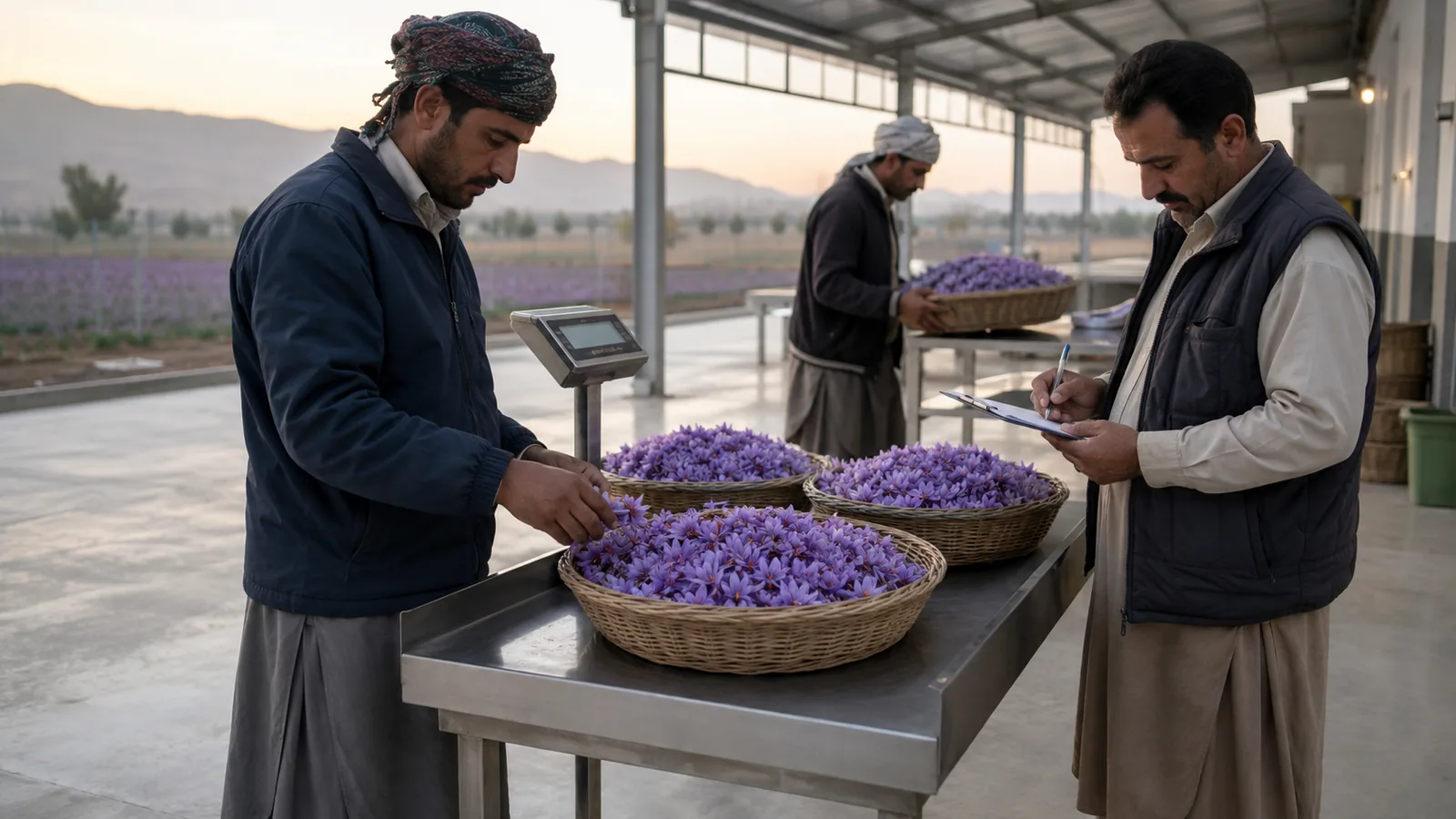
Tayebi said a market had been created in Farooj to centralize purchasing and make prices clearer. He believed the arrangement had not delivered the expected minimum level and argued that buying lacked effective oversight.
An Iranian Agricultural News Agency report from the same season said 30 saffron-flower purchasing booths were planned in North Khorasan and that 15 in Farooj had already been leased. It also records the earlier practice in which flowers could be collected before a price was disclosed.
The broker complaint and what can be established
Tayebi blamed the price decline on brokers and alleged that buyers were coordinating the same offer. That was the farmer’s account. The surviving article does not include transaction records or an investigation that independently proves coordination.
It does, however, show why transparent weighing, visible prices and a clear handover record matter. When sellers know the price before delivery and can compare active buyers, fewer decisions depend on informal promises made after a perishable crop has left the farm.
Harvest and cleaning labour changed the calculation
The report put a worker’s daily cost at 90,000–120,000 tomans and the fee for cleaning flowers at 17,000 tomans per kilogram. Tayebi also referred to roughly three tonnes of flowers needing to be cleaned overnight during the busy period.
Those figures describe the local rates and workload cited at the time. They do not provide a full farm budget. A proper profitability calculation would also need each field’s yield, transport, irrigation, corm and land costs, the conversion from flowers to dried saffron, the grade obtained and the eventual dry-saffron selling price.
Coronavirus did not remove the labour problem
The harvest took place during the coronavirus outbreak. Tayebi said workers were still available and were collecting flowers under health guidelines, so the complaint was not simply a shortage of hands. His point was that the flower price had to cover wages and current farm expenses while leaving a viable return.
A worker’s presence also does not guarantee enough processing capacity at the right hour. Picking, transporting, separating and drying are linked. If one stage falls behind, the condition of the harvested flowers can deteriorate before the finished saffron is secured.
Why post-harvest quality affects value
The economics do not end when a flower is bought. Clean separation, controlled drying, grading and traceable packing determine how much usable saffron reaches the next buyer. The Food and Agriculture Organization’s work on Iranian saffron emphasizes post-harvest practices, standardization and quality integrity as part of a stronger value chain.
That does not guarantee a particular farm-gate price. It explains why a market based only on kilograms of mixed fresh flowers can miss differences in flower condition, stigma yield and processing quality.
The threat to replace saffron with wheat or barley
Tayebi said that if the trend continued, growers might plough the saffron fields and plant wheat or barley in later years. The statement expressed the severity of his concern; it was not a confirmed account of what every Farooj farmer subsequently did.
Replacing a perennial saffron field is a major decision. A grower has already invested in corms and establishment, while another crop brings a different water schedule, machinery requirement, market and return. One difficult season can influence that decision, but it should be assessed against several years of field performance and costs.
How to use the prices on this page
The 150,000 and 80,000–90,000 toman figures document a rapid fall in Farooj’s 2020 fresh-flower market. They should not be converted into today’s price without accounting for the date, inflation, currency conditions, flower-to-stigma yield and local harvest supply.
The useful lesson is structural. Fresh saffron flowers are time-sensitive, labour-intensive and costly to process. A fairer market needs prices disclosed before delivery, reliable weighing, enough separation and drying capacity, and buyers who distinguish flower condition and expected yield. Those conditions help both growers and processors make a decision based on more than the pressure of the day’s harvest.

![Exporting Saffron to Turkey + Price Guide [Complete 0 to 100]](https://img.rowhanisaffron.com/20260827003933/saffron-export-turkey-quality-inspection.webp)



