


The statement that 65% of the world’s saffron is produced in Iran came from an earlier conference report about the country’s saffron industry. It described Iran’s leading position at that time, but it should not be read as a fixed or current world-production share.
What the historical 65% figure means
The original article attributed the figure to Dr Abdollah Mollafilabi, secretary of an international saffron conference and a researcher in Iranian saffron production. His wider point was that Iran’s importance went beyond crop volume: saffron supplied a substantial part of the income of about 85,000 families in the central and southern parts of Khorasan.
Production shares change from one crop year to another, and reports may count harvests, exports or traded volume differently. A current Food and Agriculture Organization statement about Iran’s saffron value chain gives the country’s share as more than 90%. The 65% in this page title is therefore preserved as a historical estimate, not substituted for the later figure.
Saffron’s importance to Khorasan families
Saffron provides income at several stages. Farmers prepare and maintain the beds, workers pick flowers during a short autumn window, and the stigmas must then be separated, dried, graded and packed. Much of that work is concentrated into a few demanding weeks.
The old conference account’s estimate of 85,000 families illustrates the crop’s regional reach. It does not identify the survey year or define whether the total includes seasonal workers, farm owners, processors or all saffron-dependent households. It is best treated as an estimate from the period rather than a present-day count.
The report’s 160-ton export figure
Mollafilabi said Iran had exported 160 tonnes of saffron in the preceding year. As with the 65% production share, the article does not preserve the exact customs period, destination list or product code. Those details are necessary before comparing the number with a modern export total.
The durable point is that a large part of Iranian production entered international trade. Export weight alone does not show how much value returned to growers: the form of the product, package size, destination, quality documentation and position of intermediaries all affect the final result.
A damaged production series in the source text
The surviving English translation also contains a numerical passage that cannot be accepted literally. It says production moved from 30 tonnes on 6,850 hectares in “1388” to “137 thousand tonnes” on 43,408 hectares in a “2002 crop year.” The calendars run in opposite directions, and 137,000 tonnes is impossible in this context.
At least one year or unit was damaged during translation or transcription, perhaps more than one. The figures are retained here so the historical text is not silently erased, but they cannot support a trend calculation without the original table. What can safely be concluded is that Mollafilabi was describing a major expansion in cultivated area and production over time.
Why Spain appeared in a report about Iranian saffron
The conference account argued that Spain held a stronger position in the international saffron market than its domestic harvest alone would suggest. It described Iranian saffron being purchased, packaged and distributed through Spain and other European channels.
This was a value-chain observation, not evidence that all saffron sold from Spain was Iranian. Spain has its own saffron production and protected regional products. The important distinction is between origin, processing and the country from which a package is exported.
Packaging changes where value is created
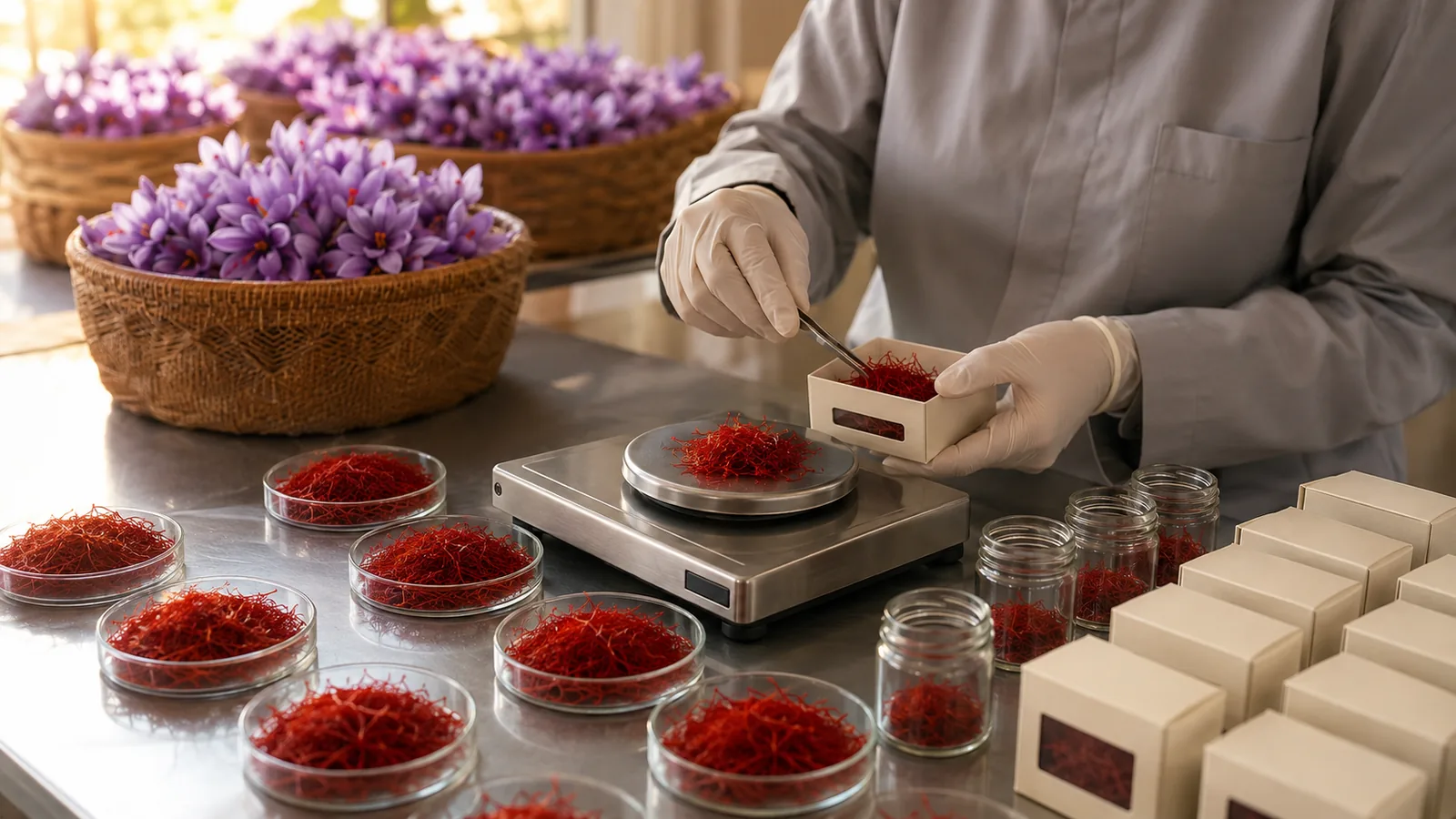
Bulk saffron can be graded, divided into consumer quantities, branded and sold by another business closer to the final market. Those later steps add convenience and commercial value even though they do not change where the flower was grown.
Research indexed by FAO’s AGRIS database has examined target markets for packaged Iranian saffron by product form and package size. Its findings reinforce the conference report’s central idea: a market strategy needs to distinguish whole saffron, powder and different retail quantities rather than treating every buyer as if it wanted the same product.
Customer demand is more than package size
The original text says some customers wanted saffron flowers while others wanted saffron powder. That wording needs care. Fresh flowers are highly perishable and are not interchangeable with dried saffron; powder is convenient but gives a buyer fewer visual clues about thread integrity.
Meeting customer demand should therefore include traceability, accurate labelling and evidence of quality. A format that is easy to use still needs protection from moisture, light, contamination and adulteration. The FAO’s recent work in Iran focuses on authenticity testing and post-harvest guidance because market trust depends on more than an attractive box.
Food, fragrance, cosmetics and other uses
Mollafilabi described saffron as having uses in food, pharmaceutical, perfumery, cosmetics and textiles. Food remains the most familiar use: properly bloomed saffron contributes aroma, colour and a mild bitter note to rice, sweets, drinks and savoury dishes.
Other industries may use saffron or isolated compounds under different technical and regulatory requirements. A broad list of applications should not be taken as proof that any saffron product is suitable for every use, and it does not establish a medical benefit. Buyers need the specification, processing history and intended-use documentation appropriate to their market.
How to read Iran’s place in the saffron market today
The 65% headline, 160-ton export statement and 85,000-family estimate belong to the report’s historical context. They are valuable evidence of the scale and concerns discussed at the time, but none should be presented as a current statistic without a dated source.
The report’s strategic argument remains relevant. A producing country retains more recognition when quality is protected from the field onward, origin is traceable, packages meet the needs of real customers and sellers can reach final markets directly. Iran’s production leadership matters, but testing, careful processing and clear presentation determine how that leadership is understood by the buyer.

![Exporting Saffron to Turkey + Price Guide [Complete 0 to 100]](https://img.rowhanisaffron.com/20260827003933/saffron-export-turkey-quality-inspection.webp)



