


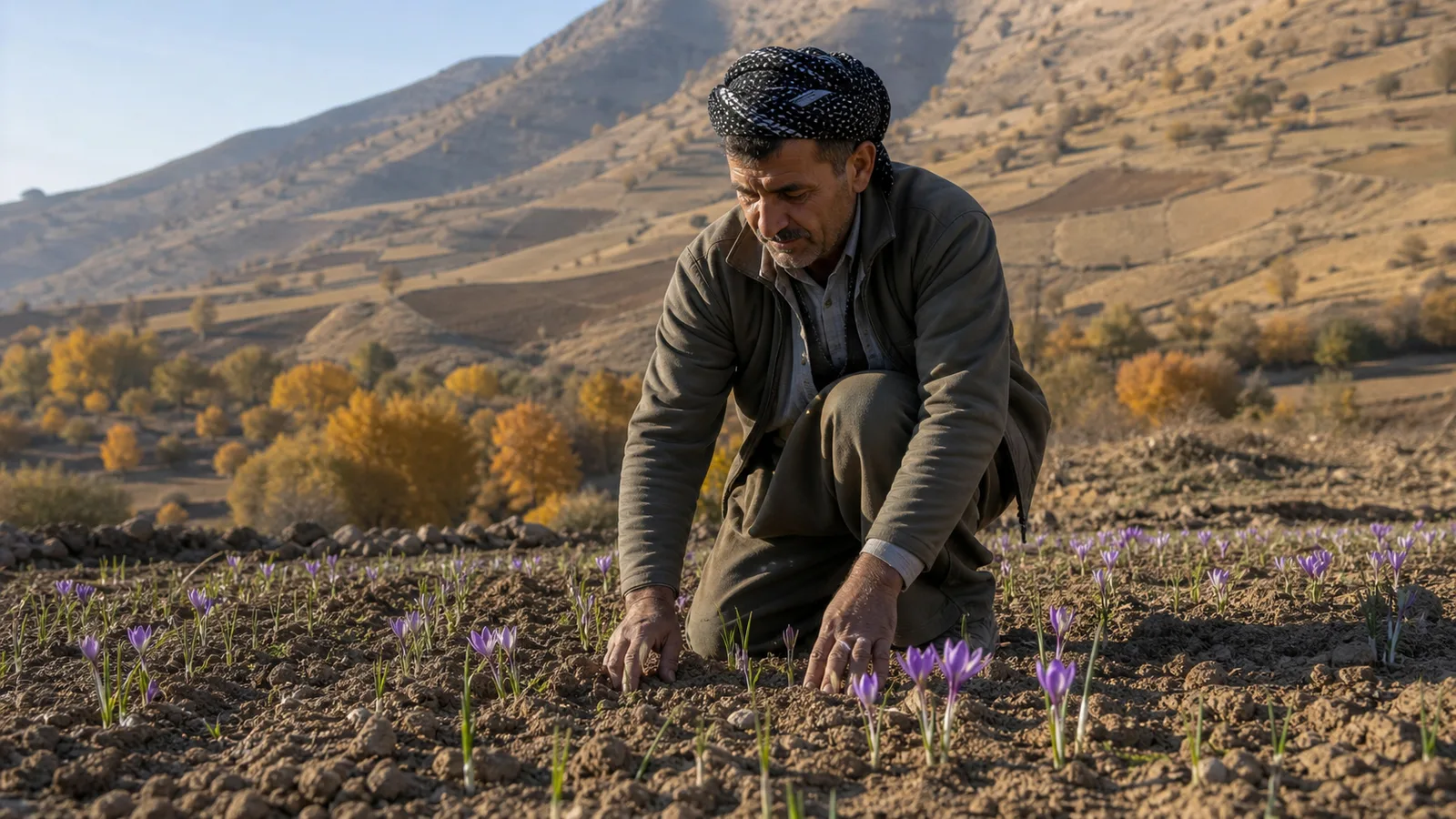
Kurdistan saffron cultivation is possible, but not every field in the province is automatically suitable. The archived reports behind this article describe pilot planting in Bijar, Saqez and Kamyaran, along with wider plans for training and support. They point to genuine potential in the Zagros region. They do not, however, provide a current province-wide acreage figure or prove that every early trial became a lasting commercial farm.
The practical conclusion is more useful than the old “red gold” slogan: Kurdistan can develop saffron where soil drainage, seasonal temperatures, water timing, healthy corms, farmer training and a route to market all line up. The experience of neighboring Hamedan also shows why cultivation alone is only part of the job.
What “origin of red gold” means here
The original headline asked whether Kurdistan could become an “origin” of saffron. In this context, origin means an emerging production area, not a claim about the botanical birthplace of Crocus sativus. That distinction matters. A province can be well suited to growing a crop without rewriting its history.
Medicinal-plants specialist Mohammad Sibi based his argument on Kurdistan’s Zagros climate, agricultural economy and plant diversity. The archived account attributes roughly 782 plant species to the province, including 169 medicinal or wild-growing types. Those figures describe a broader botanical setting; they are not, by themselves, a saffron suitability test.
What the early Kurdistan trials actually showed
The source records pilot saffron cultivation in three Kurdistan counties: Saqez, Kamyaran and Bijar. Sibi also said that the lack of coordinated support meant there was no dependable official total for planted area or harvested yield at that stage.
That missing baseline limits what can honestly be concluded. The pilots show that farmers and local specialists were testing the crop in different parts of the province. They do not establish a single yield for Kurdistan, nor do they show which fields remained productive over several seasons.
For readers looking specifically at crops grown in Bijar, saffron therefore belongs on the list as a documented pilot crop. The evidence available in these reports is historical and preliminary, not a current production census.
Does the Zagros climate suit saffron?
The old report gave a broad altitude and temperature range, but a farmer should not use two thresholds as a planting decision. Saffron performance depends on several interacting conditions. A peer-reviewed field study of saffron in non-traditional highland locations found that altitude, soil texture, temperature, humidity and rainfall all affected yield and quality. The results varied materially between locations.
That evidence supports the case for local trials while arguing against a blanket promise. A prospective Kurdistan field needs assessment of:
- soil drainage and texture, because corms should not sit in waterlogged ground;
- local frost, rainfall and temperature patterns across the whole growth cycle;
- available irrigation at the stages when rainfall is insufficient;
- healthy planting corms and a suitable planting density;
- labor for the short, demanding flower harvest and stigma separation period; and
- a realistic buyer, grading method and drying process before acreage expands.
Saffron is often discussed as a lower-water alternative to many crops, but “lower water” does not mean “no water” or “any poor field.” Poorly drained, diseased or badly timed production can fail even in a broadly suitable climate.
How to read the historical yield comparison
Sibi cited Iranian agricultural statistics for year 1393, approximately 2014–15, to compare western provinces with Khorasan Razavi. The reported dried-saffron yields were about 5.7 kilograms per hectare in Lorestan, 3.8 in Hamedan, 3.9 in Kermanshah and 3.0 in Khorasan Razavi.
Those numbers are worth preserving because they explain why local specialists considered the western provinces promising. They are not a forecast for a new Kurdistan field. Yield can change with field age, corm size, planting density, disease pressure, weather, irrigation and harvest practice. The archived article also does not provide the underlying sample sizes or measurement protocol, so the comparison should remain attributed and historical.
A separate completed review of Kurdistan’s later 42.5-hectare saffron programme provides more detail on district acreage, young and bearing fields, rainfed potential and the practical insurance issues growers raised.
Neighboring Hamedan’s 200-hectare plan
The source article assigned to this page adds a useful neighboring example. Shahram Parvaresh, identified as a provincial Agricultural Jihad official for crop-production improvement, announced a plan to bring 200 hectares of Hamedan land under saffron by the end of that programme year.
The archive does not clearly preserve the programme year or a later completion report. The 200-hectare figure must therefore be read as a target, not proof that the province planted or harvested that area. Hamedan, described in the source as a cold, mountainous province around the Alvand range, was being considered as another western location where saffron might fit selected farms.
Parvaresh contrasted Hamedan’s slower development with the long-established Khorasan industry. He argued that saffron’s ability to perform with limited irrigation and on less-favored agricultural land helped it spread in North, Razavi and South Khorasan. The useful lesson is crop fit, not that worse soil produces better saffron. Local soil, drainage and management still need testing.
A production chain matters as much as planted area
Hamedan’s plan was not limited to planting corms. The official described a medicinal-plants production chain intended to connect each crop with packaging, export and related industries. That is directly relevant to Kurdistan.
Saffron flowers arrive in a concentrated seasonal window. Growers need a clean process for collecting flowers, separating stigmas, drying the product and protecting it from moisture and contamination. After that come grading, traceability, packaging and access to buyers. Expanding hectares without those downstream steps can leave farmers with inconsistent quality or weak bargaining power.
The experience of saffron expansion in Golpayegan illustrates the same broader pattern: acreage and harvest estimates are only part of a regional programme; training, processing and market access determine whether it becomes durable.
What Kurdistan growers would need before expanding
The original Kurdistan proposal called for extension classes, wider farmer information, finance and coordination from provincial institutions. It also suggested that universities could direct research toward local cultivation questions. Those needs remain logically connected to the gaps in the pilot evidence.
A sound expansion programme would start with measured demonstration plots in different microclimates, record yields across several field ages and publish the cultivation protocol behind the results. Farmers would also need clarity on corm health, irrigation timing, insurance, labor, drying standards and the buyer’s quality requirements before taking on debt or replacing another crop.
So, can Kurdistan become a saffron-producing region?
Yes, selected parts of Kurdistan have credible saffron potential, and the archived pilots in Bijar, Saqez and Kamyaran show that the idea moved beyond theory. Historical yield figures from nearby western provinces and Hamedan’s planned 200-hectare expansion strengthen the regional case.
The evidence does not support a province-wide guarantee. The safest path is field-by-field evaluation, multi-season records and a production chain ready to handle the harvest. Under those conditions, Kurdistan saffron cultivation can be developed as a serious agricultural option rather than another untested “red gold” promise.

![Exporting Saffron to Turkey + Price Guide [Complete 0 to 100]](https://img.rowhanisaffron.com/20260827003933/saffron-export-turkey-quality-inspection.webp)



