


A provincial report described 42 hectares and 5,000 square metres—42.5 hectares in total—as being used for saffron cultivation in Iran’s Kurdistan Province. That is 425,000 square metres, or about 105 acres. The same account identified 60 growers, a young crop base and an expected harvest of more than 22 kg for the reported season.
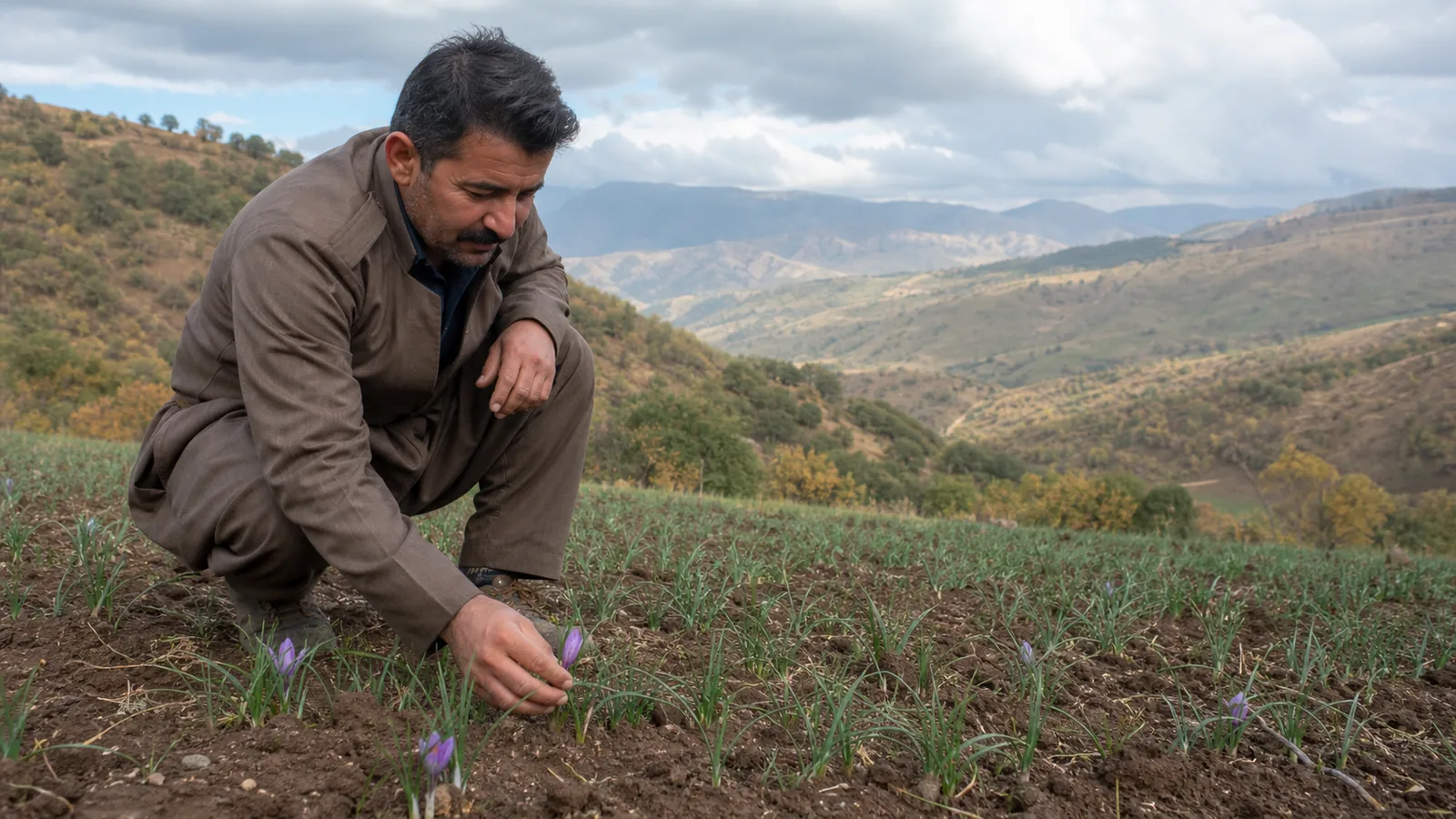
A later statement from the same provincial horticulture official added the possibility of rainfed cultivation in Sarvabad and Marivan, along with unresolved insurance and water-allocation questions. This article combines those details without turning old figures into a current land survey or treating “rainfed” as a promise that every field can succeed without supplemental water.
The reported 42.5 hectares of saffron in Kurdistan
Zahed Haji Mirzaei, identified as director of horticultural affairs at the Kurdistan Agricultural Jihad Organization, divided the reported area into two stages. About 23 hectares were described as productive or bearing, while approximately 19 hectares were young or not yet bearing. The translated source called these areas “fertile” and “infertile,” but that wording does not fit the surrounding explanation about field age.
The district breakdown placed the largest area in Dehgolan at about eight hectares. Bijar followed with more than seven hectares and Sarvabad with more than six. These figures account for only part of the provincial total; the source did not provide a complete district-by-district list.
For scale, 42 hectares alone equals 420,000 square metres, while the additional 5,000 square metres brings the stated program to 42.5 hectares. The wording “allocated land” should also be read carefully. The article reported land under saffron cultivation; it did not document a title transfer, lease or government grant for every plot.
Harvest and yield expectations
Haji Mirzaei expected more than 22 kg of dried saffron from the province in the reported season, with about 9 kg attributed to Dehgolan. Those are forecast figures from the article, not audited final harvest results.
He explained the low provincial output by noting that many fields were in their early years. Saffron is propagated by daughter corms, and a new plot can produce more flowers as healthy planting material multiplies and the stand becomes established. The general plant cycle is explained in our guide about Iranian saffron.
The official projected mature yields of roughly 5–7 kg per hectare. Yield cannot be inferred from field age alone: corm size and density, soil, drainage, weather, water timing, nutrition, weeds, disease, harvest labour and drying losses all matter. Because the article supplied no trial design or measured mature-field sample, the range should be treated as a local planning estimate.
Can saffron be grown under rainfed conditions in Sarvabad and Marivan?
In the source assigned to this page, Haji Mirzaei said the climate made rainfed—or “dry”—saffron cultivation possible in Marivan and Sarvabad. This was a statement of regional potential, not a guarantee for every farm.
Rainfed cultivation relies mainly on precipitation stored in the soil rather than a regular irrigation supply. It does not mean that flower emergence and yield are independent of water. A 2024 field study in Agricultural Water Management found large yield differences between low- and higher-rainfall seasons and reported a major benefit from pre-flowering irrigation in its semi-arid test conditions. Its exact water treatment should not be copied to Kurdistan without local validation, but the result shows why “rainfed” and “no water risk” are not synonyms.
The older destination article contained the opposite-sounding claim that saffron has a “very high water requirement.” That appears to be a translation error. Saffron is valued in water-limited farming because it generally uses less irrigation than many conventional crops, but timing and local rainfall still affect flowers and daughter corms.
Why planting date needs local coordination
Haji Mirzaei emphasized that planting time was critical and asked prospective growers to coordinate dates with the Agricultural Jihad office in their city. That advice is more useful than copying a calendar date from another province.
Marivan and Sarvabad differ from Iran’s established eastern saffron districts in rainfall pattern, winter conditions and soil. A sound site decision needs:
- local rainfall and temperature records, including untimely rain around flowering;
- soil depth, texture, drainage and waterlogging risk;
- healthy corms suited to the planned planting density and field life;
- a locally tested planting window rather than a nationwide date;
- a realistic source of supplemental water if establishment or flowering conditions require it; and
- labour for the short flower-picking and separation period.
The provincial official’s recommendation to use city-level advice should therefore be read as a dependency, not bureaucracy to skip. Rainfed potential still needs field-specific assessment.
The agricultural-insurance gap
The source reported that saffron was not yet covered by agricultural product insurance in Kurdistan because the crop was new and occupied only about 42 hectares at that time. According to Haji Mirzaei, the risks and coverage terms had not been established for the province.
He said the organization was pursuing protection specifically for untimely rainfall that can damage saffron flowers. The article did not provide an insurer, policy wording, premium, loss threshold or effective date. It therefore documents an unresolved request, not proof that coverage later became available.
A grower considering saffron now should verify current cover directly. Important questions include whether the policy covers corm loss, waterlogging, frost, untimely rain, lost flower yield or only particular declared events; how a loss is measured; and whether a new field has a different insured yield from a mature field.
Why water was described as “industrial”
Haji Mirzaei also responded to a local classification question. He said saffron remained an agricultural and medicinal plant, but that water allocated for its cultivation was being handled under an industrial category by the regional water department. In his explanation, new agricultural water allocation was restricted, so the administrative route and tariff were labelled differently.
This description concerned water administration, not the biological classification of saffron and not the legal status of the harvested spice. The Agricultural Jihad Organization did not control the decision, according to the source. Because no regulation number, tariff schedule or date was supplied, the statement must not be used as a current water-right instruction. The regional water authority would need to confirm today’s category, permit and fee for a specific site.
What saffron development could offer Kurdistan farmers
The original report promoted saffron as a way to raise income on low-yield land. It also highlighted employment during flower picking, stigma separation, processing and food use, plus the possibility of export revenue. These are opportunities, not guaranteed returns.
The crop’s high value per unit of dried weight can be attractive, but the harvest is labour-intensive and quality depends on fast, hygienic separation and drying. A field that produces well still needs a buyer, grade agreement, packaging and payment terms. Expansion should follow proven local plots and measured costs rather than the spice’s retail reputation.
For readers comparing the province with Iran’s established production centres, our review of Iran’s share of global saffron production explains why production claims need a year and metric. Kurdistan’s 42.5-hectare figure describes a small emerging area in the cited period, not the national industry.
What the combined reports establish
The reports provide a useful historical baseline: 42.5 hectares, 60 growers, about 23 bearing hectares, more than 22 kg expected output, and a provincial goal of expanding saffron on low-yield land. They also record official interest in rainfed fields in Sarvabad and Marivan.
Just as important, they identify what had not been settled: field-specific water needs, insurance for untimely rain, the administrative category for allocated water and the performance of young fields as they matured. Those open questions belong at the centre of saffron cultivation in Kurdistan. They are the practical conditions that determine whether a promising trial becomes a durable farm business.

![Exporting Saffron to Turkey + Price Guide [Complete 0 to 100]](https://img.rowhanisaffron.com/20260827003933/saffron-export-turkey-quality-inspection.webp)



